


Data Analytics vs Data Science: Tools, Technologies & Skills Explained
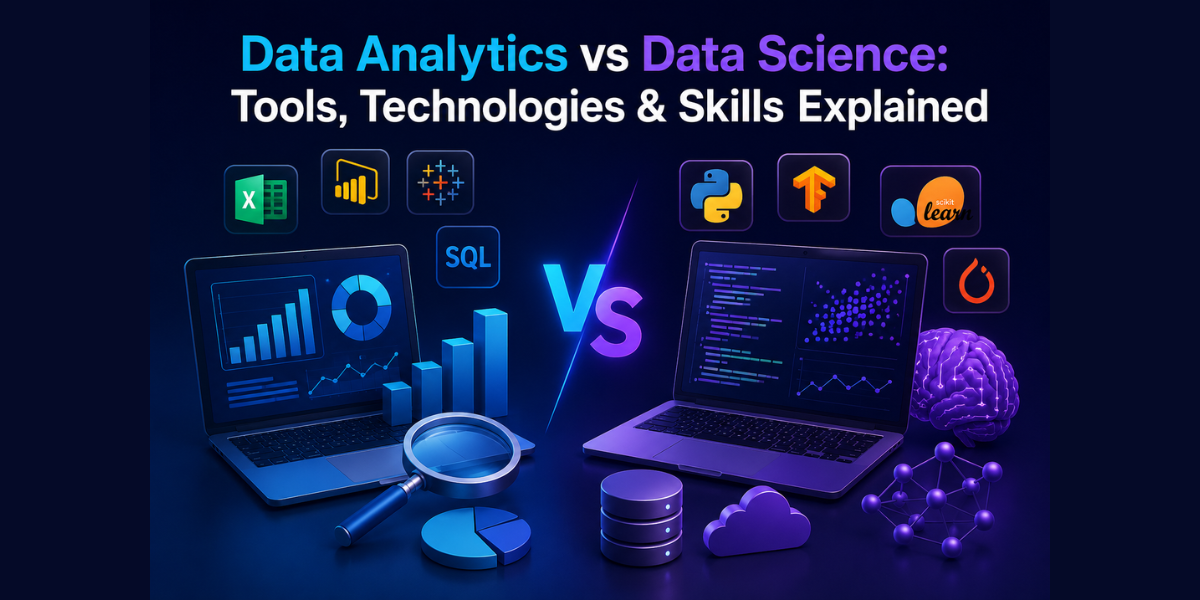
Every week, thousands of students and working professionals search for this exact comparison. Both fields deal with data. Both pay well above average. Both are hiring aggressively in 2026. They are not the same job, not the same skill set, and not the same career trajectory.
Here's the number that makes the distinction worth understanding: data scientists in the U.S. earn a median salary of $112,590, with averages reaching $156,790. Data analysts earn a current average of $111,000, up $20,000 since 2025, per 365 Data Science's April 2026 analysis of over 1,000 job postings. The entry-level gap is wide. The senior-level gap is narrower than people expect. Getting onto the wrong track because you misunderstood the difference costs years, not months.
This article covers:
-
What each field actually does without the jargon
-
The tools and technologies each uses day to day
-
Skills employers specifically ask for in 2026
-
Salary benchmarks and job growth at every level
What Each Field Actually Does: Because Textbook Definitions Don't Help
Data analytics looks backward. A data analyst's job is examining what already happened, like sales dropping in Q3, customer churn spiking in one region, or a campaign underperforming, and figuring out why. The outputs are dashboards, reports, and recommendations business teams can act on without a statistics degree.
Data science looks forward. A data scientist builds systems that predict what happens next, or learn from patterns and improve automatically. Fraud detection models. Recommendation engines. Demand forecasting. Natural language processing. The work is closer to engineering than reporting, and the math goes considerably deeper.
The practical difference most people miss: analysts make data understandable. Scientists make data do something. Both deal with imperfect data and unclear business questions. The difference is where the work ends-analysts end at insight; scientists end at a system that keeps generating insight automatically.
The Tools: What You'll Actually Use at Work
|
Tool / Technology |
Data Analytics |
Data Science |
|
SQL |
Core — used daily |
Core — data extraction and prep |
|
Excel |
41.3% of analyst postings — still essential |
Quick checks only |
|
Tableau |
28.1% of analyst postings — top visualization tool |
Occasional |
|
Power BI |
24.7% of analyst postings |
Less common |
|
Python |
Growing — 35–40% of analyst postings |
Core — required in most roles |
|
Machine learning libraries (scikit-learn, TensorFlow, PyTorch) |
Rarely required |
Core at mid-to-senior level |
|
Cloud platforms (AWS, Azure, GCP) |
Increasingly expected |
Standard — model deployment lives here |
|
Git / version control |
Not always required |
Standard expectation |
One finding from 365 Data Science's 2026 job posting analysis: 69.3% of data analyst postings seek domain specialists with specific tool depth, while 30.7% want versatile generalists. The market rewards depth over breadth at the analyst level right now.
Skills Employers Are Actually Asking for in 2026
Tools are the surface layer. The skills underneath are what separate candidates who get hired from those who get screened out.
For data analysts, the 2026 hiring trend is moving toward experience. Demand for candidates with 4–6 years jumped most sharply in 365 Data Science's analysis; entry-level hiring dropped. Organizations want analysts who own a reporting function, communicate findings to C-suite stakeholders, and make recommendations that hold up under scrutiny. SQL, statistics, and visualization are the technical floor. Business communication is what separates the good from the employable.
For data scientists, machine learning expertise keeps appearing at the top of postings. Deep learning, NLP, and model deployment on cloud infrastructure are in consistent demand. Python and SQL remain non-negotiable. What's shifted in 2026: employers increasingly want scientists who can explain their models to non-technical stakeholders. The black-box era of model building is losing ground to interpretability requirements from regulators and business leaders who won't act on outputs they don't understand.
Salaries and Job Growth Numbers That Actually Matter
The global data analytics market is projected to reach $104.39 billion by the end of 2026, growing at 21.5% annually per Fortune Business Insights. Nearly 11.5 million new jobs in data science and analytics are expected by late 2026. Data science roles are growing at 34% annually, healthcare analytics at 33.4% CAGR, and financial risk analytics at 33.6%.
|
Role |
Entry-Level (U.S.) |
Mid-Level |
Senior Level |
Growth Rate |
|
Data Analyst |
$65,000–$71,000 |
$86,000–$111,000 |
$130,000–$145,000 |
23% annually |
|
Data Scientist |
$90,000–$130,000 |
$126,000–$156,790 |
$180,000–$220,000+ |
34% annually |
|
ML Engineer |
$110,000–$140,000 |
$155,000–$185,000 |
$200,000–$250,000+ |
Highest in category |
|
Analytics Engineer |
$95,000–$120,000 |
$130,000–$160,000 |
$170,000–$200,000 |
Fast-growing hybrid |
India holds 17–18% of global analytics job postings, up more than 50% in five years per 2026 NASSCOM data. AI, machine learning, and data analytics rank as the most in-demand skill cluster there ahead of cybersecurity, cloud, and full-stack development.
Which Path Should You Actually Take
Data analytics is the lower-barrier entry. If you're business-minded, comfortable with SQL and Excel, and want to produce reports and dashboards that get acted on in meetings, start here. The path to senior analyst and then analytics manager is well-defined and pays genuinely well.
Data science is the higher-ceiling option. If you enjoy building things more than reporting on them and want to work on problems where the output is a system rather than a slide, that's the direction. The entry bar is higher, degree requirements steeper (most postings expect at least a master's in statistics, mathematics, or computer science), and the ramp takes longer. Payoff is higher too, both in salary and in the scale of problems you tackle.
One thing is clear across both paths: AI is not replacing either role. It's raising the floor. Analysts who can't work alongside AI tools are losing ground to those who can. Scientists who can't deploy models and explain them to business stakeholders are less competitive. Both paths reward people who keep moving.
FAQs:
What's the simplest way to explain the difference?
Data analytics answers what happened and why. Data science answers what will happen next and builds systems to act on that automatically. An analyst produces insights. A scientist produces models. Both work with data, but the end product and technical depth required are meaningfully different.
Which is easier to get into with no prior experience?
Data analytics. SQL, Excel, and one visualization tool, Tableau or Power BI, get you to a competitive position for junior analyst roles. Data science typically requires stronger programming, statistical foundations, and often a graduate degree. Analysts who build skills over time can transition into data science from within the same organization.
Do data scientists need to know everything analysts know?
Yes and more. Data scientists need SQL, statistical reasoning, and communication skills that analysts develop, plus machine learning, advanced Python, and cloud deployment on top. The skill sets overlap at the foundation and diverge sharply at the advanced level.
Is data science still worth it in 2026 given AI tools?
Yes, but not as a shortcut. AI is automating parts of the data pipeline, but demand for professionals who can build, evaluate, deploy, and explain AI and ML systems has gone up, not down. The World Economic Forum estimates 97 million new data-related roles will emerge even as automation displaces 85 million existing jobs, a net strongly positive for both fields.
Which pays more long-term?
Data science has the higher ceiling. Senior data scientists and ML engineers in tech and finance regularly earn $180,000–$250,000+. Senior data analysts in leadership roles earn $130,000–$145,000. The gap widens with experience. Analysts moving into analytics engineering or data leadership can close a significant portion without switching fields entirely.

 English
 Arabic
 French
 Spanish
 Portuguese
 Deutsch
 Turkish
 Dutch
Dutch
 Italiano
 Romaian
 Portuguese (Brazil)
 Greek
Greek
