


Healthcare API Integration: How FHIR and HL7 Actually Connect Your Systems
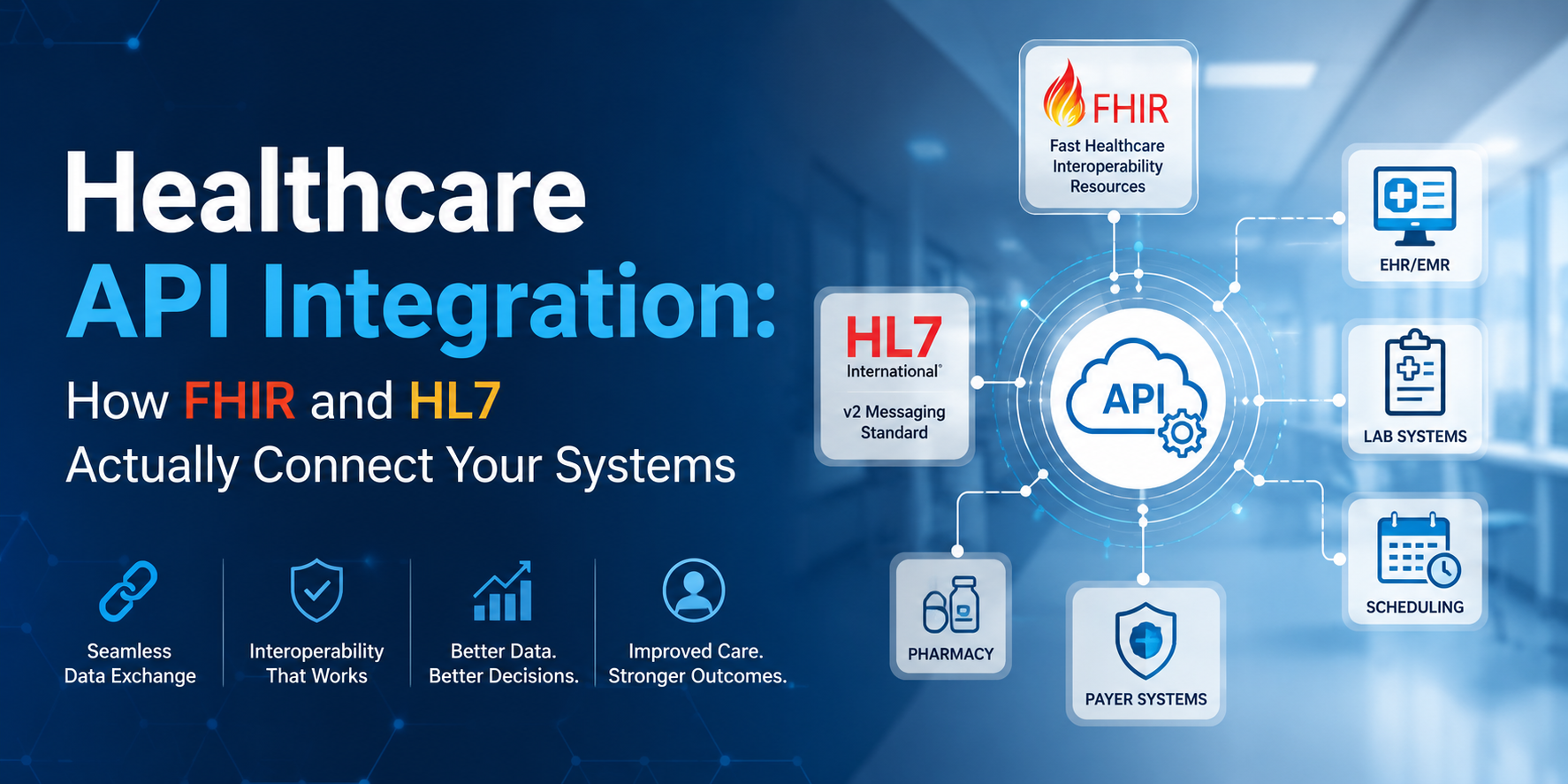
Most healthcare data still travels through connections built one system at a time. A lab result lands in the electronic health record (EHR). A scheduling tool reads a patient roster. Each link holds until something upstream changes, and then it quietly breaks. Healthcare API integration replaces that fragile web with a shared language, so two systems that were never designed together can still pass a medication list, an allergy, or an appointment without a hand-built bridge for every pair. As healthcare organizations modernize their digital infrastructure, many rely on healthcare IT consulting to evaluate legacy systems, define interoperability strategies, and implement scalable integration frameworks.
The mechanics behind that shared language come from two standards published by Health Level Seven (HL7): the long-established HL7 v2 messaging format and the newer Fast Healthcare Interoperability Resources (FHIR) specification. Understanding how each one behaves, and where they hand data to each other, is what separates a healthcare API integration that grows cleanly from one that needs a rewrite every few months. The standards are stable and public. The hard part is wiring them into systems that were built long before either mattered.
The Standards Behind Healthcare API Integration
Two facilities can run identical software and still fail to exchange a single record if they interpret the same field differently. Standards exist to close that gap, and four of them do most of the work in practice.
HL7 v2: The Messaging Layer Already in Your Building
HL7 v2 has moved clinical messages between systems since the late 1980s, and it is still the default inside hospitals. When a patient is admitted, an ADT (Admit, Discharge, Transfer) message fans out to the lab system, the pharmacy, and billing. When an order is placed, an ORM message routes it; when a result posts, an ORU message carries it back. The format is a pipe-delimited string that looks cryptic at first, and its flexibility is both its strength and its cost: sites customize segments so heavily that no two interfaces are quite alike. Messages typically travel over Minimal Lower Layer Protocol (MLLP), and each one expects an acknowledgment (ACK) back, so a missing ACK is the first signal that a downstream system has stalled. Any serious integration plan starts by inventorying which v2 message types already flow, over which transport, and where they land.
FHIR R4 and US Core: The Web-Native Layer
FHIR reframes health data as resources, such as Patient, Observation, MedicationRequest, and Encounter, exchanged over ordinary REST calls and returned as JSON. A developer who has used a modern web API feels at home quickly. Reading a patient record is a GET request; a search filters resources through query parameters; and a Bundle groups related resources into a single response, so one call can return a patient and every recent lab result together. FHIR R4 is the version most implementations target, and the US Core profiles constrain it into a predictable shape: they define which fields are required, which code systems apply, and how a Patient or an Observation must look so that every conforming server answers the same question the same way. That predictability matters because raw FHIR permits wide variation, and two servers can both be valid yet return incompatible data. Building to US Core, rather than raw FHIR, is what makes an app portable across EHR vendors instead of rebuilt for each one.
SMART on FHIR and CDS Hooks: Apps Inside the Clinical Workflow
SMART on FHIR (Substitutable Medical Applications, Reusable Technologies) defines how a third-party app launches inside an EHR, authenticates through OAuth 2.0, and requests only the data scopes it needs. A clinician opens the app from within the chart, and the patient context travels with it. CDS Hooks complements this by firing a service call at defined moments, such as when a provider signs an order, and returning a card with guidance or an alert. Together they move software from a separate tab into the decision itself, which is where interoperability starts to change behavior rather than just move bytes.
How the Integration Architecture Fits Together
A working connection is rarely a straight line from one system to another. Between the source and the destination sit a few components that each earn their place.
An interface engine (also called an integration engine) is the traffic controller. It receives HL7 v2 messages, transforms fields into the format the receiver expects, routes each message to the right endpoint, and retries when a target is down. For FHIR traffic, an API gateway plays a parallel role: it terminates transport encryption, validates tokens, enforces rate limits, and forwards clean requests to the FHIR server. Mapping and transformation logic lives in between, reconciling code sets so that a diagnosis coded one way at the source arrives correctly coded at the destination.
The demand for this plumbing is not theoretical. In 2024, certified EHR adoption reached 99.4% of non-federal acute care hospitals, which means nearly every provider now runs a system that other applications need to reach. Two patterns dominate how they reach it. Point-to-point links connect systems directly and feel fast to build, but the count of connections climbs sharply as systems multiply. A hub-and-spoke model routes everything through the interface engine, so adding a system means one new connection to the hub instead of many. For anything beyond a handful of systems, the hub approach costs less to maintain over time.
Reliability is the part that separates a demo from a production interface. Clinical messages cannot be silently dropped, so the engine holds them in a durable queue and retries delivery until the receiver confirms it. Operations that write data need to be idempotent, so a retried message updates a record once rather than creating a duplicate order. Monitoring watches queue depth, delivery latency, and error rates, and it alerts a human when a downstream system falls behind. These qualities rarely appear in a first prototype, yet they are exactly what a hospital tests before granting an interface access to live patient traffic.
Securing Protected Health Information Across the Connection
Every field that crosses an integration is likely Protected Health Information (PHI), and the Health Insurance Portability and Accountability Act (HIPAA) treats each transfer as an event that must be controlled and recorded. Security here is layered by design, because no single control is sufficient on its own.
Transport comes first: all traffic runs over Transport Layer Security (TLS 1.2 or 1.3), so nothing moves in the clear, inside the network or out. Authorization comes next through OAuth 2.0, the mechanism SMART on FHIR uses to issue scoped, time-limited access tokens. A token that permits reading a medication list should not permit writing an order, and scopes make that boundary explicit. Identity ties back to the person or system behind each call, so access is granted narrowly and revoked cleanly.
Then comes the record. HIPAA's audit requirements mean every read and write of PHI is logged with who, what, and when, and those logs are retained and reviewable. The minimum-necessary principle shapes the API design itself: an endpoint returns the smallest set of data that satisfies the request, not a full record dump because it was easier to code. Consent and patient-access rules add a further layer, governing when data may flow to a patient-authorized app.
Contracts matter as much as code. Any outside vendor that touches PHI signs a Business Associate Agreement (BAA), which binds them to the same safeguards the covered entity follows and makes breach responsibilities explicit. For analytics, reporting, or model training, de-identification strips the direct identifiers so the data falls outside HIPAA's protected category, which lets a team work with realistic volumes without exposing patients. Security built into the interface from the first sprint holds up under audit far better than controls bolted on the week before go-live.
Where the Regulations Are Pushing Every Integration
Standards adoption is no longer optional in most of the market. The Centers for Medicare & Medicaid Services (CMS) now requires impacted payers to expose Patient Access and Provider Access APIs built on FHIR, and its prior-authorization rules extend that mandate to the slow, costly exchanges that frustrate patients and clinicians alike. The Trusted Exchange Framework and Common Agreement (TEFCA), coordinated by the Assistant Secretary for Technology Policy (ASTP/ONC), sets a national floor for how networks share data with one another.
The practical effect is convergence. When a payer, a hospital, and a startup all build to FHIR R4 and US Core, the cost of connecting any two of them drops, because each has already done the conformance work once. Betting on the standards is now the low-risk position, and integrations designed around them age well as the rules tighten.
A Practical Sequence for Your First Integration
Teams that move fast on healthcare API integration tend to follow a similar order of operations. The sequence below keeps the risky decisions early, where they are cheap to change.
-
Inventory the data and the systems: catalog which HL7 v2 messages already flow, which FHIR endpoints each EHR exposes, and which resources the project actually needs.
-
Define the contract: specify the exact FHIR resources, US Core profiles, and code systems each side will honor, so both teams build against the same target.
-
Stand up security early: configure TLS, register the app for OAuth 2.0, and define SMART scopes before writing feature code, not after.
-
Build transformation and mapping: reconcile code sets and field differences in the interface engine, and validate every message against its profile.
-
Test with realistic, de-identified data: exercise edge cases such as missing fields, duplicate identifiers, and out-of-order messages that production will eventually send.
-
Instrument audit logging and monitoring: confirm that every PHI access is recorded and that a failed delivery raises an alert rather than vanishing.
-
Roll out in stages: pilot with one message type or one department, watch the logs, then widen the scope once the connection proves stable.
Two habits separate smooth projects from painful ones. Engaging healthcare IT consulting during the inventory phase surfaces the undocumented v2 customizations that would otherwise derail a timeline mid-build. And treating conformance testing as a gate, rather than a formality, catches the profile mismatches that are far cheaper to fix before real patient data flows. Partnering with a team experienced in custom healthcare software development also shortens the learning curve on vendor-specific FHIR quirks that documentation rarely covers.
Building Integrations That Hold Up
Healthcare API integration works when the standards do the heavy lifting and the custom code stays thin. HL7 v2 still moves the operational traffic inside most facilities, while FHIR R4, US Core, and SMART on FHIR open that data to modern apps under OAuth 2.0 and audited, scoped access. Treat security and profile conformance as design inputs rather than final checks, and each new connection gets faster instead of harder. Pressure from CMS and TEFCA keeps aligning payers and providers on the same FHIR baseline, so the groundwork you lay now compounds with every system you add. Teams that want that foundation built once and built right invest in healthcare app development services with interoperability designed in from the first sprint.

 Arabic
 French
 Spanish
 Portuguese
 Deutsch
 Turkish
 Dutch
Dutch
 Italiano
 Russian
 Romaian
 Portuguese (Brazil)
 Greek
Greek
