


Cost Optimization Strategies for Running AI Models at Scale
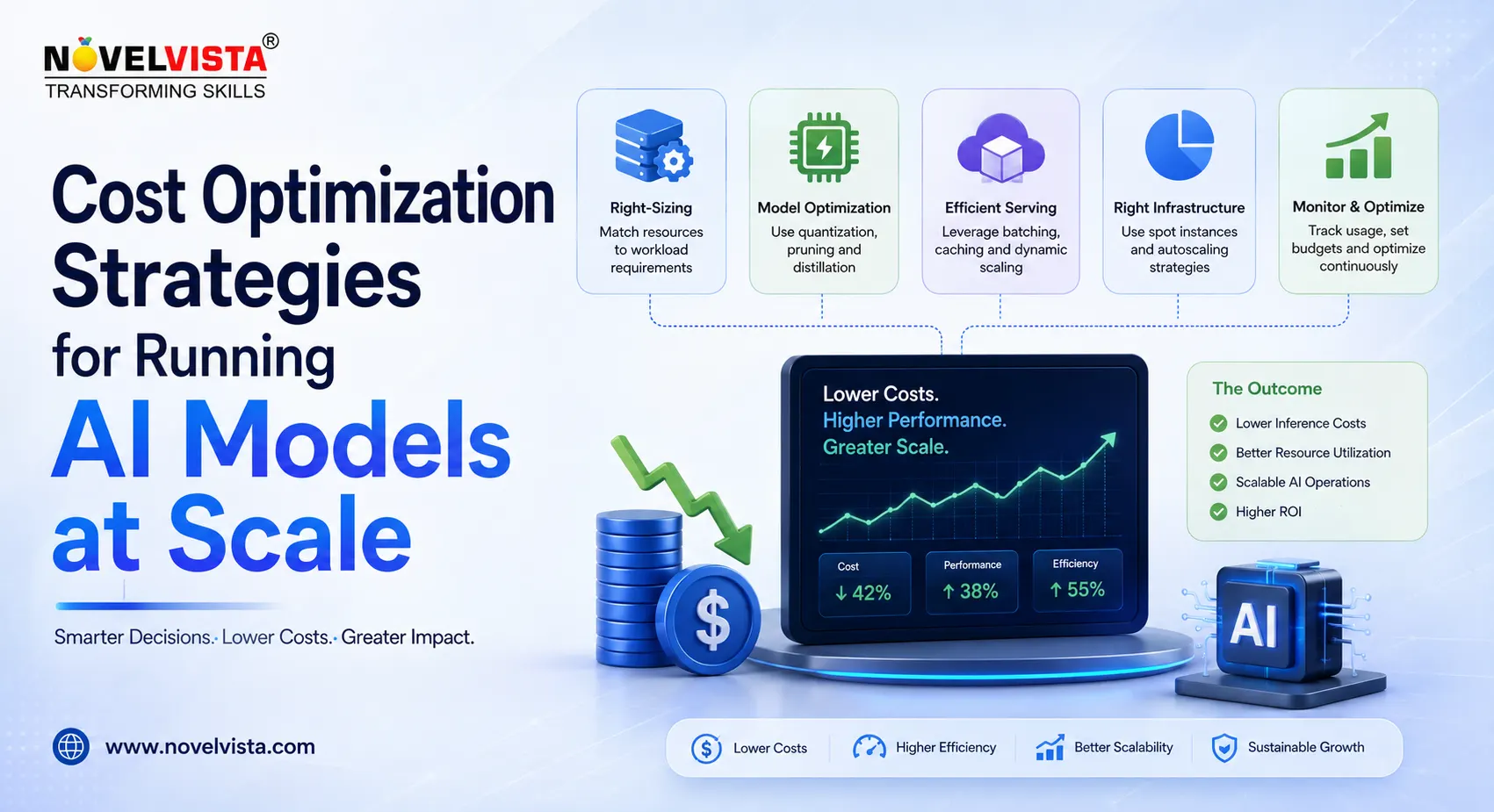
Running an AI model in a small proof of concept is often affordable. Running the same model across thousands of users, millions of requests, and multiple business applications is a very different challenge.
At scale, AI costs can rise quickly because organisations are paying not only for model inference, but also for computing infrastructure, data storage, vector databases, network traffic, monitoring, retraining, and application support. Without a clear optimization strategy, a successful Aiops Engineer product can become financially difficult to sustain.
Cost optimization does not mean choosing the cheapest model or reducing quality at every opportunity. It means designing the system so that expensive resources are used only when they create measurable value.
Choose the Right Model for Each Task
One of the most common cost mistakes is using the largest available model for every request.
A powerful frontier model may be useful for complex reasoning, technical analysis, or high-value content generation. However, it may be unnecessary for classification, summarisation, data extraction, routing, sentiment analysis, or simple question answering.
A better approach is model routing. Smaller and less expensive models can handle routine requests, while larger models are reserved for difficult cases.
For example, an incoming support request could first be classified by a lightweight model. Only requests requiring deeper reasoning would be forwarded to a more capable model.
This tiered architecture can significantly reduce inference costs while maintaining a strong user experience.
Reduce Unnecessary Token Usage
For language models, cost is often linked directly to the number of input and output tokens processed.
Long prompts, excessive conversation history, duplicated instructions, and oversized retrieved documents all increase cost. Teams should regularly review prompts and remove content that does not improve the final answer.
Conversation history should also be managed carefully. Instead of sending the entire chat every time, applications can summarise older messages and retain only the context needed for the current request.
Output length should be controlled as well. A user asking for a short factual answer does not need a five-paragraph response. Setting appropriate generation limits helps control both cost and latency.
Prompt optimization is therefore not only a quality exercise. It is also a financial discipline.
Optimize RAG Retrieval
Retrieval-Augmented Generation can reduce hallucinations, but poorly designed RAG pipelines may send too much information to the model.
Retrieving ten large document chunks for every question increases token usage and may reduce answer quality by introducing irrelevant context.
Teams should tune chunk size, retrieval count, similarity thresholds, metadata filters, and reranking logic. The goal is to provide the smallest amount of context required to answer the question accurately.
Hybrid search can also help. Combining semantic search with keyword matching may improve retrieval for product codes, policy names, legal clauses, and technical identifiers.
Better retrieval means fewer tokens, faster responses, and more grounded outputs.
Use Caching Where Appropriate
Many AI applications receive repeated or similar requests.
Frequently asked questions, common summaries, standard reports, embeddings, and search results can often be cached. Instead of calling the model again, the system can return a previously generated response when the request and relevant data have not changed.
Semantic caching goes one step further by identifying questions with similar meaning. For example, “How do I reset my password?” and “What is the password reset process?” may be served from the same cached response.
Caching should be used carefully when information is personalised, sensitive, or frequently updated. However, for stable and repetitive workloads, it can provide substantial savings.
Batch Requests and Use Asynchronous Processing
Not every AI request needs an immediate response.
Document classification, embedding generation, report creation, data enrichment, and large-scale evaluation can often be processed in batches. Batch processing allows infrastructure to handle multiple records efficiently and may take advantage of lower-cost processing options.
Asynchronous workflows are also useful for tasks that take longer to complete. Instead of keeping expensive resources active while users wait, the application can process the task through a queue and return the result when it is ready.
This approach improves resource utilisation and makes high-volume workloads easier to manage.
Select the Right Infrastructure
Infrastructure decisions have a major impact on AI operating costs.
Teams running open-source models should carefully select GPU types, instance sizes, autoscaling rules, and deployment regions. An oversized GPU running at low utilisation can be more expensive than using a managed model API.
Quantization, model compression, and efficient inference engines can reduce memory and compute requirements. Smaller numerical formats may allow models to run on less expensive hardware with only a limited impact on quality.
Autoscaling is equally important. Capacity should increase when demand rises and decrease during quiet periods. For predictable workloads, reserved capacity may offer savings. For flexible batch jobs, spot or preemptible instances can reduce compute costs further.
Monitor Cost by Application and User
AI cost management requires visibility.
Teams should track usage by model, application, department, customer, workflow, and user group. Important metrics include token consumption, inference cost, latency, cache hit rate, retrieval size, GPU utilisation, and cost per successful task.
A monthly cloud bill is not enough. Organisations need to understand which features generate value and which consume resources without producing meaningful outcomes.
Budgets, alerts, quotas, and rate limits can prevent unexpected spikes. Internal chargeback or showback models can also encourage teams to use AI services responsibly.
Evaluate Cost Against Business Value
The cheapest architecture is not always the best architecture.
A more capable model may be worth the additional cost when it improves conversion rates, reduces manual work, prevents errors, or supports high-value decisions. Cost should therefore be measured alongside quality, reliability, and business impact.
Teams can calculate metrics such as cost per resolved support case, cost per generated lead, cost per processed document, or cost per analyst hour saved.
This shifts the discussion from “How much does the model cost?” to “What value does the system produce for each unit of cost?”
Running AI models at scale requires continuous optimization rather than a one-time infrastructure decision. By combining model routing, token management, efficient retrieval, caching, batching, infrastructure tuning, and detailed monitoring, organisations can build AI systems that remain both powerful and financially sustainable.

 English
 Arabic
 French
 Spanish
 Portuguese
 Deutsch
 Turkish
 Dutch
Dutch
 Italiano
 Russian
 Romaian
 Portuguese (Brazil)
