


AI Engineer Data: Building RAG, NL2SQL and GenAI Pipelines on Databricks and Azure
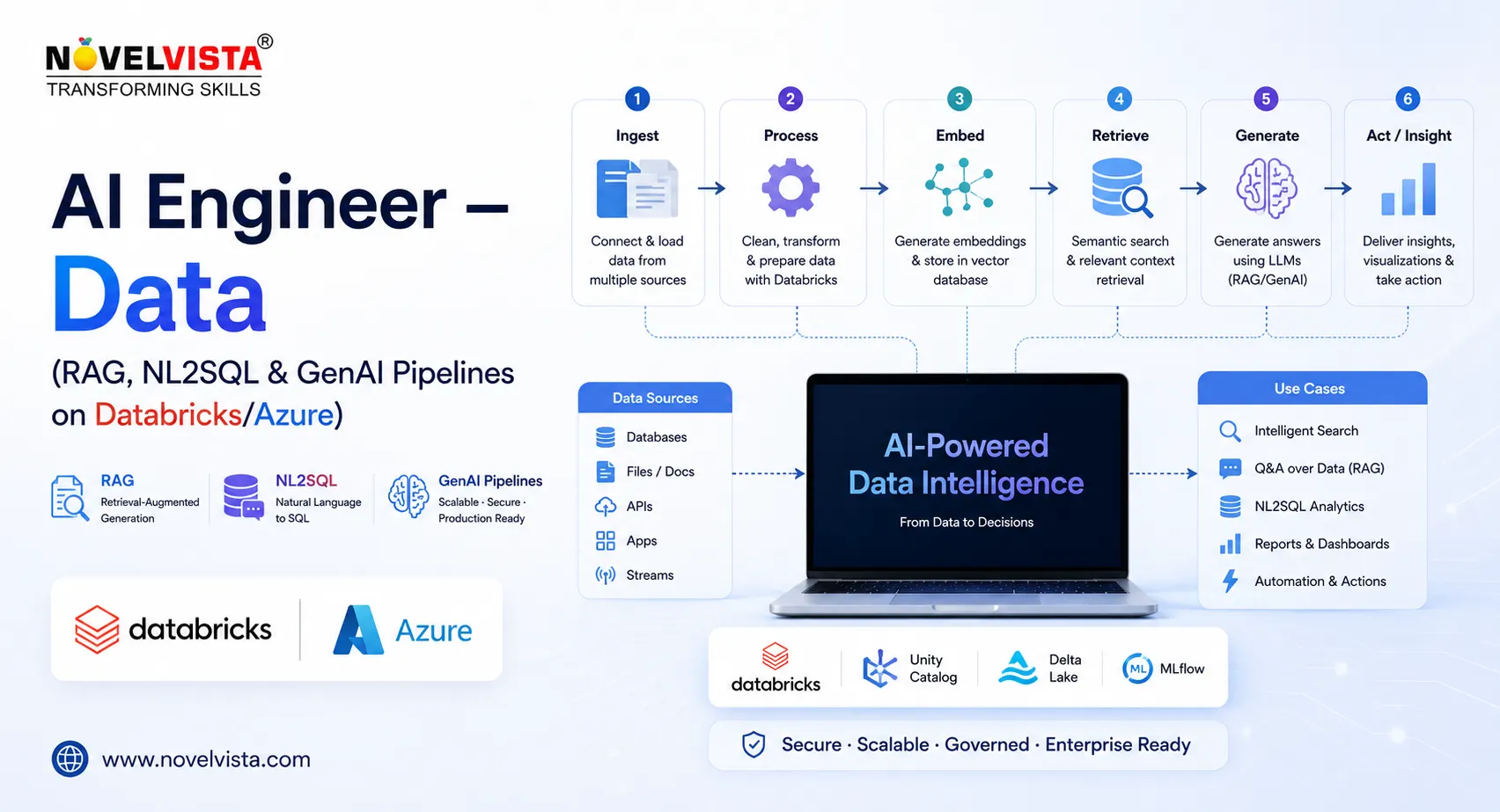
The role of an AI Engineer is changing quickly. It is no longer limited to training machine learning models or experimenting with prompts. Modern AI engineers are expected to build complete, production-ready data and generative AI systems that connect enterprise information, cloud platforms, analytics tools, and large language models.
For organisations using Databricks and Microsoft Azure, this role often focuses on three high-value capabilities: Retrieval-Augmented Generation, Natural Language to SQL, and scalable generative AI pipelines.
Together, these technologies allow businesses to turn large volumes of structured and unstructured data into practical applications such as enterprise assistants, analytics copilots, intelligent search systems, automated reporting tools, and decision-support platforms.
The AI Engineer’s Role in a Data-Driven Environment
An AI Engineer working on data platforms operates between data engineering, machine learning, software development, and cloud architecture.
The engineer is responsible for converting business requirements into reliable AI systems. This may involve preparing data, building retrieval pipelines, integrating language models, designing APIs, monitoring performance, and implementing security controls.
Unlike a simple chatbot project, enterprise AI solutions must work with real organisational data. That data may exist across databases, data lakes, PDF documents, customer records, support tickets, dashboards, and internal knowledge bases.
Databricks and Azure provide the infrastructure needed to bring these sources together and build AI applications on top of them.
Building RAG Pipelines on Databricks and Azure
Retrieval-Augmented Generation, commonly called RAG, helps language models answer questions using trusted business information.
A typical RAG pipeline begins by collecting documents from sources such as Azure Data Lake Storage, SharePoint, internal portals, or Databricks tables. The content is cleaned, divided into smaller sections, converted into embeddings, and stored in a vector search system.
When a user asks a question, the application searches for the most relevant content and provides it to the language model as context. The model then generates an answer based on the retrieved information.
Databricks can manage data preparation, document processing, experimentation, model evaluation, and pipeline orchestration. Azure services can support storage, identity management, application hosting, monitoring, and access to hosted language models.
The AI engineer must ensure that the pipeline retrieves accurate evidence rather than simply producing fluent answers. This requires careful chunking, metadata filtering, ranking, prompt design, and evaluation.
For example, an employee policy assistant should retrieve the correct policy version, department, region, and effective date before generating a response.
Creating NL2SQL Solutions
Natural Language to SQL, or NL2SQL, allows users to query databases using normal language.
A user might ask, “Which products generated the highest revenue in the western region last quarter?” The system interprets the question, identifies the relevant tables and columns, generates a SQL query, executes it, and presents the result.
This sounds simple, but reliable NL2SQL requires strong controls.
Enterprise data platforms may contain hundreds of tables with unclear names, complex relationships, and sensitive information. The model must understand the schema, business terminology, table joins, and calculation rules.
An AI engineer can improve accuracy by providing the model with selected schema information, table descriptions, sample queries, business definitions, and data lineage.
Databricks SQL provides a strong environment for executing and managing analytical queries, while Azure-based identity and governance services can control which users are allowed to access specific datasets.
Security is especially important. The generated SQL should be validated before execution. Systems should restrict destructive operations, enforce row-level permissions, apply query limits, and prevent users from accessing unauthorised data.
Designing Generative AI Pipelines
Generative AI applications require more than a single call to a language model. A production pipeline may contain several connected steps.
For example, a customer-support workflow may classify an incoming request, retrieve relevant knowledge, generate a response, check the output for policy compliance, and send it for human approval.
Databricks workflows can orchestrate data processing, model execution, evaluation, and scheduled updates. Azure services can support event-driven processing, API management, secret storage, application deployment, and observability.
The AI engineer must design each component so that the system remains reliable when models, data, or user behaviour change.
Version control is also essential. Teams should track prompts, model configurations, data sources, embedding models, evaluation datasets, and application releases. Without this discipline, it becomes difficult to understand why a system’s performance improved or declined.
Evaluation and Monitoring
A successful AI application must be measured continuously.
For RAG systems, teams should evaluate whether the correct documents were retrieved, whether answers were grounded in those documents, and whether citations were accurate.
For NL2SQL systems, evaluation should include SQL correctness, execution success, result accuracy, security compliance, and response time.
Monitoring should also track token usage, model cost, latency, failed queries, user feedback, and hallucination risk.
Databricks provides tools for experiment tracking, data monitoring, and model lifecycle management. Azure monitoring services can help teams observe application performance, infrastructure health, and operational incidents.
Human review remains important, particularly for financial, legal, healthcare, compliance, and executive decision-making use cases.
Skills Required for the Role
An AI Engineer working with Databricks and Azure needs a broad technical foundation.
Strong SQL, Python, data modelling, API development, cloud architecture, and distributed processing skills are essential. Familiarity with Apache Spark, Delta Lake, vector databases, embedding models, prompt engineering, and model evaluation is equally valuable.
The engineer should also understand identity management, encryption, access controls, data governance, and responsible AI practices.
Communication is another critical capability. The engineer must work with data teams, business analysts, cloud architects, security professionals, and business stakeholders. A technically impressive solution has limited value when it cannot solve a clear operational problem.
The Future of AI Engineering
The future of enterprise AI will depend on systems that can securely connect models with trusted organisational data.
RAG, NL2SQL, and generative AI pipelines are becoming core components of modern analytics and automation platforms. Databricks and Azure provide a powerful foundation for building these solutions at enterprise scale.
The AI Engineer Data is therefore not simply a model developer. This professional designs the bridge between data, intelligence, and business action. By combining cloud engineering, data architecture, generative AI, and responsible governance, the role helps organisations move from AI experiments to reliable production systems.

 English
 Arabic
 French
 Portuguese
 Deutsch
 Turkish
 Dutch
Dutch
 Italiano
 Russian
 Romaian
 Portuguese (Brazil)
 Greek
Greek
