


Building a RAG Pipeline in Java with LangChain4j
Generative AI applications are becoming more useful inside businesses, but large language models still have an important limitation: they do not automatically know your private, internal, or recently updated information. A model may understand general concepts, yet it cannot answer questions about your company policies, technical documentation, product manuals, or customer records unless that information is provided.
Retrieval-Augmented Generation, commonly known as RAG, solves this problem by connecting a language model to an external knowledge source. For Java developers, LangChain4j provides a practical framework for building RAG-powered applications without abandoning the familiar Java ecosystem.
What Is a RAG Pipeline?
A RAG pipeline retrieves relevant information from a collection of documents and includes that information in the prompt sent to a large language model.
Imagine building an internal support assistant. An employee asks, “How many paid leave days can I carry forward?” Instead of relying on the model’s general knowledge, the application searches the organisation’s HR policies, finds the relevant section, and sends it to the model along with the employee’s question.
The model then generates an answer grounded in the retrieved company documentation.
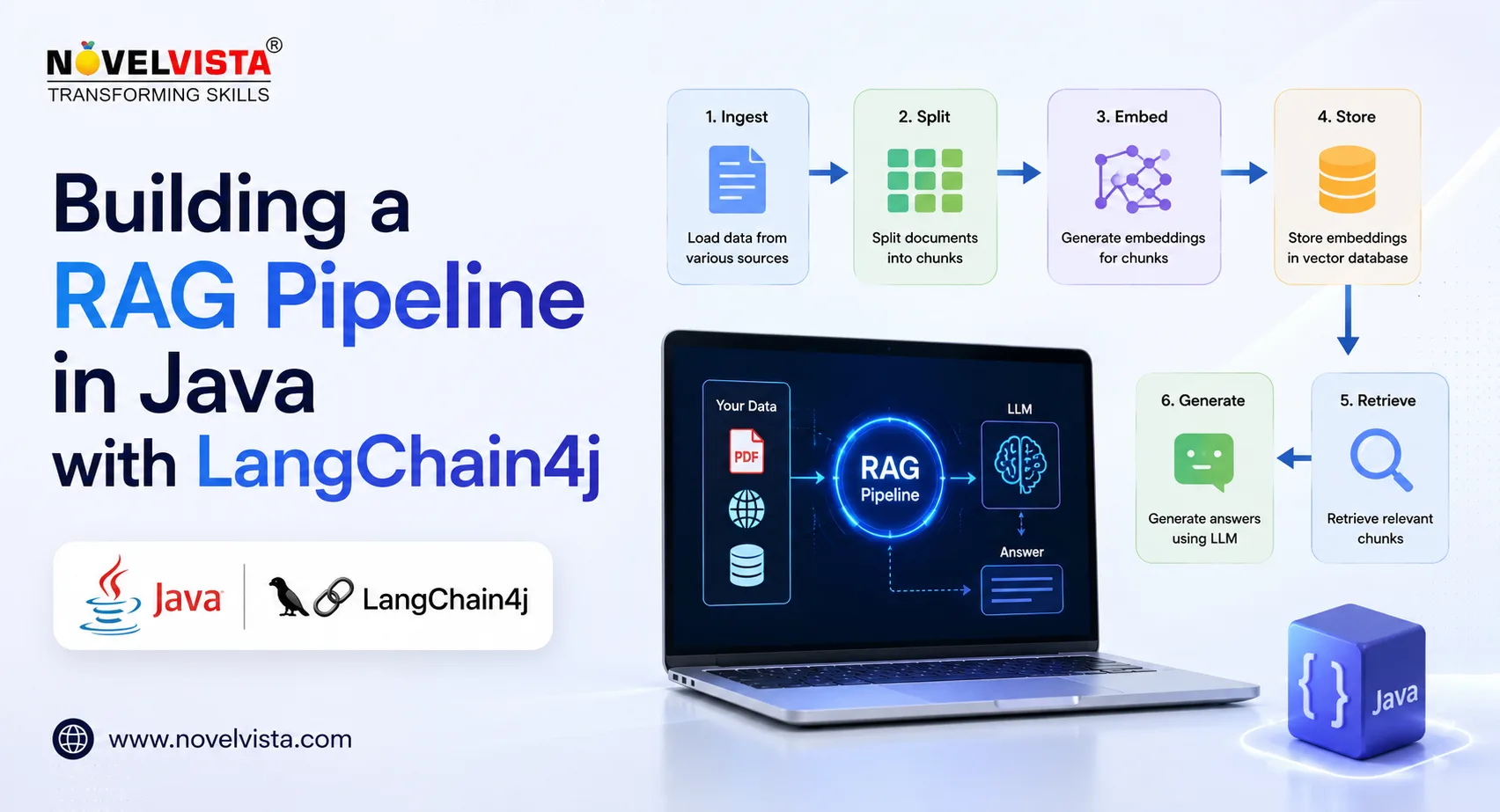
A basic RAG pipeline normally contains five stages:
- Document loading
- Text splitting
- Embedding generation
- Vector storage and retrieval
- Response generation
LangChain4j provides components for each stage and makes it easier to connect Java applications with embedding models, vector databases, and conversational AI services.
Setting Up the Java Project
You can start with a standard Maven or Gradle project. Add the LangChain4j core dependency along with the integration required for your preferred language model.
Depending on your infrastructure, you may connect the application to OpenAI, Azure OpenAI, local models through Ollama, or another supported provider. You will also need an embedding model and an embedding store.
For development and proof-of-concept applications, an in-memory embedding store is usually sufficient. Production systems often use dedicated vector databases such as PostgreSQL with pgvector, Pinecone, Weaviate, Milvus, Elasticsearch, or another enterprise search platform.
The exact choice depends on document volume, performance requirements, security expectations, and deployment architecture.
Loading and Splitting Documents
The first operational step is loading source documents into the application. These may include PDF files, Word documents, web pages, support articles, knowledge-base entries, or plain-text files.
Once loaded, large documents should be divided into smaller text segments, often called chunks. Sending an entire document to the model would be expensive and may exceed the model’s context limit.
Chunking also improves retrieval accuracy. Instead of returning a complete fifty-page policy, the system can retrieve the two or three paragraphs that directly address the user’s question.
Chunk size requires careful tuning. Very small chunks may lose important context, while very large chunks may include too much unrelated content. Overlapping neighbouring chunks can help preserve meaning across section boundaries.
Creating Embeddings
After splitting the documents, each text segment is converted into a numerical representation called an embedding.
Embeddings capture semantic meaning. Two passages can use different words but still produce similar vectors when they discuss the same topic. For example, “annual leave allowance” and “number of vacation days” may be considered closely related.
LangChain4j sends each segment to the configured embedding model and stores the resulting vector together with the original text and metadata.
Useful metadata may include the document name, department, version number, publication date, access level, page number, and source URL. This information improves filtering, traceability, and citation generation.
Retrieving Relevant Information
When a user submits a question, the application creates an embedding for that question and compares it with the stored document embeddings.
The embedding store returns the most semantically similar chunks. Developers can control how many results are returned and configure a minimum relevance score.
Retrieval quality is one of the most important parts of a RAG system. A powerful language model cannot produce a reliable answer when the wrong evidence is retrieved.
For more advanced use cases, developers may combine semantic search with keyword search, metadata filters, query rewriting, or reranking. This hybrid approach is especially valuable when users search for product codes, legal clauses, error numbers, or technical abbreviations.
Generating the Final Answer
The retrieved content is inserted into a structured prompt and sent to the chat model.
A good prompt should clearly instruct the model to answer using the supplied context. It should also explain what to do when the available documents do not contain enough information.
For example, the system may instruct the model to say that the answer could not be found instead of inventing a confident response.
LangChain4j also supports AI-service interfaces, allowing developers to represent AI capabilities through regular Java methods. This keeps the application code clean and makes the AI layer feel similar to working with a normal service class.
Moving from Prototype to Production
A production RAG pipeline requires more than connecting a model to a few documents. Teams must consider document updates, duplicate content, access control, monitoring, cost, response time, and data privacy.
The system should record which documents were retrieved, how relevant they were, and whether users found the generated answer useful. Sensitive documents should only be retrieved for authorised users.
Regular evaluation is equally important. Create a test set of realistic questions and expected source documents. Measure whether the retriever finds the correct evidence before evaluating the quality of the final generated answer.
Building a RAG pipeline with LangChain4j allows Java teams to introduce generative AI while continuing to use familiar tools, frameworks, and engineering practices. The result is not simply a chatbot, but a knowledge application that can deliver more relevant, transparent, and organisation-specific answers.

 English
 Arabic
 Spanish
 Portuguese
 Deutsch
 Turkish
 Dutch
Dutch
 Italiano
 Russian
 Romaian
 Portuguese (Brazil)
 Greek
Greek
