


Global Plant-Based Beef Market to Grow from $6.99Bn in 2026 to $45.52Bn by 2036, CAGR 20.6%
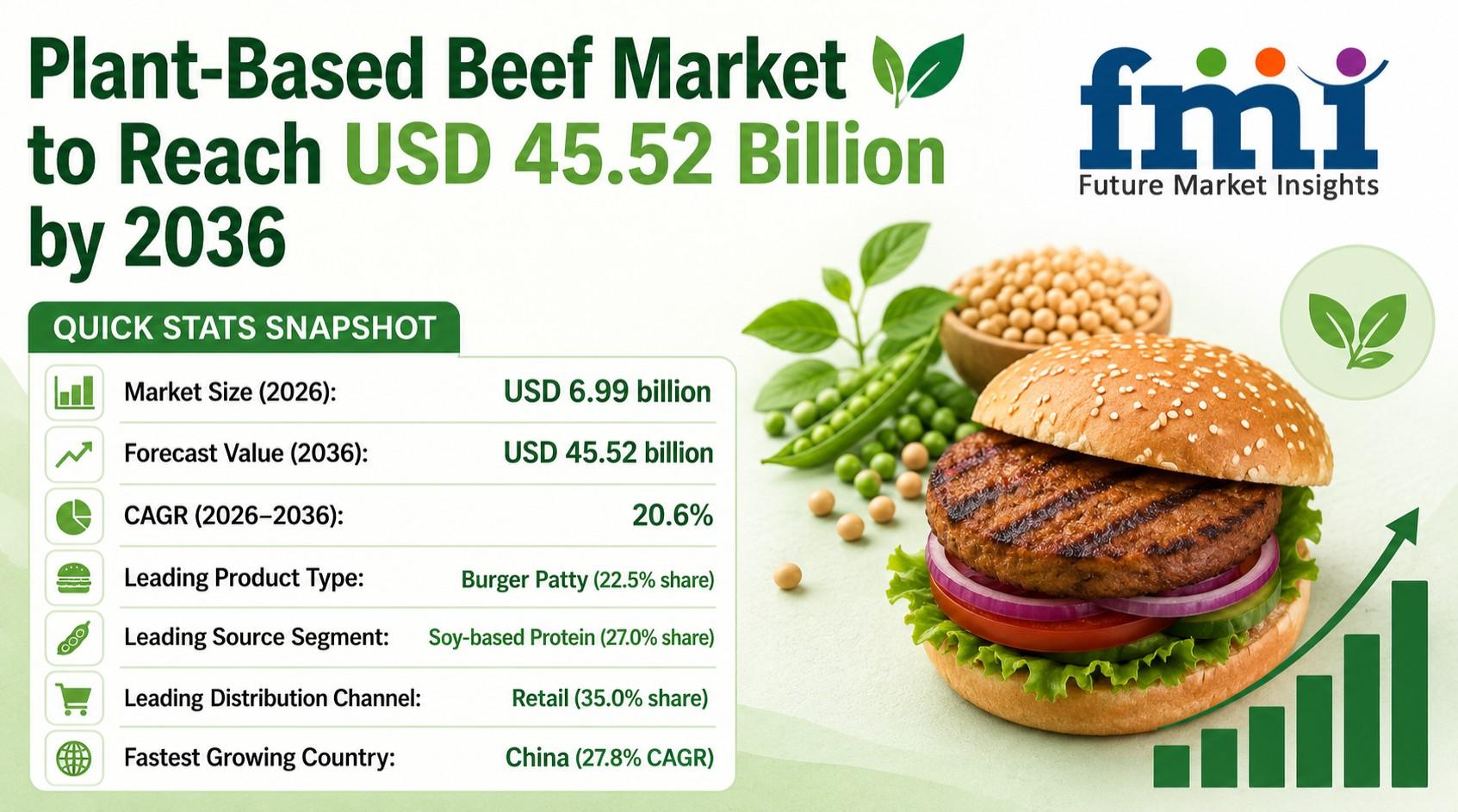
The global plant-based beef market is undergoing rapid expansion as protein extraction technologies mature and foodservice operators integrate meat-alternative options into core menus, according to latest insights by future market insights. Valued at USD 5.80 billion in 2025, the market is expected to reach USD 6.99 billion in 2026 before ascending to USD 45.52 billion by 2036. This trajectory reflects an extraordinary 20.6% CAGR over the ten-year forecast period.
Request a Sample Report: https://www.futuremarketinsights.com/reports/sample/rep-gb-12682
The transition of plant-based beef from a niche dietary alternative into a mainstream protein procurement staple is driven by high-moisture texturization advancements, sensory parity achievement, and institutional procurement mandates across public schools, hospitals, and corporate dining services.
Key Plant-Based Beef Market Highlights at a Glance
· Market Size (2026): USD 6.99 Billion
· Forecast Market Size (2036): USD 45.52 Billion
· Forecast Period: 2026–2036
· CAGR (2026–2036): 20.6%
· Leading Product Form: Burger Patty (22.5% Market Share in 2026)
· Leading Protein Source: Soy-based Protein (27.0% Market Share in 2026)
· Leading Distribution Channel: Retail (35.0% Market Share in 2026)
· Fastest-Growing Regional Market: China (27.8% CAGR)
The plant-based beef market is exiting its early-adopter phase and entering a price-competition phase where unit cost reduction determines the pace of mainstream adoption. Producers who achieve manufacturing cost parity with conventional ground beef through protein sourcing optimization, extrusion yield improvement, and production scale will capture volume share from competitors still operating at premium pricing. Nandini Roy Choudhury, Principal Consultant for Food & Beverage at Future Market Insights
Why Is the Plant-Based Beef Market Growing?
Market expansion is accelerated by technological breakthroughs in meat-like texture extrusion, growing flexitarian demographics, and government-backed sustainable protein initiatives.
Key Growth Drivers
· Foodservice Channel Integration: Quick-service restaurant chains are making plant-based burgers permanent core items, fostering habitual consumption.
· Protein Texturization Maturation: High-moisture extrusion and shear cell technology replicate fibrous meat muscle structures and fat marbling.
· Institutional Procurement Mandates: Public sector meal programs in the EU, UK, and US states incorporate plant-based protein targets into official contracts.
· Health & Environmental Awareness: Consumer shifts toward reducing saturated fats and cholesterol, paired with concerns over livestock carbon footprints.
· Scale & Unit Cost Reductions: Processors diversifying protein isolates (soy, pea, fava bean) to achieve price parity with ground beef.
Which Product Segment Leads the Market?
By Product Type
Burger Patties command 22.5% of total product type share in 2026. The format leads due to direct compatibility with existing commercial griddles and home cooking routines, serving as the primary gateway product for flexitarian trial.
By Source Ingredient
Soy-based Protein leads the source segment with a 27.0% share in 2026, thanks to its complete amino acid profile, lowest cost per gram of functional protein, and mature texturization infrastructure.
By Distribution Channel
Retail Distribution leads with a 35.0% share in 2026, driven by expanded supermarket shelf space in dedicated plant-based chilled aisles and direct-to-consumer online grocery expansion.
Regional and Country Outlook
Global growth is anchored by rapid adoption in Asian economies and steady institutional expansion across North America and Europe:
· China: Leads globally with a 27.8% CAGR through 2036, driven by government food security diversification policies, 3D/protein printing innovations, and integration into traditional dumpling/noodle dishes.
· India: Follows closely with a 25.8% CAGR, supported by a cultural affinity for vegetarianism, expanding organized retail, and rising urban middle-class demand.
· Germany: Forecast to grow at a 23.7% CAGR, aligned with EU Farm-to-Fork strategies, public R&D wet extrusion funding, and mature organic/vegan retail ecosystems.
· France: Tracks at a 21.6% CAGR, as gastronomy integrates plant-based alternatives into restaurant menus.
· United Kingdom: Advances at a 19.6% CAGR, supported by high flexitarian participation, Veganuary momentum, and private-label ranges.
· United States: Expected to post a 17.5% CAGR, driven by QSR core menu integration and retail promotional programs.
· Brazil: Expands at a 15.5% CAGR, leveraging extensive domestic soy processing infrastructure.
Competitive Landscape
The competitive landscape features vertically integrated protein processors, agile food-tech pioneers, and traditional meat packaging giants expanding into alternative proteins.
Key Companies Profiled
· Beyond Meat
· Impossible Foods, Inc.
· Gardein (Conagra Brands)
· The Vegetarian Butcher (Unilever)
· Greenleaf Foods, SPC
· MorningStar Farms (Kellogg's)
· Archer Daniels Midland Company (ADM)
· Symrise
· Roquette Frères S.A.
· Tyson Foods, Inc.
· Puris Proteins, LLC
· Ingredion Inc.
· Beneo GmbH
· Glanbia plc
Exclusive Discounts on Full Report: https://www.futuremarketinsights.com/reports/plant-based-beef-market
Frequently Asked Questions
What is the global market size for plant-based beef in 2026 and 2036?
The global market is estimated at USD 6.99 billion in 2026 and is forecast to reach USD 45.52 billion by 2036.
What is the projected CAGR for the plant-based beef market?
The market is expected to expand at an extraordinary CAGR of 20.6% from 2026 to 2036.
Which product format holds the largest market share?
Burger patties lead with a 22.5% market share in 2026 due to familiarity and ease of commercial equipment integration.
Which country is expected to exhibit the fastest regional growth rate?
China leads global growth with a projected 27.8% CAGR through 2036, followed by India at 25.8%.
FMI Custom Research: Strategic Intelligence for Confident Decision-Making
In today's rapidly evolving business environment, leadership teams need more than market data they need clear, actionable intelligence tailored to their strategic objectives. FMI's Custom Research solutions are designed around the specific business questions organizations need answered, enabling executives to evaluate growth opportunities, validate investments, assess competitive dynamics.
Key Executive Benefits
· Decision-Ready Insights tailored to business priorities
· Reduced Strategic Risk through validated market intelligence
· Market Entry Confidence with detailed competitive analysis
· Competitive Advantage supported by proprietary research
· Faster Growth Decisions through customized strategic insights
· Primary Market Validation from industry stakeholders
· Global Industry Expertise across diverse sectors
· Proven Track Record with thousands of consulting engagements
Business Impact
FMI helps organizations transform market complexity into strategic clarity, enabling leadership teams to identify growth opportunities faster, optimize resource allocation, strengthen competitive positioning, and make high-stakes business decisions with confidence.
To explore how FMI Custom Research can support your strategic priorities, please connect with our team at - sales@futuremarketinsights.com

 English
 Arabic
 French
 Spanish
 Portuguese
 Turkish
 Dutch
Dutch
 Italiano
 Russian
 Romaian
 Portuguese (Brazil)
 Greek
Greek
