


Fine-Tuning and Customizing Models on AWS: A Practical Overview
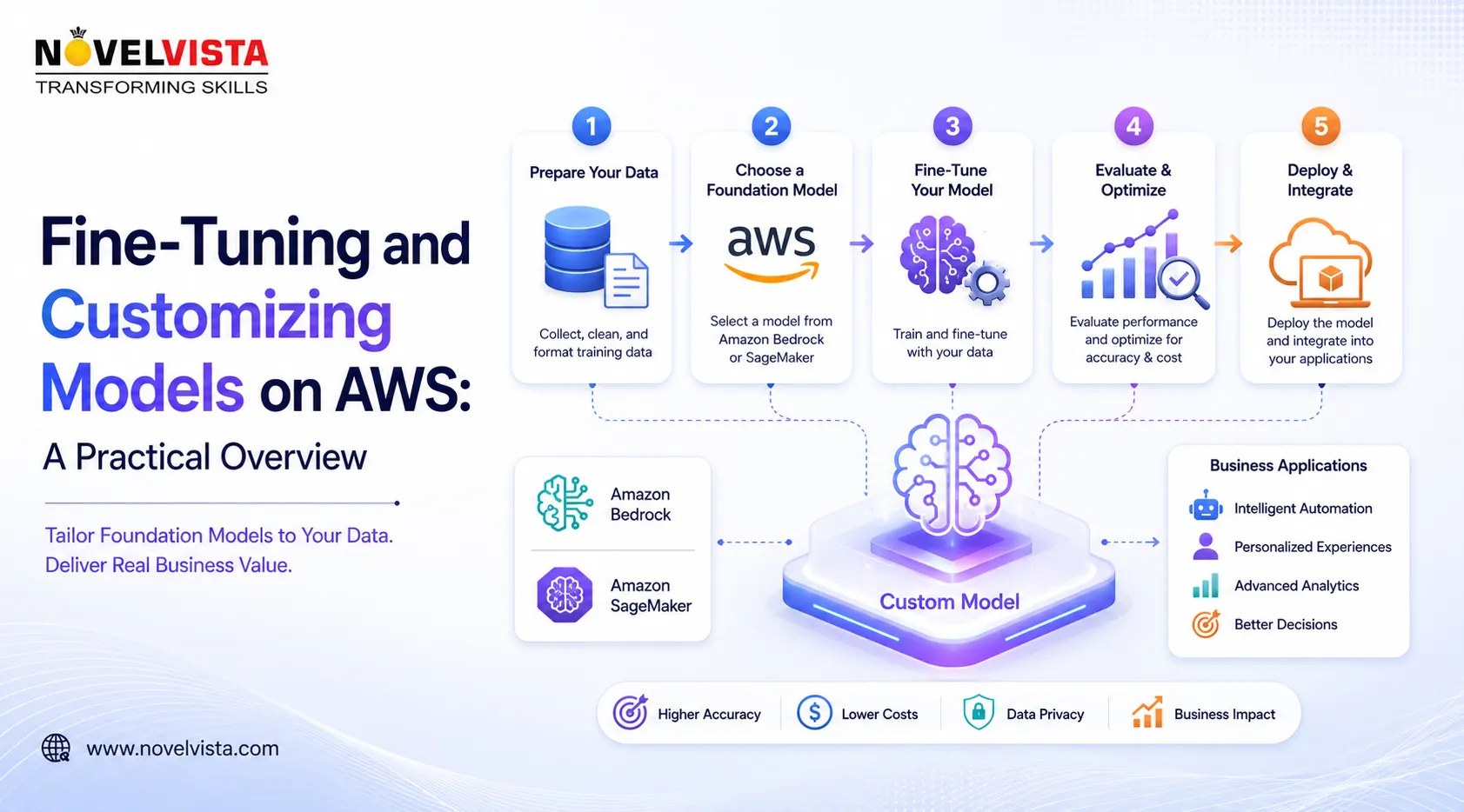
Foundation models provide strong general-purpose capabilities, but enterprise applications often require more than generic responses. A customer-support assistant must follow company policies, a technical copilot must understand domain terminology, and a document-processing system may need to produce outputs in an exact structure.
AWS provides several approaches for adapting models to these requirements. The key is choosing the lightest customization method that can reliably solve the problem.
Customization Does Not Always Mean Fine-Tuning
Fine-tuning is frequently treated as the default method for improving a model, but it should rarely be the first step.
Technical teams should begin with prompt engineering. Clear instructions, representative examples, output schemas, and appropriate model parameters may be enough to achieve the required behaviour.
Retrieval-augmented generation, or RAG, is usually more suitable when the application needs access to current or proprietary information. RAG retrieves relevant content from an external knowledge source and provides it to the model at inference time. Unlike fine-tuning, it does not require changing the model’s weights.
Fine-tuning becomes valuable when the objective is to change how the model performs a task. Common examples include following specialised instructions, generating responses in a consistent style, recognising domain-specific patterns, classifying technical requests, or producing structured outputs.
In practice, strong enterprise solutions often combine RAG and fine-tuning: RAG supplies current knowledge, while fine-tuning improves behaviour and task performance.
Choosing Between Amazon Bedrock and SageMaker AI
Amazon Bedrock offers a managed path for building and customising generative AI applications. For supported models, teams can submit model-customisation jobs without managing the underlying training infrastructure.
Amazon Bedrock currently supports customization techniques including supervised fine-tuning, reinforcement fine-tuning and model distillation. Supervised fine-tuning uses labelled input-output examples, while reinforcement fine-tuning uses reward functions to teach the model what constitutes a high-quality response. Distillation transfers capabilities from a larger teacher model to a smaller, more cost-efficient model.
Amazon SageMaker AI provides greater control over the machine-learning lifecycle. It is suitable for teams that need customised training code, broader control over infrastructure, advanced hyperparameter optimisation, open-weight models or specialised deployment configurations. SageMaker JumpStart includes foundation models that can be deployed and, where supported, fine-tuned using domain-adaptation or instruction-based approaches.
A practical operating model is to use Bedrock when managed customization and simplified integration are priorities, and SageMaker AI when the team requires deeper control over training and model architecture.
Prepare High-Quality Training Data
A fine-tuned model is only as reliable as its training data. More examples do not automatically produce a better model. The examples must accurately represent the task the model will perform in production.
For supervised fine-tuning, teams typically prepare prompt-and-response pairs. The prompts should cover realistic language, edge cases and variations, while the responses should demonstrate the exact quality and format expected from the model.
Amazon Bedrock requires training and optional validation datasets to follow the format supported by the selected model and customization method. These datasets are commonly stored as JSON Lines files, where each line contains one training record.
Before training, remove duplicate records, sensitive information, incorrect answers and inconsistent formatting. Divide the available examples into training, validation and test datasets. The test dataset should remain separate so that it can provide an unbiased comparison between the base and customised models.
Establish a Baseline Before Training
Teams should evaluate the original model before creating a customization job. Define measurable success criteria such as classification accuracy, schema compliance, factual correctness, response consistency, latency and cost.
The evaluation dataset should represent production traffic rather than idealised demonstrations. Include ambiguous requests, incomplete inputs, adversarial prompts and cases where the model should refuse or escalate.
Without a baseline, a team may successfully complete an expensive training job without knowing whether the resulting model is actually better.
Run and Monitor the Customization Job
After placing the datasets in Amazon S3, configure the required IAM permissions and select a supported base model and AWS Region. Model and Region availability varies, so teams should verify current support before finalising the architecture.
Start with conservative hyperparameters. Excessive training can cause overfitting, where the model performs well on familiar examples but struggles with new requests. Monitor training and validation metrics, compare checkpoints where available, and investigate any widening gap between training and validation performance.
For tasks with measurable success criteria, reinforcement fine-tuning can provide another option. Reward functions can evaluate outputs using rules, executable tests, AWS Lambda functions or model-based graders. AWS recommends validating the reward logic on a relatively small dataset before scaling the training process.
Deploy and Operate the Custom Model
A customised model should pass the same production controls as any other software component. Test security, privacy, prompt-injection resistance, failure handling and access permissions before release.
Amazon Bedrock custom models can be configured for on-demand inference or provisioned throughput, depending on the supported model and workload requirements. On-demand inference supports usage-based consumption, while provisioned throughput provides dedicated capacity for more predictable performance.
Teams that customise open-source models in SageMaker AI or another environment can also use Amazon Bedrock Custom Model Import for supported architectures. Imported models can then be invoked through Bedrock APIs, providing a more consistent inference layer for customised model workloads.
Start with a Measurable Business Problem
The goal of model customization is not to create a model that sounds different. It is to improve a measurable operational outcome.
Begin with one high-value use case, establish a reliable evaluation framework, compare prompting and RAG before training, and introduce fine-tuning only when it provides a clear performance advantage. With the right AWS architecture, technical teams can build specialised AI solutions without taking on the cost and complexity of training foundation models from scratch.

 English
 Arabic
 French
 Spanish
 Portuguese
 Deutsch
 Dutch
Dutch
 Italiano
 Russian
 Romaian
 Portuguese (Brazil)
 Greek
Greek
