


Agentic AI for PMs: Automating Repetitive Coordination Tasks
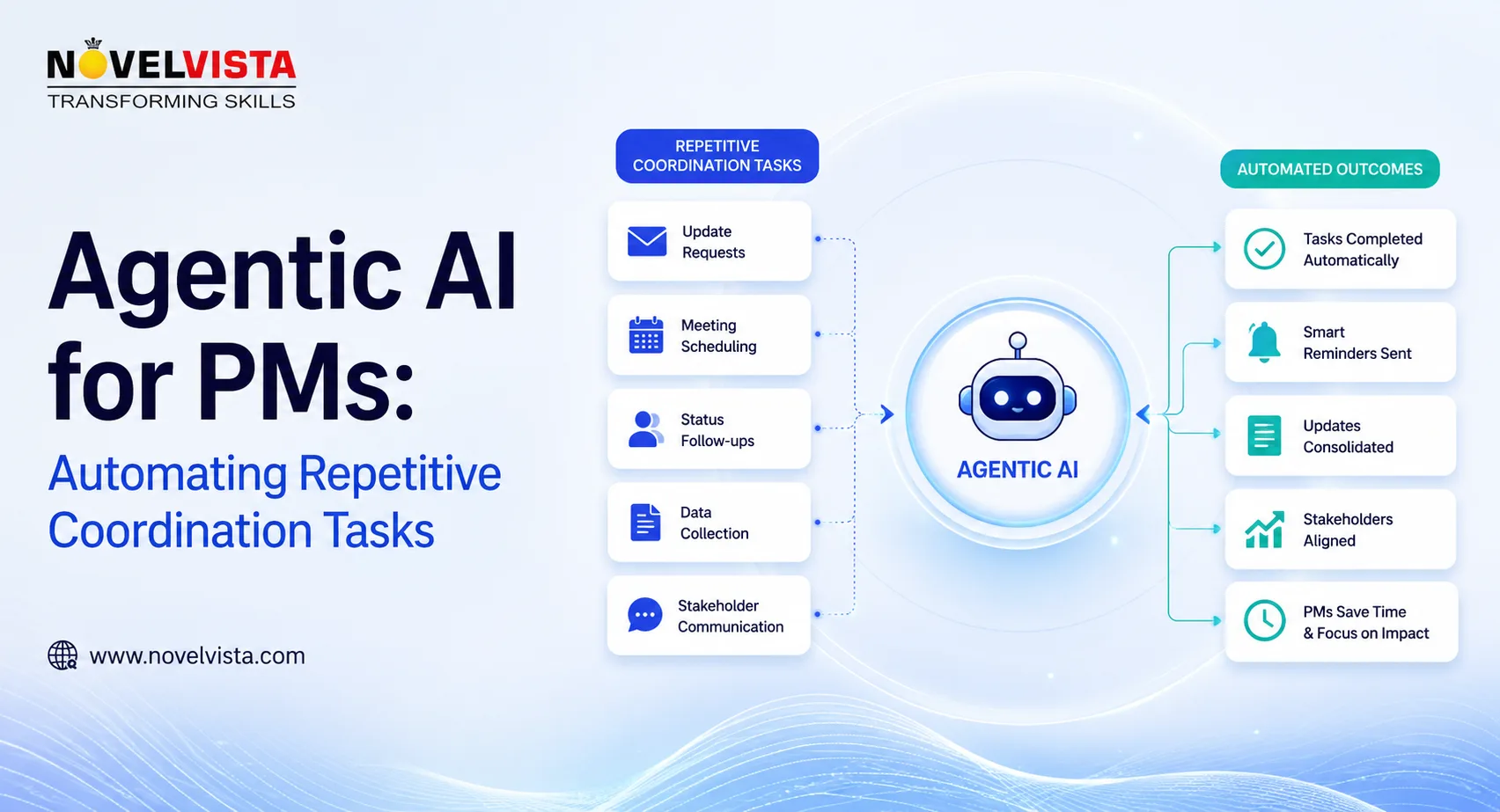
Project managers working with technical teams often spend a significant portion of their day coordinating rather than managing. They chase status updates, prepare meeting notes, remind owners about overdue tasks, update project trackers, consolidate reports, and answer the same delivery questions across multiple channels.
These activities are necessary, but they rarely require the full attention of an experienced project manager. This is where agentic AI can create meaningful operational value.
Unlike traditional automation, which follows fixed rules, agentic AI can understand objectives, evaluate context, choose actions, and complete multi-step tasks across project management tools. For Project Managers this means moving beyond simple reminders and using intelligent agents to handle repetitive coordination workflows with limited manual intervention.
What Is Agentic AI in Project Management?
Agentic AI refers to AI-powered systems that can work toward a defined goal by observing information, making decisions, and taking appropriate actions.
For example, instead of merely notifying a project manager that a task is overdue, an AI agent could:
- Review the task history and dependencies
- Contact the responsible owner
- Request an updated completion date
- Assess whether the delay affects the sprint or milestone
- Update the project tracker
- Add the risk to the weekly status report
- Escalate the issue when necessary
The project manager remains in control, but the agent performs much of the coordination work required to keep delivery moving.
Automating Daily Status Collection
Collecting project updates is one of the most repetitive responsibilities in technical delivery.
An agentic AI solution can gather updates directly from Jira, Azure DevOps, GitHub, Slack, Microsoft Teams, email, and shared documents. It can identify completed tasks, active blockers, overdue items, unresolved pull requests, failed deployments, and changes to delivery dates.
The agent can then generate a structured daily summary showing:
- Work completed
- Work in progress
- Current blockers
- Tasks at risk
- Decisions required
- Priorities for the next working day
Instead of asking every engineer for an update, the project manager can review an automatically prepared summary and focus only on exceptions requiring human judgment.
Improving Meeting Coordination
Technical teams often attend recurring stand-ups, sprint reviews, architecture discussions, risk meetings, and stakeholder calls. Each meeting creates additional administrative work.
Agentic AI can support the complete meeting lifecycle. Before the meeting, it can prepare an agenda based on open tasks, previous decisions, project risks, and unresolved dependencies. During the meeting, it can capture notes, decisions, action items, owners, and deadlines.
After the meeting, the agent can distribute the summary, create tasks, update the project plan, and schedule follow-ups. It can also track whether action items are completed before the next meeting.
This reduces the risk of decisions being forgotten or action items disappearing into meeting transcripts.
Managing Dependencies and Delivery Risks
In technical projects, delays are often caused by dependencies between engineering, testing, security, infrastructure, product, and external vendors.
An AI agent can continuously monitor these dependencies. When one task is delayed, it can evaluate downstream impact and identify which milestones, releases, or teams may be affected.
For example, if an API integration is delayed, the agent may detect that frontend testing, security validation, and user acceptance testing cannot begin as planned. It can notify the relevant owners, suggest revised dates, and update the risk register.
This gives project managers earlier visibility into issues instead of discovering them during weekly reviews.
Automating Stakeholder Reporting
Preparing project reports often involves collecting information from multiple systems and rewriting it for different audiences.
Agentic AI can automatically create tailored reports for engineering managers, product leaders, executives, customers, and delivery teams. Technical teams may receive detailed information about blockers and dependencies, while leadership receives a concise overview of progress, risks, budget, and delivery confidence.
The agent can also explain why a milestone is at risk by connecting data from tasks, incidents, scope changes, and resource availability.
This helps project managers communicate consistently without manually rebuilding the same report several times.
Maintaining Human Control
Agentic AI should not replace project leadership, stakeholder management, negotiation, or strategic decision-making. These responsibilities require business judgment, emotional intelligence, and an understanding of organisational priorities.
The most effective approach is to automate coordination while keeping important actions under human supervision. Teams can configure approval checkpoints for activities such as changing deadlines, escalating risks, contacting customers, or modifying project scope.
Clear permissions, audit logs, data controls, and escalation rules are also essential when agents interact with enterprise systems.
A Smarter Operating Model for Technical Teams
Agentic AI gives project managers an opportunity to redesign how coordination work is handled. Instead of spending hours collecting information and updating systems, they can focus on resolving constraints, aligning teams, managing risk, and improving delivery outcomes.
For technical teams, the result is fewer unnecessary meetings, faster access to project information, clearer ownership, and more consistent follow-through.
Organisations adopting agentic AI for project management can start with one high-volume workflow, such as status reporting or action-item tracking. Once the process is stable, they can expand into dependency monitoring, risk management, release coordination, and stakeholder communication.
The objective is not to automate project management completely. It is to remove repetitive coordination work so project managers and technical teams can spend more time delivering valuable outcomes.

 Arabic
 French
 Spanish
 Portuguese
 Deutsch
 Turkish
 Dutch
Dutch
 Italiano
 Russian
 Romaian
 Portuguese (Brazil)
 Greek
Greek
