


5G New Radio (NR) Market Set for Strong Growth Through 2036 Fueled by Standalone 5G Networks, Private Wireless, and Smart Manufacturing
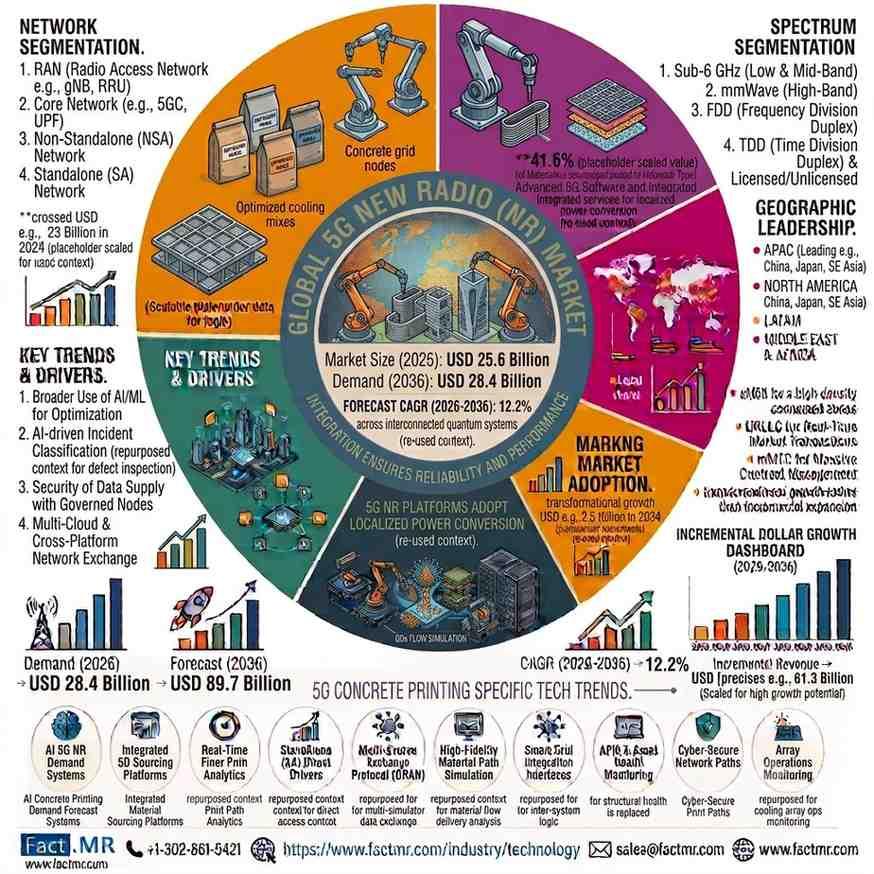
According to a market study published by Fact.MR, The global 5G New Radio (NR) market is undergoing a fundamental transformation, rising from an estimated valuation of USD 28.4 billion in 2026 to reach USD 89.7 billion by 2036. global demand for 5G NR technology is projected to expand at a compound annual growth rate (CAGR) of 12.2% over the ten-year forecast period.
Get detailed market forecasts, competitive benchmarking, and pricing trends: https://www.factmr.com/connectus/sample?flag=S&rep_id=15142
As mobile network operators transition from early coverage building toward capacity expansion, standalone (SA) migration, and 5G-Advanced readiness, radio infrastructure and specialized software upgrades continue to capture substantial capital investments across telecom and enterprise domains.
Key Market Highlights at a Glance
- 2026 Base Market Valuation: USD 28.4 billion
- 2036 Projected Market Valuation: USD 89.7 billion
- Compound Annual Growth Rate (CAGR 2026–2036):2%
- Leading Component Segment: Radio access hardware, holding a 39.0% share in 2026
- Leading Deployment Mode: Non-standalone (NSA) NR, commanding a 43.0% share in 2026
- Leading Frequency Band: Sub-6 GHz, representing a 58.0% share in 2026
- Leading Application Segment: Enhanced mobile broadband (eMBB), capturing a 54.0% share in 2026
- Leading End-User Segment: Telecom operators, accounting for a 66.0% share in 2026
- Fastest-Growing Regional Market: India, advancing at a 14.3% CAGR
Why Is the 5G New Radio (NR) Market Growing?
The expansion of the 5G New Radio market is propelled by shifting operator strategies and new enterprise connectivity requirements across global markets.
Key Demand Drivers
- Standalone Core Migration: Network operators are transitioning to standalone 5G NR architecture to enable low-latency slicing and advanced network performance.
- Capacity Expansion and Network Densification: Surging consumer data traffic and fixed wireless access demand require densification using sub-6 GHz and mmWave radio gear.
- Enterprise Private Networks: Factories, logistics hubs, and industrial sites are deploying private 5G NR infrastructure to secure automated operations.
Which Segments Drive 5G New Radio Market Revenue?
Radio Access Hardware Dominates Component Revenues
Radio access hardware leads the component axis, accounting for a 39.0% market share in 2026. Deploying physical radio units, baseband processing gear, and active antenna arrays forms the foundational capital expenditure step for network operators expanding 5G coverage.
- Radio Access Hardware Share: Holds 39.0% of total component revenues in 2026, driven by base station and antenna deployments.
- Baseband and Protocol Software: Expanding rapidly as software-defined upgrades prepare existing radio systems for 5G-Advanced standards.
- 5G NR Chipsets and Testing Equipment: Gaining steady volume through chipset integration into enterprise routers, industrial modules, and network validation suites.
Non-Standalone NR Retains Leading Deployment Share
Non-standalone (NSA) NR represents the largest deployment mode, capturing a 43.0% share in 2026. NSA deployments allow carriers to leverage existing 4G LTE core networks while deploying new 5G radios, accelerating initial service availability while managing capital spending.
- Non-Standalone NR Share: Commands a 43.0% deployment share in 2026 due to cost-effective carrier upgrades.
- Standalone NR Segment: Accelerating as carriers move toward native 5G cores to deliver ultra-low latency and dedicated slicing.
- Private and Open RAN NR: Growing in industrial campus environments seeking vendor-interoperable hardware.
Sub-6 GHz Spectrum Leads Frequency Allocations
Sub-6 GHz spectrum accounts for 58.0% of total frequency band revenues in 2026. Sub-6 GHz provides an optimal balance between broad physical coverage and enhanced data throughput, making it the primary choice for national network rollouts.
- Sub-6 GHz Band Share: Captures 58.0% of market revenues in 2026 for mid-band and low-band coverage.
- mmWave Band Segment: Serving high-density urban nodes, stadium venues, and high-throughput fixed wireless connections.
Enhanced Mobile Broadband (eMBB) Drives Application Traffic
Enhanced mobile broadband represents the dominant application segment with a 54.0% share in 2026. Consumer demand for high-definition streaming, cloud gaming, and mobile internet usage creates the primary volume base for 5G NR equipment.
- Enhanced Mobile Broadband Share: Generates 54.0% of application value in 2026.
- Fixed Wireless Access (FWA): Rapidly expanding to deliver home and small-business broadband over 5G spectrum.
- Ultra-Reliable Low-Latency Communication (URLLC): Supporting mission-critical industrial automation and connected vehicular systems.
Telecom Operators Form Primary End-User Segment
Telecom operators capture 66.0% of total market revenues in 2026. Public commercial networks require ongoing capital investment in radios, core software, and backhaul links to support growing subscriber bases.
- Telecom Operators Share: Controls 66.0% of total end-user market value in 2026.
- Enterprise End-Users: Accelerating adoption of dedicated private 5G NR setups across manufacturing and logistics sites.
Market Dynamics: Drivers, Restraints, and Key Trends
Key Market Drivers
The primary market driver is the continuous shift from early non-standalone deployments to full standalone 5G NR core architectures. Furthermore, operator expansion into fixed wireless access (FWA) broadband and enterprise demand for private 5G campus networks provide strong ongoing demand for radio hardware and software licenses.
Key Market Restraints
High initial infrastructure investment costs and complex spectrum allocation processes represent key restraints. Additionally, integrating legacy 4G systems with multi-band 5G radios can create network upgrade complexities that delay full standalone migration for smaller regional operators.
Key Industry Trends
Industry trends highlight the transition toward 5G-Advanced (Release 18) standards to enhance uplink performance and mobility management. Operators are also adopting Open RAN architectures to broaden vendor options, alongside deploying AI-assisted radio resource management to reduce operational power consumption.
Regional and Country Outlook: Asia-Pacific and North America Lead Deployment Scale
The global 5G New Radio market displays distinct growth trajectories across major geographical regions as operator maturity and industrial adoption vary.
Country Growth Profiles (CAGR 2026–2036)
- India:3% CAGR
- China:1% CAGR
- United States:2% CAGR
- Germany:1% CAGR
- Japan:4% CAGR
Country Insights
- India: India represents the world's fastest-growing country market, expanding at a 3% CAGR. Rapid operator network expansion and strong adoption of 5G fixed wireless access for home broadband drive high radio unit demand.
- China: China is projected to grow at a 1% CAGR through 2036. Deep domestic equipment manufacturing and massive industrial 5G factory deployments support sustained radio densification.
- United States: The United States market is set to register an 2% CAGR by 2036. Growth is driven by standalone NR core migrations, enterprise private networks, and mid-band C-band spectrum deployments.
- Germany: Germany is forecast to advance at a 1% CAGR through 2036. Widespread adoption of private 5G campus networks across automotive and manufacturing hubs anchors regional demand.
- Japan: Japan is projected to record a 4% CAGR by 2036. Mature network operators are focusing capital expenditure on 5G-Advanced software upgrades and dense urban capacity enhancements.
Competitive Landscape
The competitive environment in the 5G New Radio market is dominated by global telecom equipment vendors and radio solution providers. Key suppliers compete on spectral efficiency, massive MIMO processing capabilities, Open RAN compatibility, and energy-saving radio designs.
- Huawei Technologies Co., Ltd.: Offers carrier-grade RAN systems and multi-band active radio platforms.
- Ericsson: Focuses on standalone 5G NR architecture, energy-efficient radios, and network slicing software.
- Nokia Corporation: Provides Open RAN-compliant radio access networks and private 5G campus solutions.
- Samsung Electronics Co., Ltd.: Specializes in virtualized RAN software and high-performance massive MIMO radio units.
- ZTE Corporation: Delivers high-capacity radio access units and enterprise 5G network platforms.
Leading vendors are increasingly forming strategic partnerships with cloud hyperscalers and industrial software developers to simplify private 5G deployments for enterprise clients.
Read the Comprehensive Industry Report: https://www.factmr.com/report/5g-new-radio-nr-market
Frequently Asked Questions
What is the projected market size of the global 5G New Radio market by 2036?
The global 5G New Radio market is projected to reach a total valuation of USD 89.7 billion by 2036.
What is the base year market valuation for 5G New Radio in 2026?
The global 5G New Radio market is estimated to be valued at USD 28.4 billion in 2026.
What is the projected compound annual growth rate (CAGR) of the market?
The global 5G New Radio market is forecast to expand at a CAGR of 12.2% between 2026 and 2036.
Which component segment holds the largest market share in 5G New Radio?
Radio access hardware holds the largest component market share, commanding 39.0% of total revenues in 2026.
Which application segment drives the highest market revenue?
Enhanced mobile broadband drives the highest market revenue, capturing a 54.0% application share in 2026.
Which country is expected to exhibit the fastest growth rate in the 5G New Radio market?
India is expected to be the fastest-growing country market, expanding at a CAGR of 14.3% from 2026 to 2036.
Who are the key players in the global 5G New Radio market?
Key players in the global 5G New Radio market include Huawei Technologies Co., Ltd., Ericsson, Nokia Corporation, Samsung Electronics Co., Ltd., and ZTE Corporation.
To View Related Report:
5G Devices Market: https://www.factmr.com/report/5g-devices-market
5G Base Station Market: https://www.factmr.com/report/5g-base-station-market
5G NTN Market: https://www.factmr.com/report/5g-ntn-market
5G Core Market: https://www.factmr.com/report/5g-core-market
To View More Report:
F-15EX GaN-Enhanced Fighter Radars Market: https://www.openpr.com/news/4571761/f-15ex-gan-enhanced-fighter-radars-market-projected-to-reach
RFID-Enabled Gift Boxes Market: https://www.openpr.com/news/4571774/rfid-enabled-gift-boxes-market-forecast-to-reach-usd-437-00

 English
 Arabic
 French
 Spanish
 Portuguese
 Deutsch
 Turkish
 Dutch
Dutch
 Italiano
 Russian
 Romaian
 Portuguese (Brazil)
