


Microfluidic Chip Cooling Market Set for Rapid Growth Through 2036 Fueled by AI Processors, High-Performance Computing, and Advanced Thermal Management
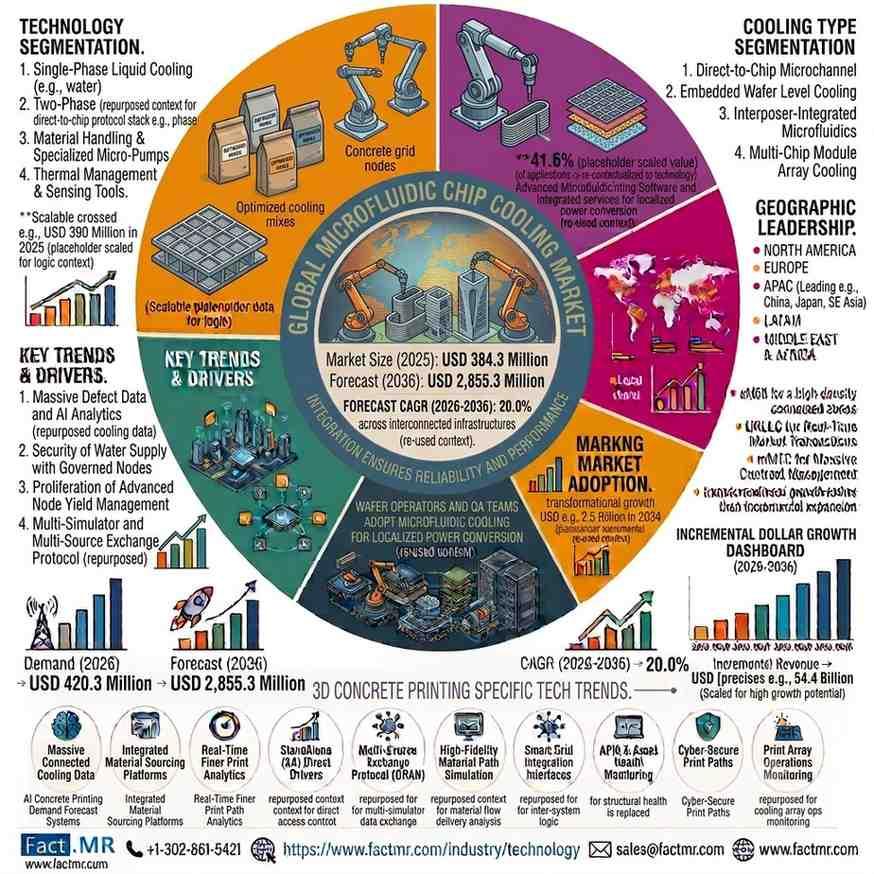
According to an in-depth market study published by Fact.MR, The global microfluidic chip cooling market is projected to expand from USD 461.1 million in 2026 to USD 2,855.3 million by 2036, growing at a compound annual growth rate (CAGR) of 20.0% during the forecast period. the market was valued at USD 384.3 million in 2025 and is poised to generate an absolute dollar opportunity of USD 2,394 million over the ten-year forecast window.
Get detailed market forecasts, competitive benchmarking, and pricing trends: https://www.factmr.com/connectus/sample?flag=S&rep_id=15170
This rapid expansion is primarily driven by escalating thermal density in artificial intelligence (AI) chips, graphics processing units (GPUs), and high-performance computing (HPC) architectures that exceed the thermal dissipation limits of traditional air cooling systems.
Key Market Highlights at a Glance
- 2025 Base Market Value: USD 384.3 million
- 2026 Estimated Market Value: USD 461.1 million
- 2036 Projected Market Value: USD 2,855.3 million
- Forecast Compound Annual Growth Rate (CAGR 2026–2036):0%
- Absolute Dollar Opportunity: USD 2,394 million
- Total Market Expansion Multiple:2x increase in market value
- Leading Integration Type Segment: Cold Plate / External Cooling (31.7% market share in 2026)
- Leading Cooling Stage Segment: Single-Phase Cooling (60.8% market share in 2026)
- Leading Application Segment: Data Centers (30.8% market share in 2026)
- Leading Component Type Segment: GPU (28.9% market share in 2026)
- Fastest-Growing Country Market: India (24.9% CAGR from 2026 to 2036)
Why Is the Microfluidic Chip Cooling Market Growing?
Demand for microfluidic chip cooling is surging across high-density computing facilities due to the thermal challenges presented by next-generation semiconductors. As chipmakers pack tens of billions of transistors into 3D-stacked chiplets, power densities frequently surpass 500 Watts per square centimeter, creating severe localized hotspots that standard air or macroscopic liquid loops cannot dissipate effectively.
Primary Demand Drivers
- Escalating Thermal Density in AI and GPU Accelerators: Modern artificial intelligence workloads generate extreme heat concentrations that necessitate direct microchannel fluid circulation at the semiconductor package level.
- Rapid Expansion of Hyperscale Data Centers: Data center operators are adopting microfluidic direct-to-chip cooling to achieve stringent Power Usage Effectiveness (PUE) targets and reduce overall facility energy overhead.
- Transition to Advanced 3D Packaging Architectures: High-bandwidth memory (HBM) integration and multi-die chiplets require integrated microfluidic channels to maintain thermal uniformity across stacked silicon layers.
Which Segments Lead the Microfluidic Chip Cooling Market?
Cold Plate / External Cooling Commands 31.7% Share of Integration Types
The cold plate / external cooling segment accounts for 31.7% of the integration type market value in 2026. This leadership position is driven by its ease of retrofitting into existing server infrastructures and low barrier to implementation compared to fully embedded in-package solutions.
- Cold Plate / External Cooling Share:7% market share in 2026, favored for modularity and easy maintenance
- On-Chip Cooling Segment: Holds a 26.4% market share, supported by rising demand for direct hotspot mitigation
- In-Package Cooling Segment: Captures a 22.8% market share due to increasing deployment in modern chiplet architectures
Single-Phase Cooling Dominates Cooling Stages with 60.8% Market Share
Single-phase cooling represents 60.8% of the total market value in 2026. Its dominant market position stems from established operational safety, predictable fluid dynamics, and widespread compatibility with non-conductive dielectric liquids.
- Single-Phase Cooling Share:8% market share in 2026
- Key Advantage: Simplified system architecture and lower operational complexity compared to two-phase evaporative setups
Data Centers Application Leads Demand with 30.8% Market Share
The data centers segment accounts for 30.8% of global market revenue in 2026. Hyperscale cloud operators and co-location providers are heavily adopting microfluidic cooling platforms to support rising rack power densities that now exceed 100 kilowatts per rack.
- Data Centers Application Share:8% of market value in 2026
- Primary Application Driver: Aggressive AI cluster buildouts and energy efficiency mandates
GPUs Represent 28.9% Share of Component Types
Graphics processing units capture 28.9% of the market share by component type in 2026. This dominance reflects concentrated market demand for thermal management in specialized processors running large-scale AI model training and inference workloads.
- GPU Component Share:9% market share in 2026
- Secondary Components: CPUs, Application-Specific Integrated Circuits (ASICs), and Field-Programmable Gate Arrays (FPGAs)
Market Dynamics: Drivers, Restraints, and Key Trends
Key Market Drivers
The primary catalyst for market growth is the global acceleration of AI infrastructure buildouts. As compute-heavy workloads grow exponentially, data center operators are forced to replace legacy air-cooling systems with microfluidic liquid cooling solutions capable of managing extreme thermal loads while lowering power consumption.
Key Market Restraints
High initial implementation capital expenditures and complex microfabrication integration represent the main barriers to market growth. Etching microscopic fluid channels directly into silicon or ceramic substrates requires specialized manufacturing equipment and stringent quality assurance to prevent fluid leakage near high-voltage server components.
Key Industry Trends
A key industry trend is the adoption of direct-on-chip microchannel etching combined with engineered dielectric fluids. Semiconductor packaging engineers are increasingly designing internal fluid micro-passages during the initial chip fabrication stage, moving thermal management from an external afterthought to a core element of silicon architecture.
Regional Outlook: India Leads Fast-Growing Asian Markets
Asia-Pacific represents the fastest-expanding region for microfluidic chip cooling, driven by massive investments in semiconductor manufacturing, data center buildouts, and digital transformation initiatives.
- India:9% CAGR (fastest-growing country market globally)
- China:5% CAGR
- South Korea:9% CAGR
- United States:8% CAGR
- Germany:7% CAGR
Country-Level Growth Profiles
- India (24.9% CAGR): India leads global market growth with a 24.9% CAGR from 2026 to 2036, propelled by government initiatives supporting national data center hubs and rapid expansion of cloud computing infrastructure.
- China (21.5% CAGR): China advances at a 21.5% CAGR, supported by state-backed AI research programs, domestic semiconductor manufacturing incentives, and large-scale data center modernization.
- South Korea (20.9% CAGR): South Korea registers a 20.9% CAGR through 2036, driven by its world-leading high-bandwidth memory (HBM) production ecosystem and advanced semiconductor packaging facilities.
- United States (17.8% CAGR): The United States expands at a steady 17.8% CAGR, backed by the presence of major hyperscale cloud providers, leading GPU designers, and early adoption of high-performance liquid cooling systems.
- Germany (16.7% CAGR): Germany anchors European market demand with a 16.7% CAGR, supported by stringent industrial energy efficiency regulations and expanding enterprise computing centers.
Competitive Landscape
The microfluidic chip cooling market features a blend of specialized thermal management engineering firms, semiconductor cooling developers, and established data center infrastructure leaders. Key market participants focus on developing pre-engineered liquid cooling modules, leak-proof microchannel cold plates, and high-efficiency dielectric fluid loops.
- JetCool Technologies, Inc.: Develops microconvective cooling technology designed for direct-to-chip application on high-power processors.
- Chilldyne, Inc.: Offers negative-pressure liquid cooling systems that prevent fluid leaks in high-density server racks.
- CoolIT Systems, Inc.: Supplies modular direct-to-chip liquid cooling solutions and coolant distribution units for enterprise data centers.
- Asetek A/S: Specializes in custom direct-to-chip liquid cooling circuits for high-performance computing and gaming servers.
- LiquidStack: Provides advanced immersion and direct-to-chip microfluidic cooling platforms for AI data centers.
- Schneider Electric SE: Integrates microfluidic server cooling loops into comprehensive data center infrastructure management solutions.
- Vertiv Group Corp.: Delivers end-to-end liquid cooling infrastructure, including chilled water loops and microchannel cold plate systems.
- Boyd Corporation: Manufactures precision microchannel cold plates and thermal management materials for advanced electronics.
- Stulz GmbH: Supplies precision cooling environments and liquid distribution units tailored for high-density computing.
- Motivair Corporation: Manufactures high-capacity chilled water systems and server-level liquid cooling interfaces for supercomputers.
The market is witnessing increased collaboration between thermal management specialists and semiconductor foundries to co-design microfluidic channels during silicon wafer fabrication.
Read the Comprehensive Industry Report: https://www.factmr.com/report/microfluidic-chip-cooling-market
Frequently Asked Questions
What is the projected market value of the global microfluidic chip cooling market by 2036?
The global microfluidic chip cooling market is projected to reach a valuation of USD 2,855.3 million by 2036.
What is the estimated market size of microfluidic chip cooling in 2026?
The microfluidic chip cooling market is estimated to be valued at USD 461.1 million in 2026.
What is the expected CAGR for the microfluidic chip cooling market?
The global microfluidic chip cooling market is expected to grow at a Compound Annual Growth Rate (CAGR) of 20.0% between 2026 and 2036.
Which integration type holds the largest market share in microfluidic chip cooling?
Cold plate / external cooling represents the largest integration type segment, holding a 31.7% share of the market in 2026.
Which application segment dominates the microfluidic chip cooling market?
The data centers application segment dominates the market with a 30.8% revenue share in 2026.
Which country is the fastest-growing market for microfluidic chip cooling?
India is the fastest-growing national market for microfluidic chip cooling, expanding at a projected CAGR of 24.9% from 2026 to 2036.
Who are the key players in the microfluidic chip cooling market?
Key companies operating in the global market include JetCool Technologies, Inc., Chilldyne, Inc., CoolIT Systems, Inc., Asetek A/S, LiquidStack, Schneider Electric SE, Vertiv Group Corp., Boyd Corporation, Stulz GmbH, and Motivair Corporation.
To View Related Report:
Chip-On-Board (COB) LED Market: https://www.factmr.com/report/chip-on-board-cob-led-market
Chip Antenna Market: https://www.factmr.com/report/chip-antenna-market
LED Chip Market: https://www.factmr.com/report/led-chip-market
NFC Chip Market: https://www.factmr.com/report/nfc-chip-market
To View More Report:
Advanced IC Substrates Market: https://www.openpr.com/news/4570805/advanced-ic-substrates-market-to-reach-usd-43-2-billion-by-2036-as
Primary Charge Roller Market: https://www.openpr.com/news/4570829/primary-charge-roller-market-to-reach-usd-0-9-billion-by-2036-as

 English
 Arabic
 French
 Spanish
 Portuguese
 Deutsch
 Turkish
 Dutch
Dutch
 Italiano
 Russian
 Portuguese (Brazil)
 Greek
Greek
