


Real Estate Tokenization and Blockchain: Understanding the New Model of Property Investment
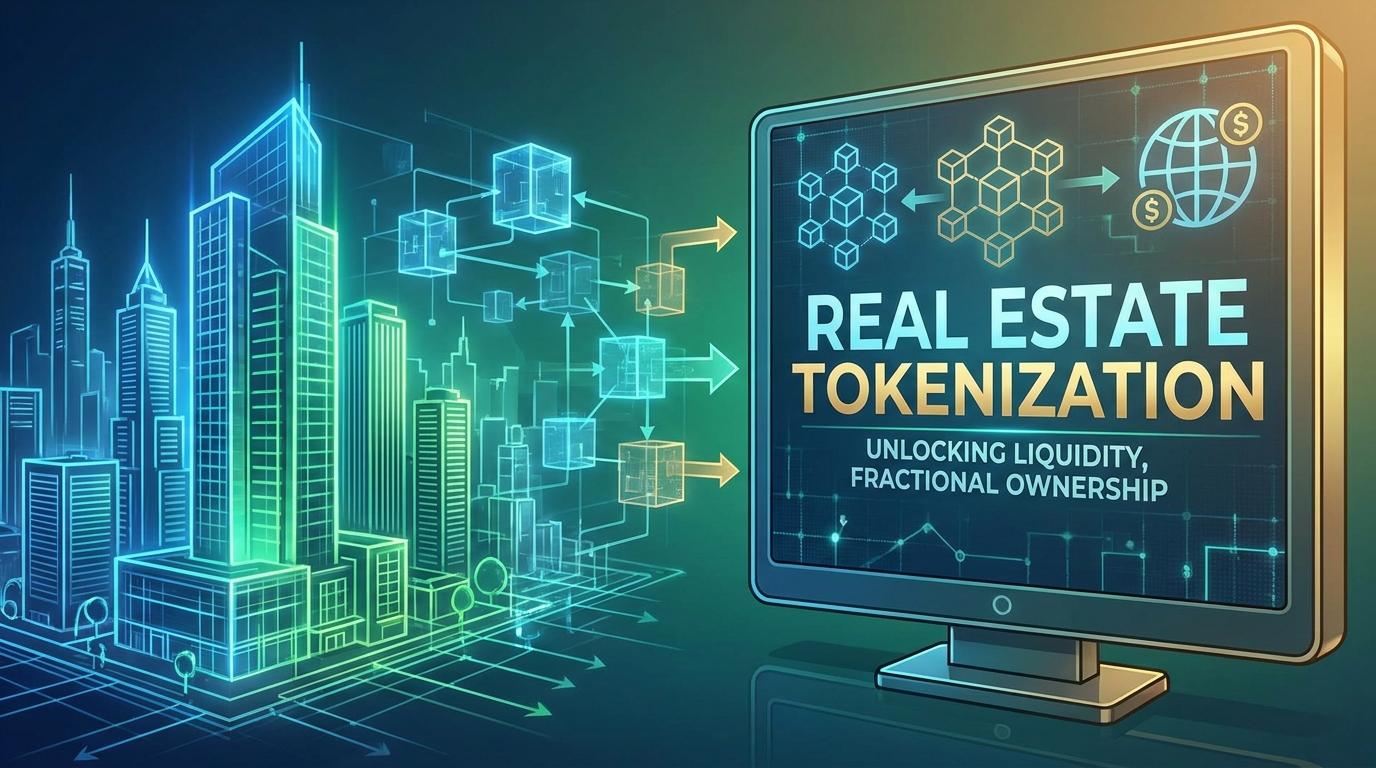
Real estate has traditionally been viewed as one of the most established long-term investment classes. Properties can generate rental income, appreciate in value, and provide portfolio diversification, but investing in them has historically involved substantial capital requirements, complex paperwork, limited liquidity, and dependence on multiple intermediaries. Blockchain technology is beginning to challenge some of these traditional limitations through a process known as tokenization.
Real Estate Tokenization refers to the process of representing ownership rights, economic interests, or investment claims connected to real estate through blockchain-based digital tokens. Instead of relying exclusively on conventional certificates, records, and intermediaries, tokenized structures can use blockchain networks to record transactions and manage certain aspects of ownership and investment. The result is a new model that potentially combines the stability of real-world property with the programmability and digital infrastructure of blockchain.
The concept has attracted considerable attention from financial institutions, property developers, technology companies, and investors. Deloitte's 2025 analysis projected that the value of tokenized real estate could grow from less than $0.3 trillion in 2024 to approximately $4 trillion by 2035, representing a projected compound annual growth rate of 27%. The estimate illustrates the scale of interest surrounding the concept, although actual adoption will depend heavily on regulation, market infrastructure, investor demand, and the development of reliable secondary markets.
What Is Real Estate Tokenization?
At its core, real estate tokenization involves creating digital tokens that represent defined rights associated with a property or real estate investment. These rights can vary considerably depending on the legal and financial structure. A token might represent an ownership interest in a legal entity that owns a property, an interest in a real estate fund, a debt claim secured by property, or another form of contractual economic exposure.
This distinction is important because purchasing a token does not necessarily mean that an investor directly owns a physical portion of a building. In many structures, the property is held by a special purpose vehicle, fund, trust, or other legal entity, while the token represents an interest in that structure. The exact rights of token holders depend on the governing legal documents and the jurisdiction in which the investment is offered.
The U.S. Securities and Exchange Commission's recent guidance emphasizes this principle: tokenized securities remain securities and are subject to applicable securities laws. The SEC has also identified different models, including issuer-sponsored tokenized securities, custodial structures, and synthetic tokenized securities, each of which can provide investors with different rights and risk exposures.
Therefore, blockchain is best understood as the technological infrastructure supporting a tokenized investment model rather than as a substitute for legal ownership structures. The underlying property, legal agreements, investor rights, and regulatory framework remain fundamental to the investment.
How Blockchain Changes the Traditional Real Estate Investment Model
Traditional real estate transactions involve a network of participants, including property owners, brokers, banks, lawyers, title companies, custodians, property managers, and regulators. Each participant performs a specific function, but the involvement of multiple intermediaries can increase costs and transaction times.
Blockchain introduces a shared digital ledger where transactions can be recorded in a transparent and tamper-resistant manner. Depending on the system's design, this can reduce duplication of records and improve the ability of authorized participants to verify transaction histories.
Smart contracts can add another layer of automation. A smart contract is a program deployed on a blockchain that executes predefined rules. In a properly designed tokenized real estate platform, smart contracts may help manage token issuance, transfer restrictions, investor eligibility, distribution calculations, or other administrative processes.
For example, imagine a commercial property generating rental income. Instead of maintaining separate manual records for every investor, a tokenized platform could maintain a digital register of eligible token holders and use programmed systems to calculate and distribute investment proceeds according to predefined rules. The underlying rental income would still need to be collected and managed through conventional financial systems, but some administrative processes could potentially become more efficient.
This hybrid approach is likely to be more realistic than the idea of completely replacing traditional real estate infrastructure. Recent research on real-world asset tokenization similarly finds that many current systems use hybrid architectures in which blockchain handles representation, transfers, compliance controls, and related functions while legal ownership, custody, verification, and enforceability remain anchored in off-chain structures.
Fractional Ownership: Expanding Access to Real Estate
One of the strongest arguments for tokenization is the potential to reduce investment barriers. Direct ownership of commercial real estate can require millions of dollars, making certain assets inaccessible to smaller investors. Tokenization can divide an investment interest into smaller digital units, potentially allowing eligible investors to participate with lower minimum investment amounts.
Consider a hypothetical office building valued at $10 million. Under a traditional ownership model, an individual investor might need substantial capital to acquire a meaningful stake. Under a properly structured tokenization model, the economic interest in the property could be divided into a large number of digital tokens. An investor might then acquire a smaller exposure rather than purchasing the entire asset.
This model could broaden participation in certain real estate opportunities, but fractionalization should not be confused with guaranteed accessibility. Securities laws, investor eligibility rules, minimum investment requirements, geographic restrictions, and platform policies can still limit who is allowed to purchase tokens.
Moreover, fractional ownership does not eliminate investment risk. If the underlying property loses value, rental income declines, tenants leave, or operating costs increase, token holders may experience corresponding financial consequences. Tokenization changes the structure through which investment is accessed; it does not remove the fundamental risks of real estate.
Liquidity: The Biggest Promise and the Biggest Challenge
Real estate is traditionally considered an illiquid asset. Selling a property can take weeks or months, and large transactions often require extensive due diligence, legal documentation, financing, and negotiations.
Tokenization is frequently presented as a solution to this problem because digital tokens can theoretically be transferred more efficiently than traditional property interests. A compliant secondary market could allow eligible investors to trade tokenized interests without requiring the underlying property itself to be sold.
However, tokenization does not automatically create liquidity.
A token can be technically transferable while still having limited buyers. Regulatory restrictions, investor eligibility requirements, low market participation, valuation uncertainty, and a lack of established trading venues can all limit secondary-market activity. Research into tokenized real-world assets has highlighted this gap between the technical ability to tokenize an asset and the practical ability to trade it efficiently.
This means that developers and platform operators should avoid presenting tokenization as an automatic guarantee of instant liquidity. The success of a tokenized real estate market ultimately depends on the existence of credible investors, compliant trading infrastructure, transparent valuations, and sufficient market depth.
The Role of a Real Estate Tokenization Company
A Real Estate Tokenization company can play an important role in helping property owners and investment businesses design and implement blockchain-based investment models. Its responsibilities may extend beyond blockchain development because successful tokenization requires coordination between technology, real estate finance, legal structures, compliance, and investor experience.
A professional tokenization provider may support areas such as:
- Token architecture and blockchain selection
- Smart contract development
- Investor onboarding and digital identity systems
- KYC and AML integration
- Token issuance and transfer management
- Property and ownership data integration
- Investor dashboards and portfolio management
- Distribution and payment infrastructure
- Compliance-oriented transfer restrictions
- Secondary-market integration
The choice of technology should be determined by the project's requirements. A platform designed for institutional investors may prioritize permissioned access, identity verification, regulatory controls, and integration with existing financial systems. A different model aimed at broader participation may require a more accessible interface while still maintaining appropriate compliance mechanisms.
The most important quality of a Real Estate Tokenization company is therefore not simply its ability to create a token. It should understand how the token relates to the underlying asset and the legal rights of investors. Technology that is disconnected from the legal structure can create significant operational and regulatory problems.
Regulatory Compliance Is Central to Tokenized Property Investment
The regulatory environment is one of the most important considerations in real estate tokenization. Depending on the structure, tokenized property interests may fall under securities regulations, collective investment rules, financial services laws, property regulations, tax requirements, and anti-money-laundering obligations.
For example, if investors purchase tokens with an expectation of receiving profits generated by a property managed by others, the arrangement may potentially be treated as an investment contract or security in certain jurisdictions. The classification depends on the specific facts and applicable laws.
This is why legal analysis should occur before technical development begins. Project operators need to determine what investors actually own, how their rights are enforced, who holds the property, how distributions are calculated, what restrictions apply to transfers, and which investors are legally eligible to participate.
The SEC's investor guidance makes clear that tokenized securities can carry the same regulatory obligations as their traditional counterparts. In other words, moving an investment instrument onto a blockchain does not automatically remove securities regulation or investor-protection requirements.
For global projects, the challenge becomes even more complex because rules differ across jurisdictions. A platform targeting investors in multiple countries may need to address cross-border securities restrictions, taxation, data protection, and licensing requirements. Professional legal and compliance advice is therefore essential.
Real-World Applications and Emerging Use Cases
Tokenization can potentially be applied to several segments of the property industry. Commercial buildings, residential developments, real estate funds, property-backed debt, land, and development projects are all being considered as possible use cases.
Deloitte's analysis identifies three broad areas of potential growth: tokenized private real estate funds, tokenized ownership of loans and securitizations, and tokenized interests in undeveloped land or projects under construction. Its forecast estimates that tokenized private real estate funds could reach approximately $1 trillion by 2035, while tokenized ownership of loans and securitizations could reach $2.39 trillion.
These projections should be treated as forecasts rather than guaranteed outcomes, but they highlight an important shift. Tokenization may eventually extend beyond individual property ownership and become part of broader financial infrastructure.
For example, a real estate fund could potentially issue digital representations of investor interests, automate certain transfer and compliance processes, and provide investors with more transparent access to portfolio information. Similarly, property-backed lending instruments could potentially use blockchain infrastructure to improve recordkeeping and settlement.
A Practical Example of Tokenized Real Estate
Consider a hypothetical developer that owns a $20 million commercial property leased to established businesses. Rather than selling the entire building, the developer establishes a legally appropriate investment structure and offers investors defined interests represented digitally.
Investors purchase eligible tokens, while the underlying property remains managed by professional operators. Rental income is collected through traditional banking channels, operating expenses are paid, and net income is distributed according to the investment agreement. The blockchain records token ownership and can enforce transfer restrictions, while smart contracts automate certain administrative processes.
If a compliant secondary market exists, eligible investors may be able to transfer their interests without waiting for the entire property to be sold.
This example illustrates the central principle of tokenization: the blockchain does not make the building itself digital. Instead, it creates a digital representation of defined economic or ownership rights connected to the property.
Risks and Limitations of Real Estate Tokenization
Despite its potential, tokenization introduces new risks. Smart contract vulnerabilities can create security threats, while poorly designed platforms may expose investors to operational or custody risks. Blockchain transactions may also be irreversible, making system security and access management critical.
There is also the problem of valuation. A tokenized property still requires credible valuation methods, independent due diligence, and transparent financial reporting. If investors cannot understand how the underlying asset is valued, tokenization may simply digitize an opaque investment.
Liquidity remains another major concern. A platform may promise secondary trading, but without enough buyers and sellers, the market can remain illiquid.
Finally, investors must carefully evaluate what a token actually represents. A token might provide direct ownership, an interest in an entity, a debt claim, or synthetic exposure. These structures can have very different rights and risks. Understanding the legal claim behind the token is therefore more important than the token's technical appearance.
Best Practices for Building a Successful Tokenized Real Estate Platform
A successful tokenization initiative should begin with the underlying asset rather than the technology. Developers should first identify the property's economic model, investor audience, legal ownership structure, and regulatory requirements.
The next step is to design a transparent framework that clearly explains investor rights, fees, distributions, governance, exit mechanisms, and transfer restrictions. Smart contracts should undergo rigorous security testing and independent auditing before deployment.
Compliance should be integrated into the platform architecture rather than added as an afterthought. KYC, AML procedures, identity verification, investor eligibility, and transaction monitoring should be designed according to the relevant jurisdiction.
Finally, transparency should remain a central principle. Investors need access to reliable information about the underlying property, financial performance, valuation, management, and risks. Blockchain can improve the integrity of digital records, but it cannot guarantee that the information initially entered into the system is accurate. Strong off-chain verification processes therefore remain essential.
The Future of Blockchain-Based Property Investment
The long-term potential of tokenized real estate depends on whether the industry can successfully combine blockchain technology with established financial and property infrastructure. The strongest future models are unlikely to operate entirely outside traditional systems. Instead, they may connect blockchain-based ownership records with regulated custodians, banks, property managers, legal entities, and compliant trading platforms.
As institutional interest in tokenized financial assets increases, the infrastructure surrounding digital securities is also developing. In 2026, for example, the NYSE announced a partnership with Securitize to develop infrastructure for tokenized securities, reflecting broader movement toward integrating blockchain-based assets with established capital markets.
For real estate, this evolution could eventually create more efficient investment ecosystems in which property interests are issued, managed, transferred, and serviced digitally while remaining connected to robust legal and financial frameworks.
Conclusion
Real Estate Tokenization represents an important evolution in the way property investment could be structured, offering potential benefits such as fractional ownership, improved administrative efficiency, transparent digital records, and more flexible investment models. However, its success depends on more than blockchain technology; strong legal structures, regulatory compliance, cybersecurity, asset verification, investor protection, and genuine market liquidity are equally essential. As the industry develops, a capable Real Estate Tokenization company can help businesses combine real estate expertise with blockchain infrastructure to create secure and efficient platforms, and Blockchain App Factory provides best services for businesses seeking professional blockchain development and real estate tokenization solutions.


 English
 Arabic
 Spanish
 Portuguese
 Deutsch
 Turkish
 Dutch
Dutch
 Italiano
 Russian
 Romaian
 Portuguese (Brazil)
 Greek
Greek
