


On-Site AI Implementation: Working Directly with Customer Teams
Artificial intelligence projects often look impressive during demonstrations. A Forward Deployment Engineer model can generate reports, answer questions, analyse documents, or automate routine tasks within seconds. However, turning that demonstration into a reliable business solution is a different challenge.
Successful AI implementation depends on more than selecting the right model or building a technical prototype. It requires a clear understanding of how the customer operates, where data is stored, which teams are involved, and what business outcomes are expected. This is why on-site AI implementation has become an important approach for organizations working on complex or high-impact AI initiatives.
By working directly with customer teams, AI specialists can understand the real operating environment, identify hidden constraints, and build solutions that fit existing processes.
What Is On-Site AI Implementation?
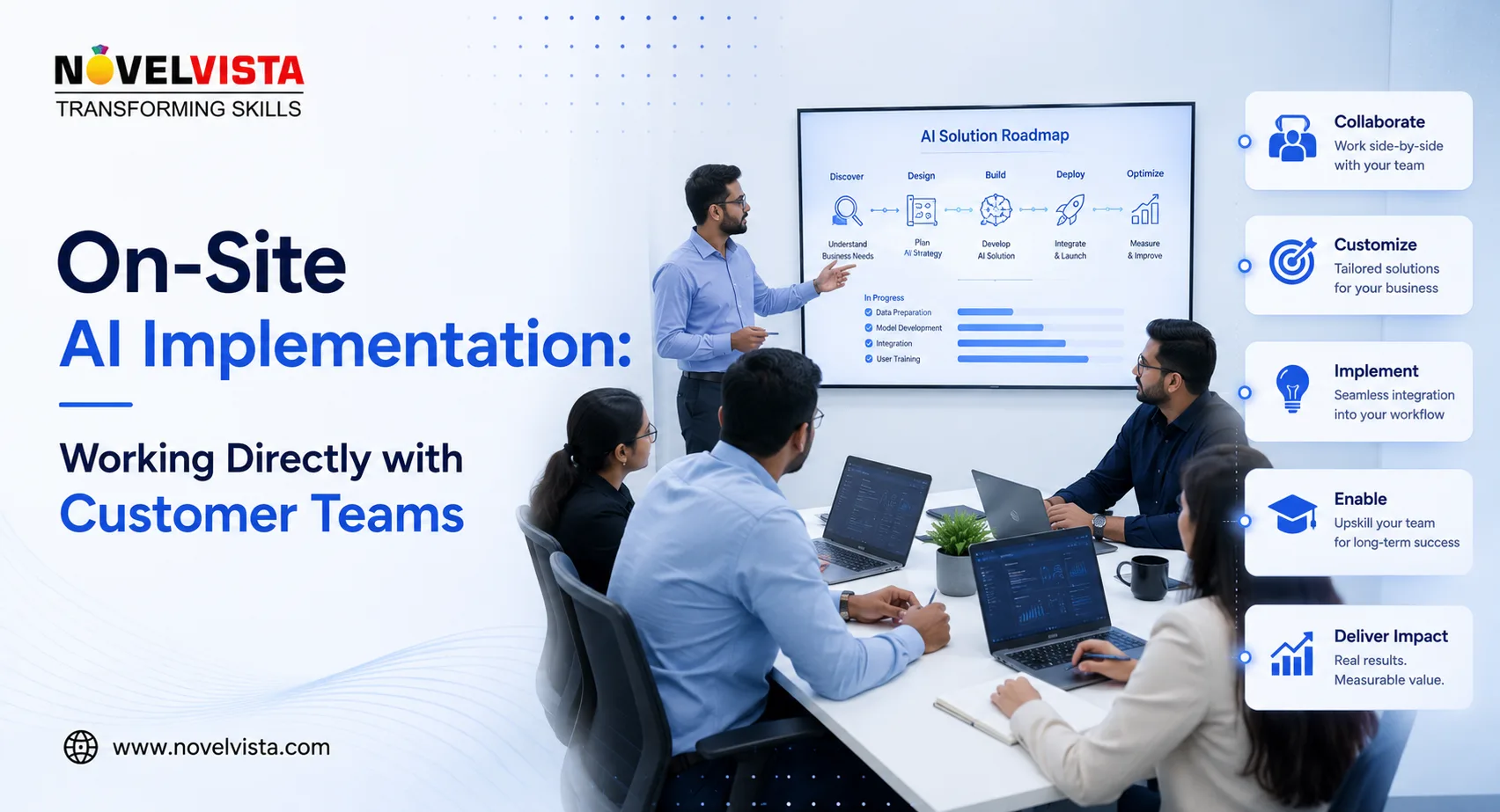
On-site AI implementation involves placing AI engineers, consultants, data specialists, or product teams directly within a customer’s working environment. Instead of developing the solution entirely from a remote location, the implementation team collaborates closely with business users, IT departments, leadership teams, and operational staff.
The work may take place at the customer’s office, factory, data centre, or another operational location. In some cases, teams follow a hybrid model, combining on-site discovery and deployment with remote development.
The objective is not simply to install an AI tool. The goal is to understand the customer’s business challenges and integrate AI into the way people already work.
Understanding the Real Business Problem
One of the biggest risks in AI projects is solving the wrong problem.
A customer may initially ask for an AI chatbot, forecasting system, document assistant, or automated reporting solution. After speaking directly with employees, the implementation team may discover that the real issue is poor data quality, unclear approval processes, disconnected systems, or excessive manual work.
On-site engagement allows specialists to observe how tasks are actually completed. Employees may describe a process one way during a formal meeting but follow several undocumented steps in practice.
By sitting with users and watching the workflow, the team can identify repeated activities, delays, dependencies, and exceptions. This makes it easier to define an AI use case that delivers measurable value rather than creating another tool that employees do not use.
Working with Cross-Functional Teams
AI implementation usually affects more than one department. A customer-facing assistant may involve sales, marketing, customer support, legal, security, and IT teams. A predictive maintenance solution may require collaboration between engineers, operators, data teams, and plant managers.
On-site implementation helps bring these groups together.
Business teams explain the operational requirements and expected results. Technical teams provide information about systems, APIs, infrastructure, and data availability. Security and compliance teams identify risk controls. Leadership teams help define priorities and success measures.
The AI implementation team acts as a bridge between these groups. It translates business needs into technical requirements while explaining technical limitations in practical terms.
This collaboration reduces misunderstandings and helps the project move faster.
Handling Data and System Integration
AI systems depend heavily on data. In many organizations, that data is spread across spreadsheets, databases, cloud services, email systems, CRM platforms, and internal applications.
An on-site team can work directly with data owners to understand where information comes from, how it is maintained, and whether it is reliable. They can also identify access restrictions, missing fields, duplicate records, inconsistent formats, and outdated information.
This is especially important for generative AI applications using retrieval-augmented generation, or RAG. If the connected documents are inaccurate or poorly organized, the AI system may produce misleading responses.
Working directly with customer IT teams also makes integration easier. The implementation team can test connections, understand network limitations, and resolve authentication or permission issues more efficiently.
Building Trust Through Prototypes
Customer teams may be interested in AI but still uncertain about its reliability. Employees may worry that the system will make incorrect decisions, expose confidential information, or replace parts of their role.
Small, practical prototypes can help build trust.
Instead of attempting a large deployment immediately, the team can create a limited solution for one department or process. Users can test the system, review the output, and provide feedback.
For example, an AI assistant may first generate draft responses rather than sending them automatically. A document review tool may highlight risks while leaving the final decision to a human reviewer.
This human-in-the-loop approach allows the organization to gain confidence before expanding automation.
Managing Change and User Adoption
Even a technically strong AI solution can fail if people do not use it.
On-site teams can provide demonstrations, training sessions, documentation, and ongoing support. They can answer questions in real time and adjust the solution based on user feedback.
Employees are more likely to adopt a new system when they understand how it helps them. The implementation team should explain the practical benefits, such as reducing repetitive work, improving response times, or making information easier to find.
It is also important to involve users early. When employees participate in testing and design, they are more likely to support the final solution.
Measuring Business Impact
A successful implementation should be measured using clear business outcomes.
Depending on the use case, these may include time saved, reduced operating costs, improved response accuracy, faster issue resolution, higher customer satisfaction, or fewer manual errors.
The on-site team can establish a baseline before implementation and compare it with results after deployment. Regular reviews help determine whether the solution is delivering value and where further improvements are required.
Conclusion
On-site AI implementation brings technical specialists closer to the people, processes, systems, and data that determine whether an AI project succeeds.
By working directly with customer teams, organizations can identify the right problems, build realistic solutions, manage risks, and improve user adoption. The result is not simply an AI model connected to business data. It is a practical operating solution designed around the customer’s real environment.
The strongest AI implementations are built through collaboration. Technology provides the capability, but direct engagement with customer teams turns that capability into measurable business value.

 English
 Arabic
 French
 Spanish
 Portuguese
 Deutsch
 Turkish
 Italiano
 Russian
 Romaian
 Portuguese (Brazil)
 Greek
Greek
