


Connecting n8n to ChatGPT, Claude, and Other AI Models
Artificial intelligence becomes far more valuable when it can work with the applications and data a business already uses. A chatbot that only answers questions is useful, but an AI model that can read incoming emails, analyse documents, update a CRM, create reports, and notify the right person can transform an entire workflow.
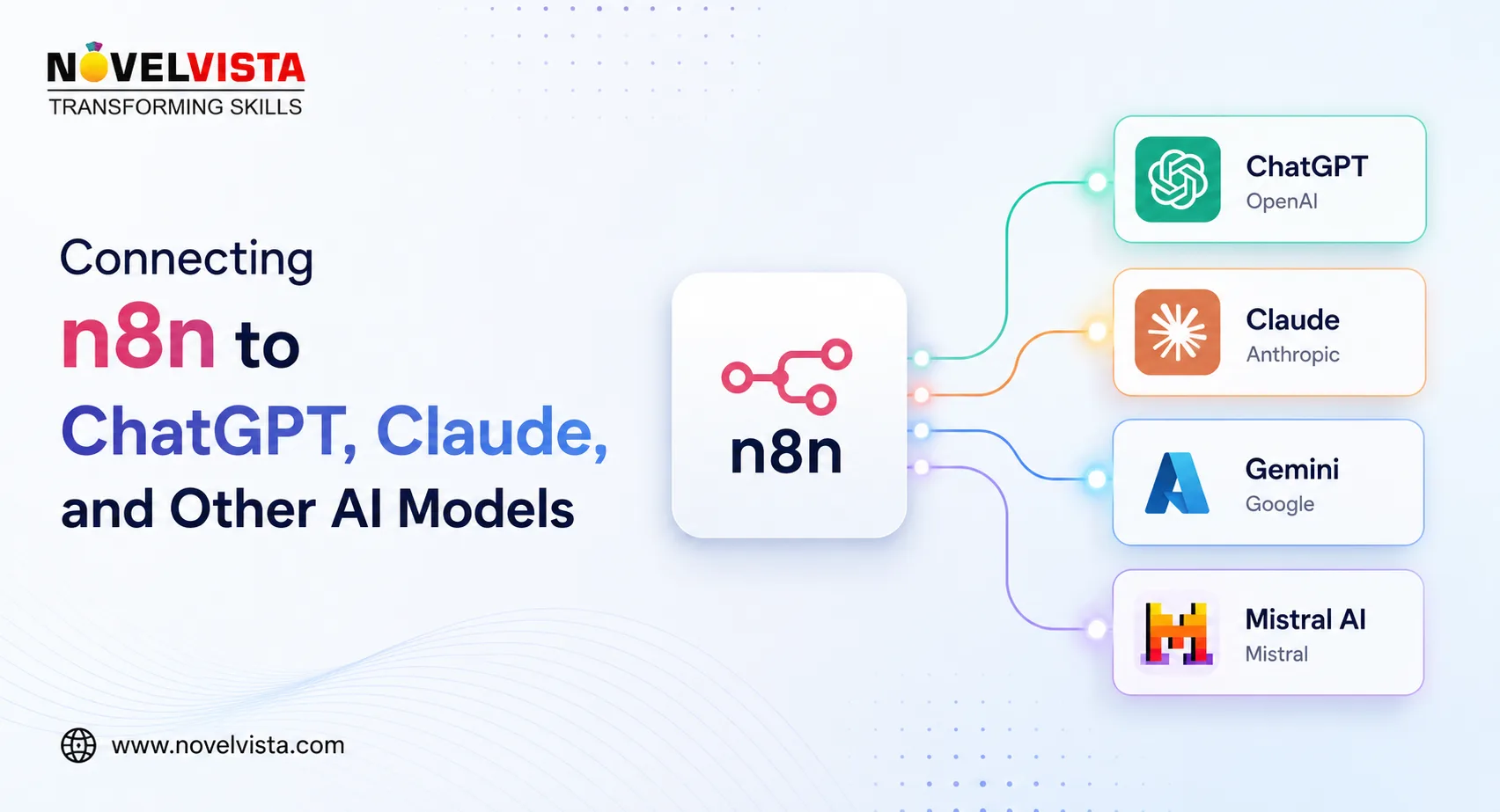
This is where n8n plays an important role. n8n is a workflow automation platform that allows organizations to connect applications, databases, APIs, and AI models through visual workflows. By integrating n8n with ChatGPT, Claude, Gemini, open-source models, and other AI services, businesses can build intelligent automations without developing every component from scratch.
Why Connect AI Models with n8n?
AI models are excellent at understanding text, summarising information, generating content, classifying data, and making recommendations. However, they usually need another system to provide information and perform actions.
n8n acts as the orchestration layer between the AI model and business applications. It can collect data from one source, send it to an AI model, process the response, and then pass the result to another application.
For example, an n8n workflow can receive a customer support request, send the message to ChatGPT for classification, create a suggested response, and route the ticket to the appropriate support team. The same workflow can also update the customer record and send a notification through Slack or Microsoft Teams.
Instead of employees manually transferring information between systems, the workflow handles the process automatically.
Connecting n8n to ChatGPT
ChatGPT can be connected to n8n using OpenAI credentials or API-based nodes. After configuring the connection, users can send prompts, application data, customer messages, documents, or database records to the model.
A simple workflow may begin with a trigger, such as a new form submission. The form data is passed to ChatGPT with instructions to summarise the request and identify its priority. n8n can then use the generated response to create a task, update a spreadsheet, or send an email.
ChatGPT integrations are commonly used for:
- Drafting emails and customer responses
- Summarising meetings and documents
- Categorising support tickets
- Generating marketing content
- Extracting structured information from text
- Creating personalised recommendations
The quality of the output depends heavily on the instructions sent to the model. Prompts should clearly define the expected role, input, output format, and business rules.
Connecting n8n to Claude
Claude is frequently used for tasks involving long documents, detailed analysis, structured reasoning, and natural-sounding written content. It can be connected to n8n through supported integrations or API requests.
A company could use Claude to review contracts, analyse policy documents, summarise research reports, or compare information across multiple files. n8n can collect the documents from cloud storage, send the relevant content to Claude, and save the response in a document management system.
For example, a legal operations team could create a workflow that detects a newly uploaded agreement, extracts its text, asks Claude to identify important clauses, and sends the results to a reviewer. The AI does not replace the reviewer, but it reduces the time required to perform the initial analysis.
Using Other AI Models
n8n is not limited to a single AI provider. Organizations can connect models from Google, Microsoft, Cohere, Mistral, Hugging Face, or other platforms through built-in nodes and HTTP API requests.
Businesses may also connect privately hosted or open-source models. This can be useful when data privacy, cost control, customization, or infrastructure requirements make public AI services unsuitable.
Different models can even be used within the same workflow. One model may classify an incoming request, another may create the response, and a third may validate the result. This multi-model approach helps teams select the best model for each task rather than depending on a single provider.
Building Reliable AI Workflows
Connecting an AI model is only the first step. Production-ready workflows need validation, monitoring, error handling, and security controls.
Structured output formats such as JSON can make AI responses easier to process. n8n can check whether required fields are present before continuing the workflow. When the model produces incomplete or invalid output, the workflow can retry the request, use a fallback model, or send the case for human review.
Sensitive information should be handled carefully. API credentials must be stored securely, access should be limited, and confidential data should not be sent to external models without appropriate approval.
Organizations should also monitor API usage, response time, token consumption, failures, and model costs. Logging important workflow decisions makes troubleshooting and auditing easier.
Practical Business Use Cases
AI-powered n8n workflows can support many departments. Sales teams can qualify leads and prepare follow-up messages. Human resources teams can summarise candidate applications. Finance teams can extract information from invoices. Marketing teams can repurpose content across channels. IT teams can analyse incident tickets and recommend troubleshooting steps.
The most successful implementations usually begin with a repetitive, clearly defined process. After the workflow has been tested and reviewed, it can be expanded gradually.
Conclusion
Connecting n8n to ChatGPT, Claude, and other AI models turns standalone AI capabilities into practical business workflows. n8n provides the triggers, integrations, routing, and automation logic, while the AI model handles language understanding and content generation.
Together, they allow organizations to automate complex processes, reduce manual effort, and respond faster. The real advantage does not come from simply adding AI to a workflow. It comes from designing a reliable system where AI, business applications, data, and human oversight work together.

 English
 Arabic
 French
 Spanish
 Portuguese
 Deutsch
 Turkish
 Dutch
Dutch
 Italiano
 Russian
 Romaian
 Portuguese (Brazil)
