


Industrial Twin Microservices Market Set for Rapid Growth Through 2036 Fueled by Digital Twins, Modular Architecture, and Industry 4.0 Adoption
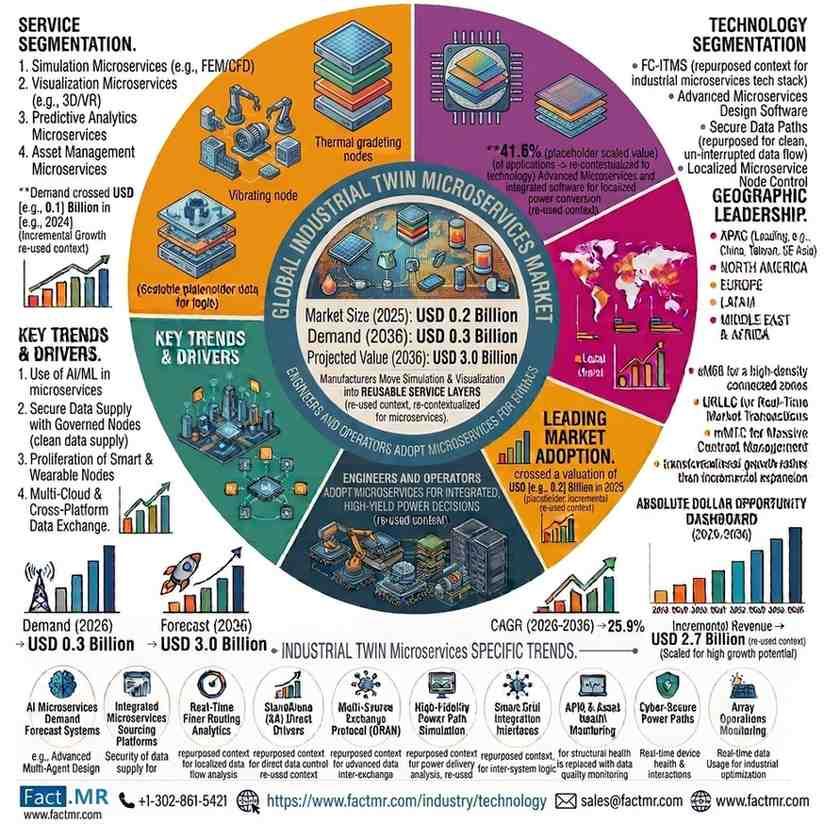
The global industrial twin microservices market is valued at USD 0.3 billion in 2026 and is projected to reach USD 3.0 billion by 2036, accelerating at a compound annual growth rate (CAGR) of 25.9% over the forecast period (2026–2036).
Get detailed market forecasts, competitive benchmarking, and pricing trends: https://www.factmr.com/connectus/sample?flag=S&rep_id=15451
This rapid market growth follows a valuation of USD 0.2 billion in 2025 and reflects a major architectural transition across industrial sectors. Plant software teams, system integrators, and independent software vendors are actively moving away from heavy, monolithic digital twin platform builds toward callable, containerized microservices for rendering, simulation, data federation, spatial streaming, and asset ingestion.
Key Market Highlights at a Glance
- 2025 Market Size: USD 0.2 billion
- 2026 Estimated Market Size: USD 0.3 billion
- 2036 Projected Market Size: USD 3.0 billion
- Compound Annual Growth Rate (CAGR): 25.9% (2026–2036)
- Leading Service Layer Segment: Simulation Services (holds a 32.0% market share in 2026)
- Leading Deployment Segment: Cloud APIs (holds a 38.0% market share in 2026)
- Leading Use Case Segment: Industrial Twins (holds a 36.0% market share in 2026)
- Leading Industry Vertical: Manufacturing (holds a 42.0% market share in 2026)
- Leading Buyer Type: Independent Software Vendors (holds a 33.0% market share in 2026)
- Fastest-Growing Country: South Korea (projected CAGR of 31.8% through 2036)
Why Is the Industrial Twin Microservices Market Growing?
Industrial twin microservices demand is expanding as manufacturing and engineering enterprise developers seek modular service layers that integrate into existing plant software pipelines without full platform replacement.
- Demand for Reusable Twin Functions: Factory software teams require reusable twin microservices for rendering, simulation, and data connection instead of starting one-off visualization projects for every site.
- Virtual Test Spaces for Automation: Robot simulation teams require virtual test environments to validate equipment paths, control algorithms, and safety parameters before physical machinery moves on the shop floor.
- Data Federation Needs: System integrators depend on specialized data federation microservices that seamlessly link static engineering CAD models with high-frequency live sensor records.
"Industrial twins are being rebuilt as software services," states Shambhu Nath Jha, Senior Analyst at Fact.MR. "I see plant teams asking for rendering, simulation, and data connection that their developers can call directly. Providers that combine industrial context with usable APIs are likely to enter more factory software roadmaps."
How Does the Industrial Twin Microservices Market Break Down by Segment?
Service Layer Breakdown: Simulation Services Lead Demand
By service layer, Simulation Services account for the largest share at 32.0% in 2026. Industrial software buyers rely on simulation microservices to perform scenario testing, layout evaluations, and virtual commissioning before committing capital to plant modifications.
- Simulation Services Share: Holds 32.0% of the market share in 2026.
- Key Drivers: Pre-installation layout testing, robot route validation, virtual commissioning, and scenario modeling.
- Secondary Service Layers: Rendering, data federation, spatial streaming, and asset ingestion microservices.
Deployment Breakdown: Cloud APIs Command Market Dominance
By deployment model, Cloud APIs lead the overall market with a projected 38.0% share in 2026. Software engineering teams prefer managed cloud endpoints for rapid application development and simplified maintenance across multi-plant environments.
- Cloud APIs Share: Captures 38.0% of total market share in 2026.
- Key Drivers: Developer preference for managed hosted endpoints, lower maintenance overhead, enterprise cloud integration, and cross-facility scalability.
- Edge Microservices Role: Edge deployments retain critical importance in ultra-low latency scenarios and bandwidth-constrained plant environments.
Use Case Breakdown: Industrial Twins Hold Leading Share
By use case, Industrial Twins hold 36.0% market share in 2026. Plant operators select comprehensive industrial twin services because they unite equipment telemetry, facility layout data, and live process visibility within a single service ecosystem.
- Industrial Twins Share: Represents 36.0% market share in 2026.
- Key Drivers: Unified visibility spanning facility assets, equipment health monitoring, and operational process flows.
- Secondary Use Cases: Robot simulation and factory layout simulation microservices.
Industry Vertical Breakdown: Manufacturing Drives Core Adoption
By industry vertical, Manufacturing commands 42.0% market share in 2026. Discrete and process manufacturing facilities generate massive volumes of sensor telemetry, driving the highest demand for asset models, real-time data ingestion, and automated operational monitoring.
- Manufacturing Share: Holds 42.0% of total industry vertical share in 2026.
- Key Drivers: High density of connected industrial equipment, rapid adoption of industrial robotics, and complex shop-floor layouts.
Buyer Type Breakdown: Independent Software Vendors Lead Purchasing
By buyer type, Independent Software Vendors (ISVs) account for 33.0% market share in 2026. ISVs purchase microservice components to embed advanced digital twin, simulation, and predictive maintenance capabilities into their commercial software offerings.
- Independent Software Vendors Share: Represents 33.0% buyer share in 2026.
- Key Drivers: Embedding microservices into commercial maintenance platforms, control software, and industrial simulation suites.
- Other Buyer Types: Industrial Original Equipment Manufacturers (OEMs) and System Integrators.
Market Dynamics: Drivers, Restraints, and Key Trends
Market Drivers
The primary driver behind market expansion is the industry-wide shift toward API-first industrial software architecture. Factory developers need standardized cloud endpoints and modular microservices to build custom digital twin applications rapidly without committing to rigid, single-vendor platform architectures.
Market Restraints
System security boundaries and legacy plant floor connectivity present notable market restraints. Connecting isolated operational technology (OT) networks to external cloud APIs requires rigorous security reviews, protocol translation, and strict data governance before twin microservices enter active production environments.
Market Trends
A key market trend is the rapid adoption of standardized digital twin ecosystem frameworks. Industrial software providers are increasingly aligning microservice APIs with open standards set by bodies like the National Institute of Standards and Technology (NIST), facilitating modular deployment and seamless cross-platform data exchange.
Regional and Country-Level Outlook
South Korea is the fastest-growing country in the global industrial twin microservices market, projected to expand at a 31.8% CAGR through 2036. The country's strong growth trajectory is underpinned by high industrial robot density and advanced factory software infrastructure across automotive and electronics manufacturing hubs.
- South Korea: Projected CAGR of 31.8% through 2036 (Driven by world-leading industrial robot density and advanced smart factory infrastructure).
- China: Projected CAGR of 31.0% through 2036 (Propelled by massive industrial modernization initiatives, rapid plant simulation adoption, and asset data ingestion demand).
- India: Projected CAGR of 30.4% through 2036 (Fuelled by expanding enterprise software development capabilities and accelerating industrial digital transformation).
- United States: Projected CAGR of 29.1% through 2036 (Anchored by extensive cloud platform adoption, enterprise developer readiness, and advanced software ecosystem strength).
South Korea leads global market velocity due to high automation levels, China follows closely with nationwide industrial digitization projects, India gains momentum through enterprise software integration, and the United States maintains market scale through deep hyperscaler and cloud API ecosystems.
Competitive Landscape
The competitive landscape in the industrial twin microservices market is characterized by cloud providers, simulation specialists, and industrial automation vendors expanding modular API offerings for plant developers.
- Hyperscale Cloud Providers: Delivering hosted cloud APIs, spatial streaming infrastructure, and managed data ingestion connectors for industrial enterprise developers.
- Industrial Automation Software Vendors: Packaging physical equipment models and control system connectors as callable microservices.
- Specialized Simulation Developers: Exposing physics engine modules, robot route testing, and spatial rendering layers through developer APIs.
- Independent Software Vendors (ISVs): Integrating third-party microservices to enrich proprietary industrial asset management products.
Market participants focus on offering pre-built data connectors, standardized API endpoints, and comprehensive developer documentation to secure early positions on enterprise plant software roadmaps.
Read the Comprehensive Industry Report: https://www.factmr.com/report/industrial-twin-microservices-market
Frequently Asked Questions
What is the projected market size of the Industrial Twin Microservices Market by 2036?
The industrial twin microservices market is projected to reach a value of USD 3.0 billion by 2036, rising from an estimated USD 0.3 billion in 2026.
What is the expected CAGR for the industrial twin microservices market from 2026 to 2036?
The industrial twin microservices market is forecast to expand at a compound annual growth rate (CAGR) of 25.9% during the 2026–2036 period.
Which service layer holds the highest market share in 2026?
Simulation Services lead the service layer market segment, holding a 32.0% share in 2026.
Which deployment model is expected to dominate the industrial twin microservices market?
Cloud APIs represent the dominant deployment model, capturing a projected 38.0% share of the overall market in 2026.
Which industry vertical leads the adoption of industrial twin microservices?
The Manufacturing industry vertical represents the largest market segment, holding a 42.0% share in 2026.
Which country is projected to record the fastest growth rate in the market through 2036?
South Korea is projected to record the fastest expansion, growing at a 31.8% CAGR through 2036.
Who is the leading buyer type of industrial twin microservices?
Independent software vendors represent the leading buyer type, accounting for a 33.0% share of the market in 2026.
To View Related Report:
Industrial DataOps Frameworks Market: https://www.factmr.com/report/industrial-dataops-frameworks-market
Industrial Copilot Market: https://www.factmr.com/report/industrial-copilot-market
Industrial PC Market: https://www.factmr.com/report/industrial-pc-market
Industrial LCD Modules Market: https://www.factmr.com/report/1665/industrial-lcd-modules-market
To View More Report:
Lightning Protection Technologies (LPT) Market: https://www.openpr.com/news/4582478/lightning-protection-technologies-market-to-reach-usd-5-2
3D Concrete Printing Market: https://www.openpr.com/news/4582497/3d-concrete-printing-market-to-surpass-usd-55-5-billion-by-2036-as

 English
 Arabic
 French
 Spanish
 Portuguese
 Deutsch
 Turkish
 Dutch
Dutch
 Russian
 Romaian
 Portuguese (Brazil)
 Greek
Greek
