


Ceramic Matrix Composites Market Analysis: Growth Trends and Industry Outlook
Market Overview and Growth Outlook
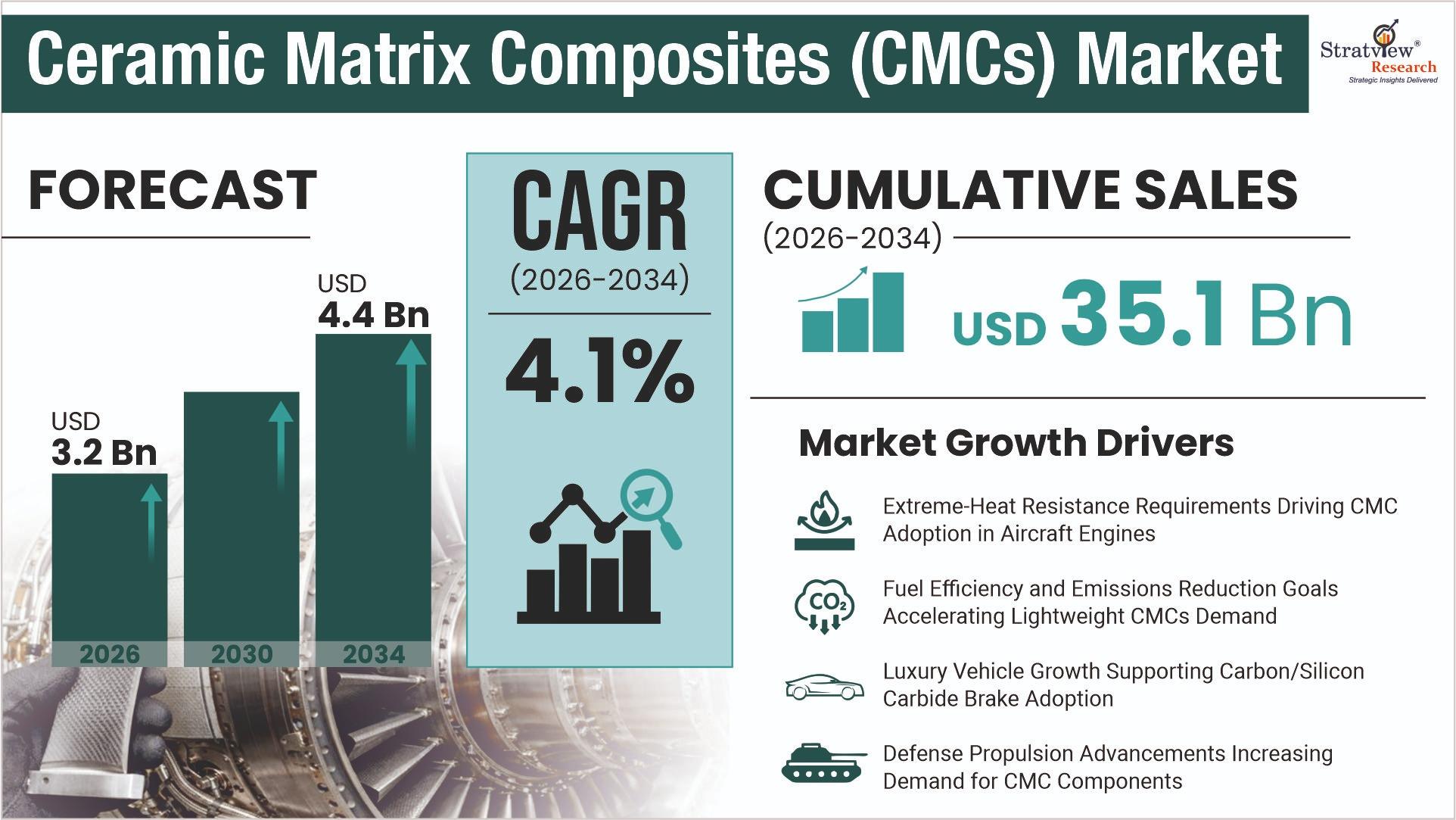
The Ceramic Matrix Composites Market was valued at USD 3.0 billion in 2025 and is expected to reach USD 4.4 billion by 2034. The market is forecast to grow at a CAGR of 4.1% during 2026–2034.
“The Ceramic Matrix Composites Market is expected to grow at a CAGR of 4.1% during 2026–2034.”
The Ceramic Matrix Composites Market growth is primarily driven by aerospace engine advancements and rising defense investments. Continuous fiber composites are gaining traction due to their structural integrity and high-temperature capabilities. At the same time, increasing applications in electrical and electronics sectors are creating additional demand layers, reinforcing the market’s long-term expansion across multiple high-performance use cases.
Market Segmentation Analysis
End-Use Industry Analysis
Aerospace & Defense, Transportation, Electrical & Electronics, Industrial, and Other Industries
Product Analysis
Oxide/Oxide (Ox/Ox), Silicon Carbide/Silicon Carbide (SiC/SiC), Carbon/Carbon (C/C), and Others
Reinforcement Analysis
Continuous Fiber Composites, Short Fiber Composites, and Other Composites
Regional Analysis
North America, Europe, Asia-Pacific, and The Rest of the World
By end-use industry, aerospace & defense is expected to remain dominant, while electrical & electronics is likely to be the fastest-growing segment. Aerospace & defense demand is supported by aircraft engines, braking systems, and structural components, where high-temperature resistance and lightweight performance are essential. The strategic implication is clear: aerospace-focused demand will remain central to market growth.
Electrical & electronics is expected to grow fastest due to rising demand for thermal management materials in semiconductors, power electronics, and high-performance devices. As miniaturization increases heat dissipation challenges, advanced ceramic matrix composites become more relevant. This creates a stronger role for CMCs in electronics-focused material strategies.
By product type, carbon/carbon (C/C) is expected to remain dominant, while SiC/SiC is likely to grow fastest. Carbon/carbon benefits from strong use in aerospace braking systems and high-temperature applications. Its thermal shock resistance and friction performance support continued adoption in demanding aerospace environments.
SiC/SiC is set to grow fastest due to adoption in next-generation aircraft engines and high-temperature turbine components. Its oxidation resistance and ability to support engine efficiency make it relevant for advanced aerospace programs.
By reinforcement type, continuous fiber composites are expected to remain dominant, while short fiber composites are likely to grow fastest. Continuous fiber composites offer strength, thermal stability, and load-bearing performance for critical aircraft engine and braking applications. Short fiber composites support lower production costs, easier processing, and scalable production for transportation, industrial, and electronics applications.
Regional Market Insights
North America is expected to maintain its leading position in the CMC market. Its leadership is supported by major aerospace OEMs, advanced manufacturing capabilities, high defense spending, and government-funded R&D. This ecosystem supports adoption in next-generation aircraft engines, propulsion technologies, and defense systems.
Asia-Pacific is anticipated to experience the fastest growth during the forecast period. Growth is driven by increasing aerospace investments, expanding industrial capabilities, and demand for advanced materials in China, Japan, and India. Government initiatives to develop domestic aerospace manufacturing further support regional demand.
Request a free sample report: https://www.stratviewresearch.com/Request-Sample/196/ceramic-matrix-composites-market.html#form
Emerging Trends Shaping the Ceramic Matrix Composites Market
The market is moving toward wider use of high-performance materials in hotter aircraft engine sections. CMCs can support higher operating temperatures than conventional metals, helping improve efficiency and durability in demanding applications.
Lightweighting remains an important market trend, especially as aerospace OEMs prioritize fuel efficiency and emissions reduction. CMCs have lower density than nickel-based alloys, helping reduce turbine component weight and improve aircraft performance.
Additive manufacturing is also opening new growth opportunities. It supports complex, customized CMC components, improves design flexibility, and may help reduce processing time and fabrication limits.
Key Growth Drivers of the Market
- Aerospace OEM demand is increasing because CMCs support aircraft engines, braking systems, and structural components that require lightweight and high-temperature performance.
- Infrastructure expansion in aerospace manufacturing strengthens demand, as engine production, defense platforms, and advanced manufacturing capabilities require durable materials.
- Emissions reduction priorities support adoption because lighter CMC components can improve fuel efficiency and reduce CO2 emissions in aircraft applications.
- The broader industry ecosystem benefits from CMC use in aerospace, transportation, electrical & electronics, industrial, and other industries, expanding the demand base.
- Additive manufacturing supports growth by enabling complex CMC components, improving design flexibility, and addressing limitations of conventional manufacturing processes.
Competitive Landscape
Top Companies in the Market
Safran S.A.
Collins Aerospace
Honeywell Aerospace Technologies
Brembo SGL Carbon Ceramic Brakes
Parker Meggitt
GE Aerospace
CoorsTek
CeramTec GmbH
Morgan Advanced Materials
Pratt & Whitney
Conclusion and Strategic Outlook
The Ceramic Matrix Composites Market is expected to grow from USD 3.0 billion in 2025 to USD 4.4 billion by 2034, at a CAGR of 4.1% during 2026–2034.
Aerospace & defense will remain the dominant end-use industry, while electrical & electronics is expected to grow fastest. North America will maintain leadership, and Asia-Pacific will record the fastest growth. The market outlook remains defined by lightweighting, thermal performance, advanced aerospace demand, and manufacturing innovation.
FAQs – Ceramic Matrix Composites Market
1. What is the forecast size of the Ceramic Matrix Composites Market?
The Ceramic Matrix Composites Market is expected to reach USD 4.4 billion by 2034. It was valued at USD 3.0 billion in 2025.
2. What is driving market growth?
Growth is driven by aerospace & defense demand, aircraft engines, braking systems, and defense platforms. Lightweighting, thermal resistance, and emissions reduction priorities also support adoption.
3. Which region leads the market?
North America is expected to maintain its leading position. The region benefits from aerospace OEMs, advanced manufacturing capabilities, defense spending, and government-funded R&D.
4. What is the investment outlook for the market?
The investment outlook is supported by demand in aerospace & defense, electrical & electronics, and additive manufacturing. The market is expected to generate a cumulative sales opportunity of USD 35.1 billion during 2026–2034.
5. What constraints could affect market growth?
High manufacturing and processing costs remain key constraints. Complex fabrication processes, expensive ceramic fibers, and multi-step densification methods can limit adoption in cost-sensitive applications.

 English
 Arabic
 French
 Portuguese
 Deutsch
 Turkish
 Dutch
Dutch
 Italiano
 Russian
 Romaian
 Portuguese (Brazil)
 Greek
Greek
