


The Generative AI Landscape in 2026: Models, Vendors, and Use Cases
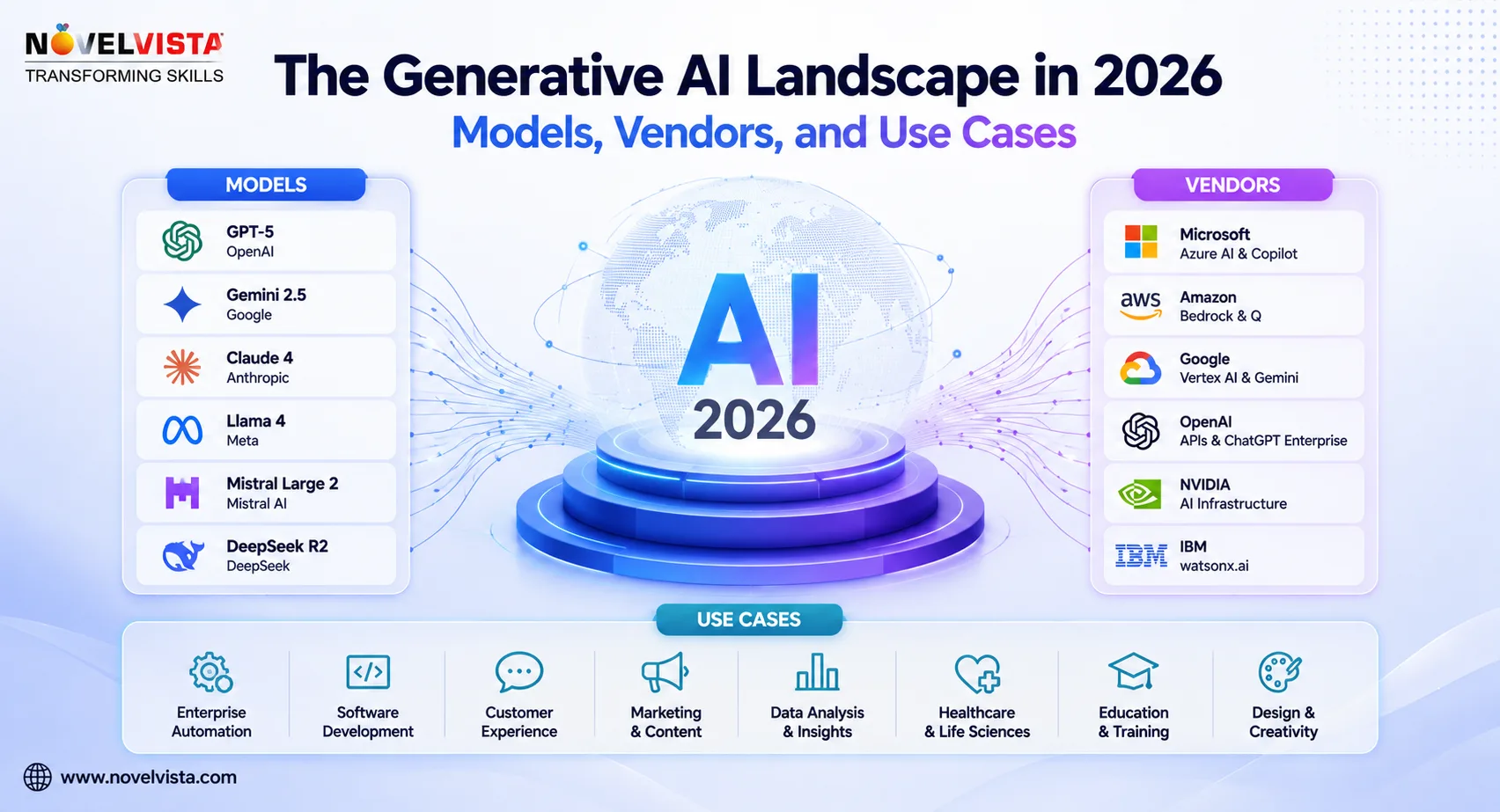
Generative AI in 2026 looks very different from the experimental chatbot market of only a few years ago. The technology has moved beyond answering questions and producing basic content. Modern AI systems can reason across large volumes of information, interpret images and documents, write and test code, operate software tools, conduct research, and complete multi-step business processes.
The market has also become more competitive. Organizations are no longer choosing between only one or two general-purpose models. They can select from proprietary frontier models, open-weight alternatives, specialized media models, smaller efficient systems, and cloud platforms offering access to multiple vendors.
As a result, the central question has changed. Businesses are no longer asking whether they should use Generative AI. They are asking which models should support each task, how those models should connect with enterprise systems, and how the resulting risks should be governed.
The Leading Model Providers
OpenAI remains one of the most influential vendors in the market. Its GPT model family is widely used for professional writing, software development, research, data analysis, multimodal understanding, and agent-based workflows. In July 2026, OpenAI introduced GPT-5.6 as its strongest model for advanced AI research and complex professional work, while also previewing GPT-5.6 Sol for demanding coding, scientific, cybersecurity, and multi-agent tasks.
Anthropic has built a strong position with Claude, particularly in coding, research, document-heavy work, and enterprise productivity. Its offering has expanded beyond conversational AI into Claude Code, workplace collaboration, scientific research, security tasks, and integrations with tools such as Microsoft 365, Slack, development environments, and web browsers.
Google’s Gemini family continues to compete through deep multimodal capabilities and integration with the broader Google ecosystem. The current Gemini portfolio includes models designed for advanced reasoning as well as faster, more economical workloads. Google describes its latest Gemini series as combining frontier intelligence with the ability to execute complex, multi-step workflows.
Meta remains important in the open-weight ecosystem. Its Llama models helped establish the market for downloadable models that organizations can customize, fine-tune, or deploy within their own infrastructure. Meta has also expanded into image, video, and media-generation models, reflecting the growing importance of AI beyond text.
Other providers, including Amazon, Microsoft, DeepSeek, Mistral, Cohere, Alibaba, Moonshot AI, and specialized startups, have made the market increasingly diverse. Competitive open-weight models are becoming particularly important for organizations seeking customization, greater deployment control, or lower inference costs.
Cloud Platforms Are Becoming Model Marketplaces
For many enterprises, the model provider is only one part of the decision. Cloud platforms increasingly act as control layers through which organizations access, compare, secure, and manage models from multiple vendors.
Amazon Bedrock now supports more than 100 foundation models from providers including Amazon, Anthropic, DeepSeek, Moonshot AI, MiniMax, OpenAI, and others. It also provides tools for security controls, agents, model access, lifecycle management, and integration with business systems.
Microsoft has positioned Copilot and its AI development platforms around workplace productivity and business agents. Microsoft 365 Copilot can assist with communication, search, content creation, workplace data, and multi-step tasks, while Copilot Studio allows organizations to build agents and workflows using generative AI.
This multi-model approach is encouraging organizations to become model-agnostic. Instead of relying on one model for every workload, companies can route simple requests to low-cost models and reserve advanced reasoning systems for complex tasks.
Major Enterprise Use Cases
Content generation remains common, but it is no longer the most strategically important use case. Organizations now use generative AI for summarizing documents, preparing proposals, drafting policies, producing training materials, and adapting communication for different audiences.
Software development is another major area. AI coding assistants can explain legacy systems, generate tests, review code, identify defects, document applications, and support migration projects. More advanced coding agents can work across repositories and complete tasks that previously required repeated human prompting.
Customer service has moved from simple FAQ chatbots toward intelligent service agents. These systems can retrieve customer information, summarize previous conversations, recommend resolutions, and complete approved actions. Microsoft has reported large-scale deployments in which generative AI agents handled millions of customer interactions, showing that the technology has moved beyond small pilots.
Generative AI is also being applied to research, financial analysis, cybersecurity, sales enablement, HR support, supply-chain planning, compliance reviews, and enterprise search. Retrieval-augmented generation allows systems to answer questions using internal documents, while agent frameworks allow them to interact with APIs, databases, applications, and workflows.
The Shift from Assistants to Agents
The defining trend of 2026 is the transition from AI assistants to AI agents.
An assistant responds to a request. An agent can plan a task, select tools, retrieve information, execute actions, evaluate results, and continue until an objective is completed. Amazon Bedrock Agents, Microsoft Copilot Studio, Claude’s development tools, Gemini’s workflow capabilities, and OpenAI’s agentic models all reflect this direction.
However, greater autonomy also creates greater risk. Organizations must address hallucinations, confidential-data exposure, prompt injection, unauthorized actions, vendor dependency, regulatory requirements, and unpredictable operating costs.
The generative AI landscape in 2026 is therefore not defined by a single winning model. It is defined by ecosystems, model choice, enterprise integration, agents, governance, and the ability to match the right level of intelligence to the right business problem. The organizations that gain the most value will not simply adopt the newest model. They will build flexible AI architectures that can evolve as the market continues to change.

 English
 Arabic
 French
 Spanish
 Portuguese
 Deutsch
 Turkish
 Dutch
Dutch
 Italiano
 Romaian
 Portuguese (Brazil)
 Greek
Greek
