


10 Prompt Engineering Frameworks You Can Reuse at Work
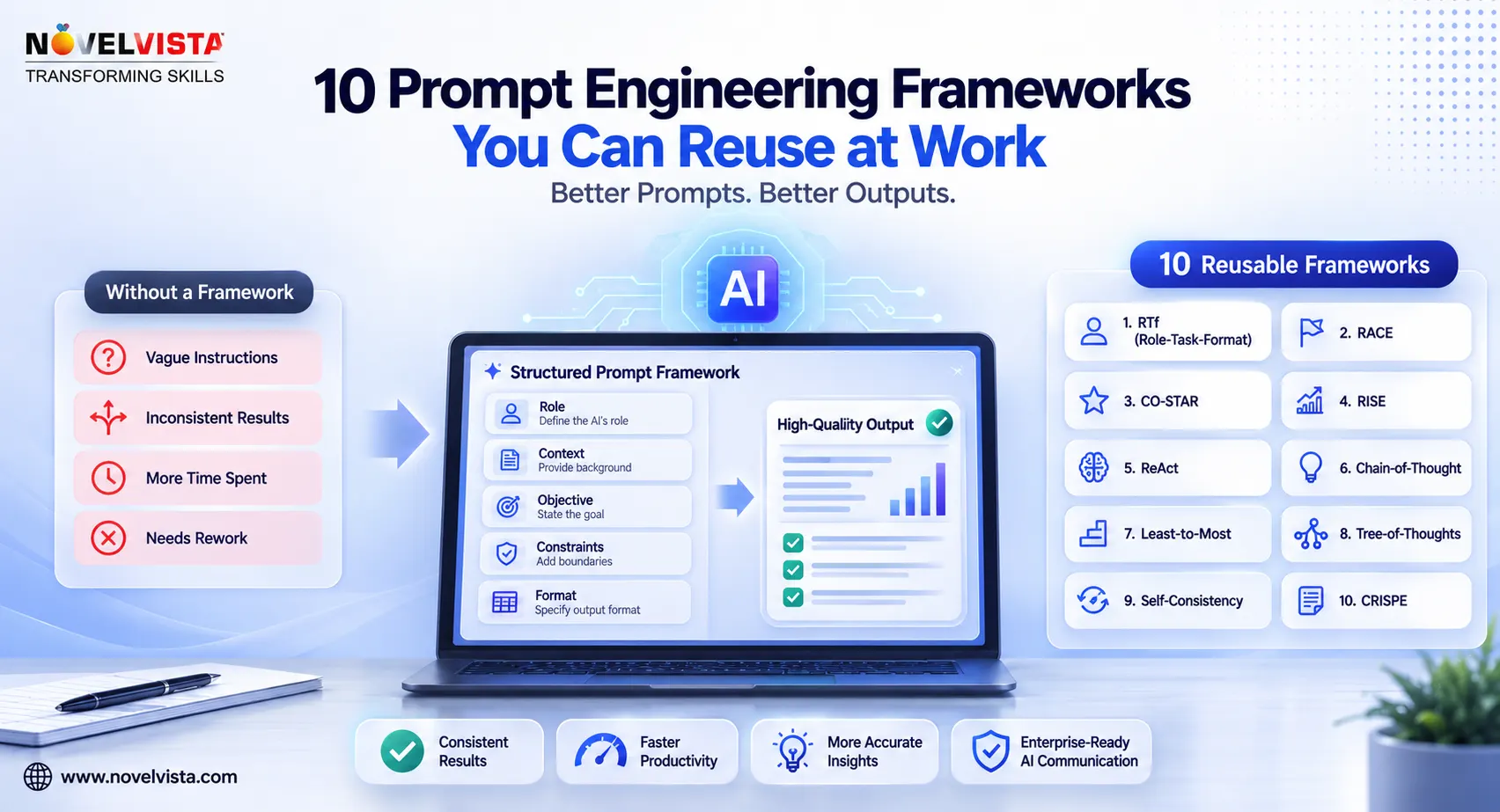
Generative AI tools can draft emails, summarize reports, analyse information, generate ideas, and support complex business decisions. However, the quality of their output depends heavily on the instructions they receive.
A vague Prompt Engineering such as “write a report” gives the AI too much room to guess. A structured prompt explains the objective, context, audience, constraints, and expected output. Prompt engineering frameworks make this process easier by providing reusable structures for common workplace tasks.
Here are ten practical prompt engineering frameworks that professionals can apply across communication, research, analysis, planning, and problem-solving.
1. Role–Task–Context–Format
This is one of the simplest and most versatile frameworks.
Start by assigning the AI a role, describe the task, provide relevant context, and specify the required format.
Example:
“Act as a project manager. Review the following project update and identify delays, dependencies, and risks. The project is scheduled to launch next month. Present the response as a table with risk, impact, owner, and recommended action.”
This framework works well for reports, assessments, business plans, and professional communication.
2. Context–Objective–Style–Tone–Audience
This framework is useful when creating content for a specific group of readers.
Provide background information, define the objective, describe the writing style and tone, and identify the audience.
Example:
“Our company is introducing a new remote-work policy. Write an announcement explaining the policy and its benefits. Use a clear, supportive, and professional tone for all employees.”
Defining the audience prevents the AI from producing content that is too technical, informal, or disconnected from the reader’s needs.
3. Before–After–Bridge
The Before–After–Bridge framework is commonly used in marketing and change communication.
“Before” describes the current problem. “After” explains the desired outcome. “Bridge” shows how to move from the current state to the improved state.
Example:
“Describe the challenges employees face when manually processing invoices. Explain the improved experience after automation. Then show how an AI-powered invoice system creates that transition.”
This approach is effective for proposals, presentations, sales emails, and transformation initiatives.
4. Problem–Impact–Solution–Action
This framework helps create persuasive and decision-oriented communication.
Define the problem, explain its business impact, recommend a solution, and specify the next action.
Example:
“Explain the problem caused by delayed software patching, its impact on cybersecurity and compliance, the recommended remediation approach, and the immediate actions the IT team should take.”
It is particularly useful for escalation emails, management reports, risk assessments, and operational recommendations.
5. Situation–Task–Action–Result
The Situation–Task–Action–Result, or STAR, framework is widely used in interviews and performance reviews.
Describe the situation, clarify the responsibility, explain the actions taken, and present the outcome.
Example:
“Turn the following notes into a STAR-format interview answer. Emphasise leadership, stakeholder communication, and measurable improvements.”
This structure can also help employees document achievements, prepare case studies, or write project success stories.
6. Goal–Constraints–Inputs–Output
This framework works well when the task has clear business or technical requirements.
State the desired goal, define limitations, provide the available information, and describe the expected result.
Example:
“Create a three-week onboarding plan for a new cloud engineer. Limit training to two hours per day. Include AWS fundamentals, security practices, internal tools, and practical assignments. Present the result as a weekly schedule.”
Constraints help prevent unrealistic, overly broad, or unusable responses.
7. Explain–Compare–Recommend
Use this framework when evaluating technologies, products, strategies, or business options.
Ask the AI to explain each option, compare them using relevant criteria, and provide a recommendation based on the situation.
Example:
“Explain the differences between public, private, and hybrid cloud models. Compare them based on cost, scalability, security, and management complexity. Recommend the best option for a regulated financial organisation.”
The recommendation should always be connected to defined requirements rather than treated as a universal answer.
8. Question–Evidence–Analysis–Conclusion
This framework is useful for research, audits, policy reviews, and structured decision-making.
Begin with a clear question, provide supporting evidence, request analysis, and ask for a conclusion.
Example:
“Should the organisation introduce mandatory multifactor authentication for all external applications? Review the provided incident data, analyse the security and usability implications, and provide a justified conclusion.”
This encourages the AI to show the reasoning behind its recommendation instead of presenting an unsupported answer.
9. Critique–Improve–Verify
AI should not only create content; it can also improve existing work.
Ask it to critique the material, suggest improvements, produce a revised version, and verify that the final result meets specific requirements.
Example:
“Review this customer support response for clarity, empathy, and professionalism. Identify weaknesses, rewrite the response, and verify that it includes an apology, resolution, and next step.”
This framework is especially valuable for quality assurance, editing, code review, and document improvement.
10. Plan–Execute–Review
This framework is suitable for complex tasks that should be completed in stages.
First ask the AI to create a plan, then complete the task, and finally review the output for errors or missing information.
Example:
“Plan a migration from an on-premises application to the cloud. Then create the migration roadmap. Finally, review the roadmap for security, downtime, cost, and rollback risks.”
Breaking a complex request into stages often produces a more organised and reliable response.
Making These Frameworks Work
Prompt frameworks are starting points, not rigid formulas. They can be combined, shortened, or expanded depending on the task.
The most effective workplace prompts clearly define the goal, include necessary background, identify the audience, establish boundaries, and describe the expected output. Sensitive or high-impact results should still be verified by a qualified person.
Prompt engineering is ultimately about reducing ambiguity. When professionals provide clearer instructions, AI becomes less of a guessing tool and more of a practical workplace assistant.

 English
 Arabic
 French
 Spanish
 Portuguese
 Deutsch
 Turkish
 Dutch
Dutch
 Russian
 Romaian
 Portuguese (Brazil)
 Greek
Greek
