


AI Risk Assessment: A Practical Framework for Organizations
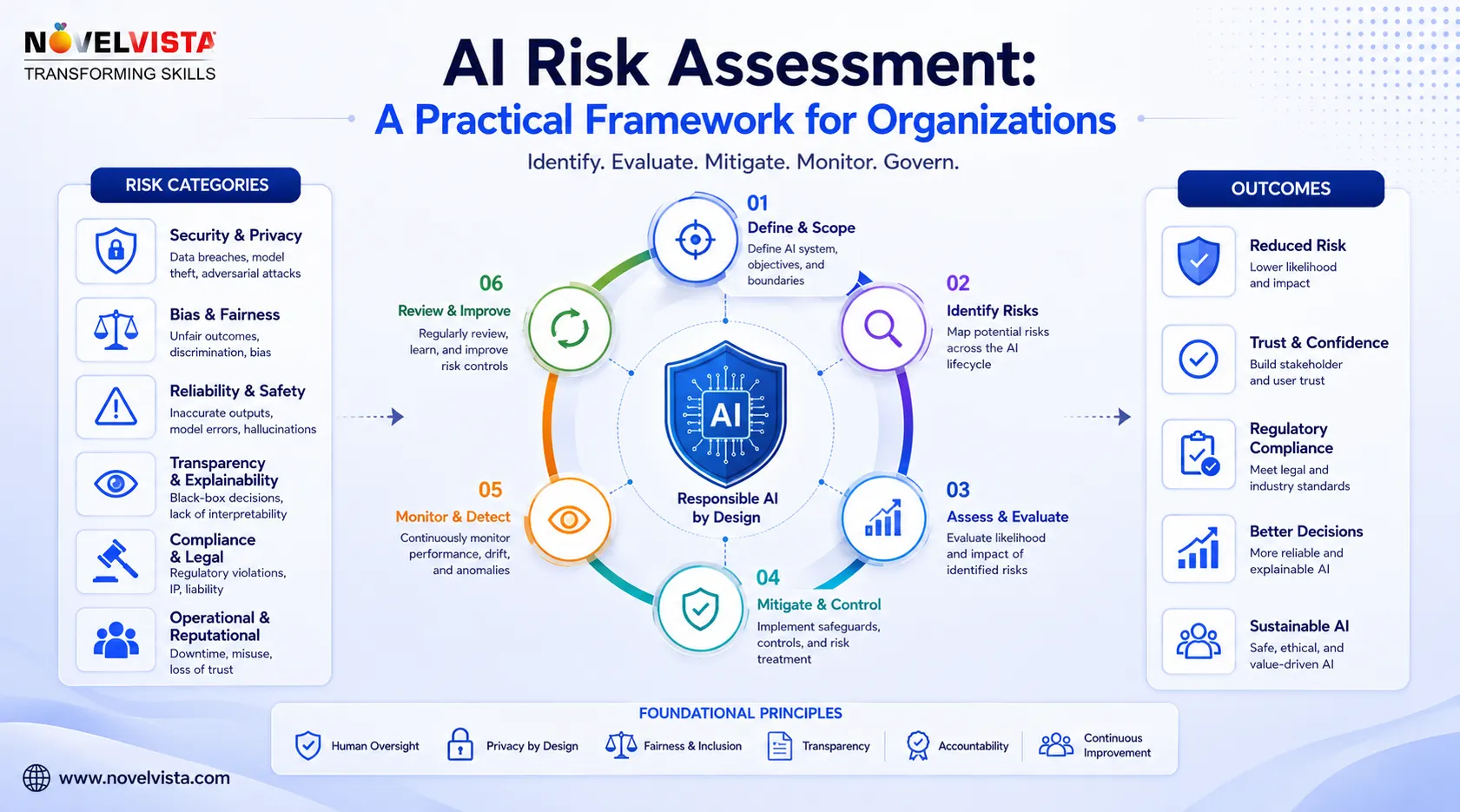
Artificial intelligence is moving rapidly from experimentation into everyday business operations. Organizations now use AI to automate customer service, screen job applicants, detect fraud, forecast demand, generate content, support medical decisions, and improve internal productivity.
These systems can create significant value, but they also introduce new risks. An AI model may produce incorrect information, expose confidential data, reinforce bias, make decisions that are difficult to explain, or behave differently when real-world conditions change.
This is why organizations need a structured AI risk assessment process. The goal is not to stop AI adoption. It is to understand where risks exist, determine how serious they are, and put appropriate controls in place before those risks cause harm.
Start by Defining the AI Use Case
Every AI risk assessment should begin with a clear description of the system and its intended purpose.
Organizations should document what the AI system does, who uses it, what decisions it supports, and which business processes depend on it. They should also identify whether the system is customer-facing, employee-facing, or limited to internal experimentation.
A chatbot that summarizes meeting notes has a different risk profile from an AI system that approves loans or recommends medical treatment. The greater the impact of the decision, the stronger the Ai Governance and controls should be.
The assessment should also define what the AI system is not allowed to do. Establishing boundaries reduces the likelihood of the system being used outside its approved purpose.
Identify Data-Related Risks
AI systems depend heavily on data. Poor-quality, incomplete, biased, outdated, or unauthorized data can lead to unreliable outputs.
Organizations should review where the data comes from, how it is collected, who owns it, and whether the organization has permission to use it. Sensitive information such as personal data, financial records, health information, intellectual property, and confidential business documents requires additional protection.
The assessment should examine whether confidential data could be exposed through model outputs, logs, integrations, or training processes. It should also evaluate whether the data represents all relevant user groups fairly.
Data quality controls, access restrictions, retention policies, masking, encryption, and human review can help reduce these risks.
Evaluate Model Performance and Reliability
An AI system may perform well during testing but fail when exposed to unusual inputs or changing conditions.
Organizations should measure accuracy, consistency, error rates, and performance across different user groups and scenarios. For generative AI systems, testing should include hallucinations, misleading responses, unsupported claims, prompt injection, and inappropriate content.
It is also important to identify the consequences of an incorrect result. If an AI-generated recommendation is wrong, can a user easily detect and correct it? Or could the mistake lead to financial loss, legal exposure, safety concerns, or reputational damage?
High-impact systems should include fallback procedures, human approval, and clear escalation paths.
Assess Fairness and Bias
AI systems can unintentionally disadvantage individuals or groups if their training data reflects historical inequalities or incomplete representation.
A practical risk assessment should test whether outcomes differ based on characteristics such as age, gender, location, disability, or socioeconomic background. The analysis should focus not only on overall accuracy but also on how the system performs for different groups.
Where automated decisions affect employment, credit, insurance, education, or access to services, fairness testing becomes especially important.
Organizations should document identified biases, corrective actions, acceptable thresholds, and any limitations that cannot be completely removed.
Review Security Threats
AI systems introduce security risks that may not exist in traditional applications.
Attackers may attempt to manipulate model inputs, poison training or retrieval data, steal sensitive prompts, extract confidential information, or exploit connected tools and APIs. Generative AI systems may also be vulnerable to prompt injection, where malicious instructions cause the system to ignore approved rules.
Security teams should assess the entire AI lifecycle, including data collection, model development, deployment, integrations, monitoring, and retirement.
Controls may include input filtering, output validation, identity management, network restrictions, encryption, secure API access, model testing, and continuous threat monitoring.
Consider Legal and Regulatory Obligations
Organizations must identify the laws, regulations, contracts, and industry standards that apply to the AI system.
Requirements may relate to privacy, consumer protection, discrimination, intellectual property, cybersecurity, record retention, or automated decision-making.
The assessment should determine whether users need to be informed that they are interacting with AI, whether consent is required, and whether the organization must explain how a decision was reached.
Legal and compliance teams should be involved early, especially when AI systems process personal data or influence high-impact decisions.
Define Risk Ratings and Controls
Once risks have been identified, they should be rated based on likelihood and impact. A simple classification such as low, medium, high, and critical can help organizations prioritize action.
Each risk should have an assigned owner, mitigation plan, target date, and monitoring requirement. High and critical risks should require formal approval before deployment.
Risk controls may include human oversight, restricted access, independent testing, user warnings, output verification, audit logging, and periodic reassessment.
Monitor Risks After Deployment
AI risk assessment should not end when the system goes live. Models, data, regulations, and user behavior can change over time.
Organizations should monitor performance, complaints, unusual outputs, security alerts, and changes in data quality. Significant updates to the model, use case, or data source should trigger a new assessment.
A practical AI risk framework combines governance, technical testing, legal review, security controls, and ongoing monitoring. By treating AI risk management as a continuous process, organizations can adopt AI confidently while protecting customers, employees, and business operations.

 English
 Arabic
 French
 Spanish
 Portuguese
 Deutsch
 Turkish
 Dutch
Dutch
 Italiano
 Russian
 Portuguese (Brazil)
 Greek
Greek
