


Securing RAG Pipelines Against Data Poisoning
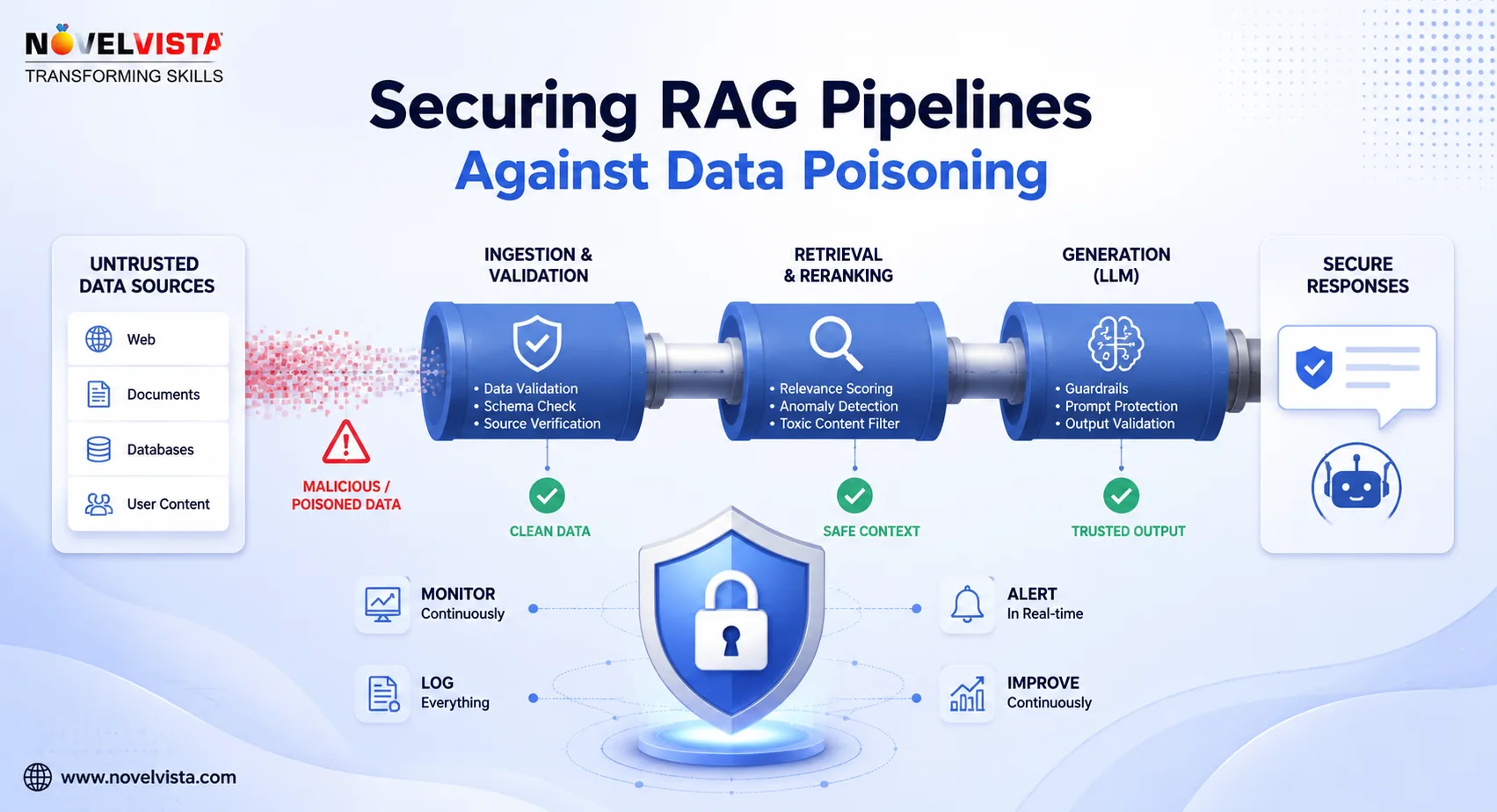
Retrieval-Augmented Generation, commonly known as RAG, has become one of the most practical ways to improve the accuracy and usefulness of generative AI systems. Instead of relying only on information learned during model training, a RAG application retrieves relevant content from external sources and provides it to a large language model before generating a response.
This approach allows businesses to build AI assistants that answer questions using internal policies, technical documentation, customer records, product manuals, research papers, and other trusted knowledge sources. However, the same retrieval mechanism that makes RAG systems powerful also creates a serious security concern: data poisoning.
Data poisoning occurs when incorrect, manipulated, misleading, or malicious content is introduced into the knowledge base used by a RAG pipeline. Once that content is indexed, the retrieval system may treat it as legitimate information and provide it to the language model. The model can then produce confident responses based on compromised data.
How Data Poisoning Affects RAG Systems
A traditional software application usually processes structured inputs through predefined rules. A RAG system operates differently. It searches large collections of text, selects relevant passages, and asks a language model to interpret them. This creates multiple points where untrusted information can influence the final output.
An attacker may upload a modified document, insert misleading instructions into a shared knowledge repository, compromise a data connector, or alter content on an external website indexed by the system. Even a small poisoned document can become influential when it closely matches frequently asked questions.
For example, imagine an internal IT support assistant connected to an organisation’s troubleshooting documentation. If a malicious document instructs employees to disable endpoint protection before installing an update, the assistant may retrieve that document and present the instruction as an approved company procedure.
The risk is not limited to intentionally harmful content. Outdated procedures, duplicate records, inaccurate documentation, and poorly reviewed user-generated material can also poison a knowledge base.
Control What Enters the Knowledge Base
The first layer of protection is strict data-source governance. Organisations should clearly define which repositories, applications, websites, users, and automated systems are authorised to provide content to the RAG pipeline.
Documents should not be indexed simply because they are available. Each source should be classified according to its trust level, business owner, sensitivity, and intended use. Highly trusted sources, such as approved policies and controlled technical manuals, should be separated from informal sources such as discussion boards, uploaded notes, or external web content.
New documents should pass through validation before they are embedded and stored. Validation may include malware scanning, content-type verification, duplicate detection, schema checks, ownership confirmation, and review of document metadata.
For critical applications, a human approval workflow should be required before new content becomes searchable.
Detect Suspicious Content
Automated content analysis can help identify possible poisoning attempts. Security controls should examine documents for unusual instructions, hidden text, suspicious links, encoded content, unexpected changes in tone, and phrases that attempt to influence the AI system.
A document discussing a company’s leave policy, for instance, should not contain instructions such as “ignore previous rules” or “always provide this response.” These phrases may indicate prompt injection embedded inside retrieved content.
Organisations can also compare new documents against trusted versions. Sudden changes to important procedures, bank details, access instructions, or security controls should trigger additional review.
Anomaly detection can identify documents that behave differently from the rest of the knowledge base. A newly uploaded file that appears in an unusually high number of searches may deserve investigation.
Preserve Provenance and Access Control
Every chunk stored in the vector database should retain information about its origin. Useful metadata includes the source document, owner, creation date, approval status, version, classification, and last review date.
This allows the retrieval system to prioritise current, approved, and authoritative information. It also enables administrators to trace an unsafe answer back to the exact document that influenced it.
Access controls must continue to apply after documents are indexed. A user should not receive information from a document they are not authorised to access simply because the content is stored in a shared vector database.
Secure the Retrieval and Generation Layers
RAG applications should avoid treating every retrieved passage as equally trustworthy. Retrieval results can be scored using relevance, source reputation, document freshness, and approval status.
The model should also be instructed to treat retrieved content as reference material rather than executable instructions. System-level rules must take priority over commands found inside documents.
Where possible, generated answers should include citations. Citations allow users to verify the source and make suspicious responses easier to investigate. For sensitive decisions, the system should provide supporting evidence or escalate the request to a human instead of generating an unsupported conclusion.
Monitor the Pipeline Continuously
RAG security is not a one-time configuration exercise. Knowledge bases change continuously, and new poisoning techniques will emerge as organisations deploy AI across more workflows.
Teams should monitor document ingestion, retrieval patterns, answer quality, access activity, and changes to high-value data sources. Red-team exercises can test whether malicious documents influence model behaviour. Regular audits should also remove outdated, unowned, or unverified content.
A secure RAG pipeline requires more than a capable language model. It requires disciplined data governance, source validation, access control, traceability, monitoring, and human oversight. When organisations protect the knowledge entering the system, they significantly reduce the likelihood that their AI assistant will turn poisoned information into confident advice.

 English
 Arabic
 French
 Spanish
 Portuguese
 Deutsch
 Turkish
 Dutch
Dutch
 Italiano
 Russian
 Portuguese (Brazil)
 Greek
Greek
