


The Rise of the Boutique All-Inclusive Diving Hotel in the Maldives
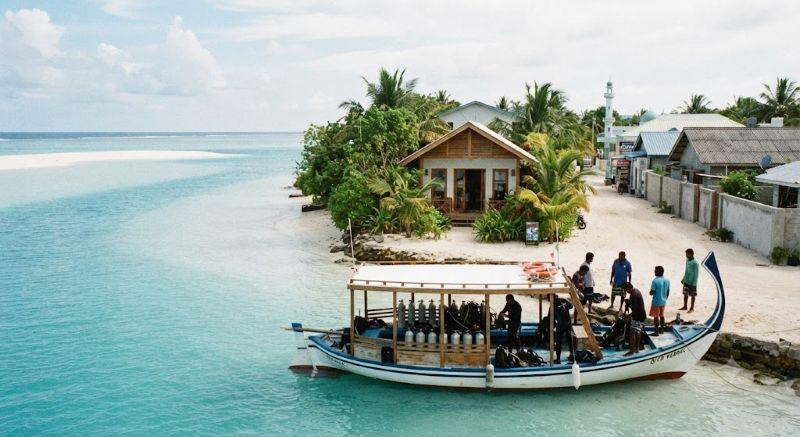
The Maldives most people picture is a single villa on a private island, reached by seaplane, with nobody else in sight. That image is real, and it sold the country to the world. But the most interesting thing to happen to Maldives diving in the past decade didn't happen on those private islands at all. It happened on the inhabited ones, the islands where Maldivians actually live, and where, until fairly recently, a visiting diver wasn't allowed to spend the night.
That changed in 2012, when the government first permitted guesthouses on local islands. A rule most travellers have never heard of quietly opened a door, and a new kind of property walked through it: the small, dive-focused, all-inclusive hotel, built on a working island by people who came to the Maldives to dive and stayed.
A country that used to keep its islands separate
For decades the Maldives ran on one model: one island, one resort. A guest flew in, transferred to a private island and stayed inside it. The local islands, with their own shops, schools and mosques, sat off the tourist map by design.
The 2012 change rewrote that. Guesthouses and small hotels could now open where Maldivians lived, and a handful of divers who had been visiting for years started to build. The people opening them had usually spent years as repeat guests before they broke ground, and they wanted to stay closer to the water than a resort let them. Boutique Beach on Dhigurah, in South Ari Atoll, is a clean example of the timeline. Construction began in August 2014. The first guest arrived in June 2015, greeted with a fresh young coconut. The atoll around it is the only one in the Maldives where whale sharks and manta rays are found year-round, across more than 50 dive sites, and it contains the country's largest marine protected area. What grew there was something the resort model had never really offered a diver.
The trade-off divers used to accept
Anyone who has planned a Maldives dive trip knows the old fork in the road: resort or liveaboard.
A liveaboard is the serious diver's default for good reason. You sleep on the boat, wake up over the reef and dive three or four times a day across sites a day-boat can't reach, including the remote atolls. The per-dive cost often works out lower too. The catch is everything that comes with living on a boat for a week: the motion, the tight cabins and the fact that it suits confident divers far more than nervous ones or families.
A resort answers the comfort and the stability. You get a real bed, a house reef and no seasickness. What resorts historically didn't give the diver was focus, or a bill that still made sense once the diving was added on.
The boutique all-inclusive dive hotel is what closed that gap. Boutique Beach describes itself, plainly, as being run rather like a liveaboard but on land. That is the category: the daily dive rhythm and the tight dive crew of a liveaboard, paired with a real bed, a hot shower and solid ground. For the diver who wants maximum remote sites and doesn't mind the boat, a liveaboard is still the better tool. Plenty of experienced divers still do both, using a comfortable land base to settle in before a week aboard. For most other divers, the land-based version now competes for the same trip.
What "all-inclusive" means when a diver runs the numbers
The word all-inclusive does a lot of work in the Maldives, because the standard Maldives dive holiday is priced in pieces.
At most properties, the diving is billed separately from the room. A single dive at a luxury resort typically runs US$65 to US$120, and guesthouses land lower, at around US$40 to US$58. Renting gear adds roughly US$20 to US$40 each time you get in the water. A service charge of 10 to 16 per cent lands on top, the government's green tax adds US$12 per person per night, and marine park fees run US$6 to US$15 a trip. None of it is hidden, exactly. It sits outside the headline number.
The boutique all-inclusive model answers that by folding the diving, the meals, the soft drinks and the boat into one all-inclusive rate, with GST and the service charge already inside it. At Boutique Beach that covers two or three dives a day for certified divers. It stays honest about what sits outside the package, too: equipment hire, Nitrox fills, PADI courses and the airport transfer are charged on their own. When the diving is already paid for, the daily maths disappears, and you get in the water because the conditions are good, with no fee ticking over in the back of your mind.
These hotels can price this way because the operator is usually a diver who runs the place personally. Boutique Beach puts the idea on its own front page: designed and managed by divers, for divers. The people costing the trip are the people running it. It's a PADI 5 Star centre with 6 instructors and 13 rooms, and it caps dive groups at 4 or 5 to an instructor. That scale is the whole point of the word boutique. It's small enough that the person who set the dive plan is often the person who greets you at breakfast.
Why the local island is the point, not the compromise
The easy assumption is that a working island is the price you pay to dive more cheaply. Spend a few days on one and the logic runs the other way.
A local island comes with a life already running through it. Dhigurah has around 630 residents, two schools and a medical centre, and a hotel built into that setting ends up part of it. Boutique Beach sponsors school prizes and local sports teams. The island itself takes part in Parley for the Oceans, a marine-plastic programme that collects beach and ocean plastic and has it turned into the raw material for Adidas Ultraboost running shoes. The bottle a guest drops on the sand can end up on someone's feet in a marathon. That loop is the island's, not the hotel's, and a sealed resort island has no community life running through it for a hotel to join.
The money tends to stay local, too. When Boutique Beach needed its own dive boat, the captain travelled north to Raa Atoll to buy a wooden hull, the build happened on Dhigurah, and the whole thing was funded by a local family in exchange for rent paid out over 20 years. There's an honest cost to the model as well. Dhigurah is a Muslim island, so no alcohol is served, and guests who want a drink take a short boat trip to a nearby resort. The boutique dive hotel doesn't pretend the trade-offs away. It bets that most divers will take a working island and a straight bill over a minibar.
What the category actually signals
It's tempting to read the boutique all-inclusive dive hotel as a marketing label bolted onto a small resort. What it actually reflects is the possibility the 2012 rule created. For the first time, a person could come to the Maldives as a diver, learn one atoll's reefs over years and build for other divers the exact trip they'd have chosen for themselves.
Strip away the branding and what's left is simple enough. It's the liveaboard's discipline, its daily dive rhythm and its small crew who know the sites, brought ashore and given an address on a real island. The rise isn't really about hotels getting smaller. It's about who's doing the building.

 Arabic
 French
 Spanish
 Portuguese
 Deutsch
 Turkish
 Dutch
Dutch
 Italiano
 Russian
 Romaian
 Portuguese (Brazil)
 Greek
Greek
