


Dips and Spreads Market to Cross USD 188.33 Billion by 2036
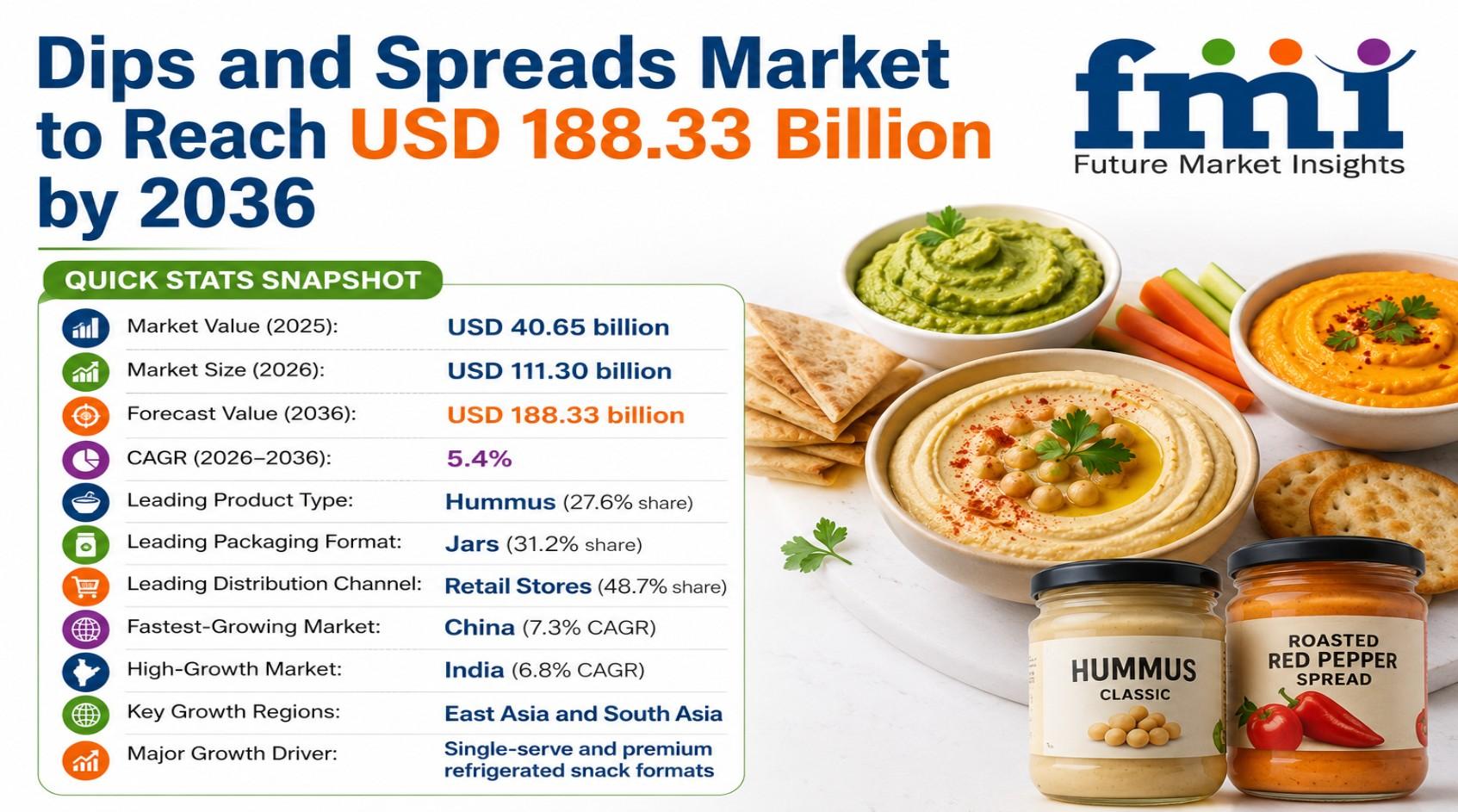
The global dips and spreads market is undergoing a significant value migration, according to latest insights by future market insights. Moving beyond traditional commoditized, shelf-stable glass jars, this category is establishing itself as a premier refrigerated destination driven by clean-label reformulations and format innovations. The global industry, which is valued at USD 105.60 billion in 2025, is projected to reach USD 111.30 billion in 2026. Expanding at a steady Compound Annual Growth Rate (CAGR) of 5.4% over the ten-year forecast period, the market is anticipated to cross a total valuation of USD 188.33 Billion by 2036, yielding an absolute incremental opportunity of USD 77.03 billion.
Request a Sample Report: https://www.futuremarketinsights.com/reports/sample/rep-gb-22852
Market Performance Overview (2026–2036)
To understand the core varietal configurations and transactional pathways guiding this USD 77.03 billion market scale-up, a detailed segment share analysis highlights where commercial volume is concentrated:
- Retail Stores Channel (48.7% share): Commands the distribution network in 2026, highlighting the continued importance of supermarkets and hypermarkets in capturing consumer volume through prominent cold-case displays and impulse promotions.
- Jars Packaging Format (31.2% share): Maintains the leading position in packaging by volume, favored for ambient lines and premium gourmet collections due to its resealability and product visibility. However, high-speed single-serve packets represent the fastest value growth.
- Hummus Product Type (27.6% share): Leads the product category, driven heavily by its positioning as a healthy, protein-rich plant alternative that aligns with clean-label requirements and Mediterranean dietary trends.
Technical Drivers and Sourcing Catalysts
The rapid transition of the global dips and spreads sector into functional snacking matrices is propelled by distinct industrial and retail catalysts:
Single-Serve Format Migration Economics
A critical mechanism rewriting the margin architecture of the market is the shift toward pre-portioned, single-serve dip packs paired with crackers or breadsticks. While a standard multi-use 200g jar and a 50g snack pack often share similar processing equipment, the snack pack delivers three to four times the revenue per kilogram at retail, optimizing square footage margins in functional cooler spaces.
Plant-Based Protein Positioning
Health-conscious consumers are prioritizing nutrient-dense, legume- and bean-based bases over empty-calorie condiments. This demand forces manufacturers to refine clean-label formulations such as chickpea-heavy hummus, fresh guacamole, and dairy-free spreads positioning them as clean, protein-forward snacks that justify premium price structures.
Cold-Chain Retail Expansion Moats
Major grocery chains across the United States, Germany, and the United Kingdom are expanding their perimeter refrigerated sections. Retailers increasingly favor fresh, temperature-controlled dips over ambient alternatives, establishing advanced cold-chain distribution capabilities as a critical gatekeeper for core brand shelf listings.
Industrial Infrastructure Challenges
Global processing facilities and corporate supply chain directors must successfully coordinate to overcome technical limitations:
- High-Speed Capital Project Demands: Transitioning lines to accommodate multi-compartment single-serve packaging requires immense upfront capital investments in automated filling and sealing hardware, straining smaller regional processors.
- Perishable Raw Material Volatility: Sourcing fresh, natural agricultural inputs like avocados for guacamole or fresh herbs exposes converters to sudden crop failures and trade supply shocks, demanding rigid multi-year agreements with certified producers.
Regional Growth Outlook
The geographic analysis showcases monumental growth velocity across expanding Asian snack cultures alongside steady premiumization within classic Western markets:
- China (7.3% CAGR): The global growth frontrunner, driven by rapid urbanization, expanding middle-class consumption, and an escalating consumer willingness to adopt Western-style packaged snack lines.
- India (6.8% CAGR): Spurring rapid development via expanding modern retail outlets, higher disposable incomes, and local optimization of value-added legume-based condiments.
- Germany (6.2% CAGR): Leading Western European expansion, driven by intense consumer demands for organic, natural ingredients and clean-label compliance profiles.
- France (5.7% CAGR): Propelled by a strong retail infrastructure and sophisticated consumer palates that favor gourmet, small-batch artisanal small packs.
- United Kingdom (5.1% CAGR): Driven by an established eco-friendly consumer demographic that prioritizes sustainable packaging and functional plant alternatives.
- United States (4.3% CAGR): Sourcing a dominant baseline volume footprint globally, where brand differentiation relies on functional innovations like dual-dip compartments and clean-label allergen-free matrices.
Competitive Landscape
The global dips and spreads environment features a highly integrated upper tier of multinational food groups alongside specialized regional processors. Scale-driven volume distribution, multi-channel brand portfolios, and comprehensive snack ecosystem integration are led by market titans including The Kraft Heinz Company, Nestlé S.A., Conagra Brands Inc., Hormel Foods Corporation, General Mills, Inc., and PepsiCo, Inc.
Specialized market innovation, plant-based processing superiority, and small-batch premiumization are driven by leading operators such as Sabra Dipping Company LLC (now fully integrated under PepsiCo), Cedar’s Mediterranean, Lantmannen Unibake, Grupo Bimbo, Armanino Foods, Cucina Fresca Gourmet, Stonewall Kitchen, Lancaster Colony Corp., and Amy’s Kitchen, Inc. To protect shelf allocations against rapid private-label expansions, leading global manufacturers are aggressively prioritizing investments in direct-to-retail promotional sampling and organic certifications.
Full Report for Detailed Insights: https://www.futuremarketinsights.com/reports/dips-and-spreads-market
Frequently Asked Questions
What is the projected valuation of the global market by 2036?
The global dips and spreads market is projected to reach USD 188.33 billion by 2036, expanding upward from an estimated baseline valuation of USD 111.30 billion in 2026 at a CAGR of 5.4%.
Why does the Hummus segment command a 27.6% market share?
Hummus matrices inherently leverage the clean-label legume profile of chickpeas, tahini, and olive oil, delivering complete, plant-based protein payloads that fit directly into daily healthy snacking routines.
What exclusions govern the boundaries of this market report?
The analytical scope strictly focuses on semi-solid or viscous dips and spreads, explicitly excluding standalone unblended condiments (such as standard ketchup or plain mayonnaise), nut-based butters (peanut or almond butter), and foodservice-only bulk dressings not packaged for retail.
FMI Custom Research: Strategic Intelligence for Confident Decision-Making
In today's rapidly evolving business environment, leadership teams need more than market data they need clear, actionable intelligence tailored to their strategic objectives. FMI's Custom Research solutions are designed around the specific business questions organizations need answered, enabling executives to evaluate growth opportunities, validate investments, assess competitive dynamics.
Key Executive Benefits
· Decision-Ready Insights tailored to business priorities
· Reduced Strategic Risk through validated market intelligence
· Market Entry Confidence with detailed competitive analysis
· Competitive Advantage supported by proprietary research
· Faster Growth Decisions through customized strategic insights
· Primary Market Validation from industry stakeholders
· Global Industry Expertise across diverse sectors
· Proven Track Record with thousands of consulting engagements
Business Impact
FMI helps organizations transform market complexity into strategic clarity, enabling leadership teams to identify growth opportunities faster, optimize resource allocation, strengthen competitive positioning, and make high-stakes business decisions with confidence.
To explore how FMI Custom Research can support your strategic priorities, please connect with our team at - sales@futuremarketinsights.com

 English
 Arabic
 French
 Spanish
 Portuguese
 Deutsch
 Turkish
 Dutch
Dutch
 Italiano
 Russian
 Romaian
 Greek
Greek
