


Building Your First AI Agent: A Step-by-Step Framework Overview
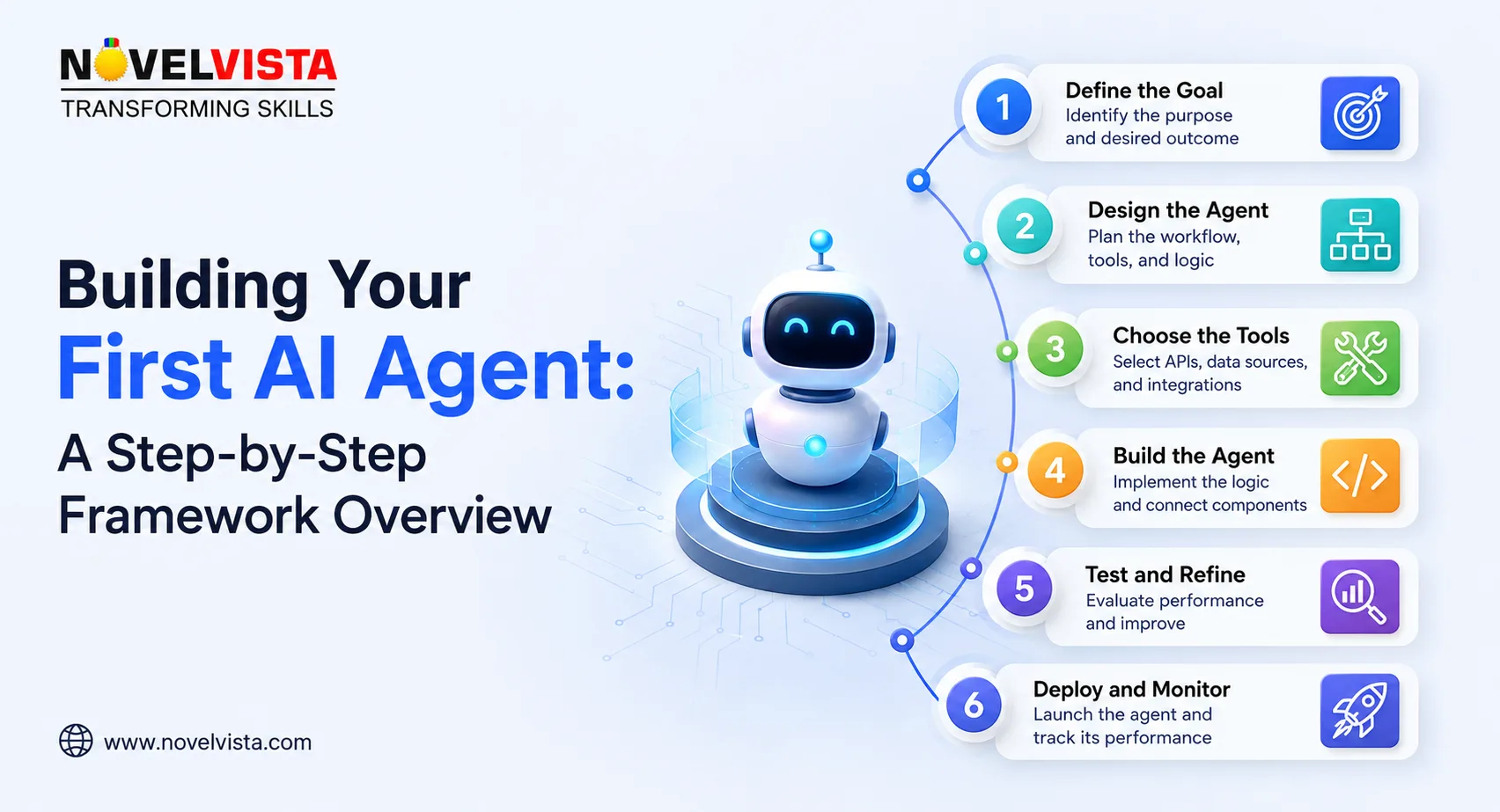
Artificial intelligence is moving beyond simple chatbots and recommendation systems. Today, organizations are building AI agents that can understand goals, make decisions, use tools, and complete tasks with limited human intervention. From answering customer queries to analyzing reports and automating business workflows, AI agents are becoming practical digital team members.
Building your first AI agent may sound complicated, but the process becomes manageable when it is divided into clear stages. You do not need to create a highly autonomous system from the beginning. A focused agent that performs one task reliably is often the best starting point.
What Is an AI Agent?
An AI agent is a software system designed to observe information, interpret instructions, make decisions, and take actions to achieve a specific objective.
A standard chatbot usually responds to a question and waits for the next message. An AI agent can go further. It may search a database, call an application programming interface, generate a report, update a customer record, send an email, or decide which step should be completed next.
Most AI agents contain five core elements:
- A clearly defined goal
- A reasoning or decision-making model
- Access to relevant data
- Tools or external applications
- Memory for maintaining context
The quality of an agent depends less on how many features it has and more on how clearly these elements work together.
Step 1: Define the Agent’s Purpose
The first step is deciding exactly what the agent should accomplish.
Avoid broad objectives such as “create an AI assistant for the company.” Instead, choose a measurable use case. For example, the agent could summarize customer support tickets, classify incoming leads, prepare meeting notes, generate weekly project reports, or answer employee questions using internal policy documents.
A strong objective might be:
“Review incoming support requests, identify their category and urgency, and recommend the appropriate support team.”
This goal gives the agent a clear scope, expected input, and defined output. It also makes testing easier.
Step 2: Identify Inputs and Outputs
Once the purpose is clear, determine what information the agent will receive and what it should produce.
Inputs may include user questions, uploaded documents, database records, emails, form submissions, or application events. Outputs may include text responses, structured JSON data, notifications, reports, database updates, or automated actions.
For example, a recruitment screening agent may receive a job description and candidate resume. Its output could include a skills match score, missing qualifications, relevant experience, and a recommendation for human review.
Defining the input and output format early prevents confusion during development.
Step 3: Select the AI Model
The language model acts as the reasoning engine of the agent. It interprets instructions, understands context, creates responses, and decides how to proceed.
Model selection should depend on the complexity of the task. A lightweight model may be suitable for classification or simple summarization. More advanced models may be required for multi-step reasoning, document analysis, coding, or detailed decision support.
Cost, response time, data privacy, accuracy, and integration capabilities should all be considered. The most powerful model is not always the most practical choice.
Step 4: Write Clear Instructions
An AI agent needs a strong system prompt that explains its role, goal, rules, boundaries, and expected output.
Instead of writing, “Analyze this support ticket,” provide more structured instructions:
“You are a support ticket classification agent. Classify each request as Technical, Billing, Access, or General. Assign an urgency level of Low, Medium, High, or Critical. Provide a short reason for your decision. Do not change customer information.”
Clear instructions reduce unpredictable behaviour and improve consistency.
Step 5: Connect Tools and Data
Tools allow the agent to perform real work. Depending on the use case, the agent may connect to a search engine, CRM platform, calendar, email service, database, cloud storage system, or internal application.
A sales agent, for example, may retrieve customer information from a CRM, check previous communication, create a personalized follow-up email, and schedule a reminder.
Tool access should follow the principle of least privilege. The agent should only receive the permissions required for its assigned task. Sensitive actions, such as deleting data, approving payments, or sending external communications, should require human confirmation.
Step 6: Add Memory and Context
Memory helps an AI agent maintain useful information across multiple interactions.
Short-term memory may include the current conversation or workflow state. Long-term memory may include previous customer preferences, completed actions, approved decisions, or relevant business information.
However, memory must be carefully controlled. Outdated, unnecessary, or sensitive information should not be stored without a valid reason. Organizations should define how information is collected, secured, updated, and removed.
Step 7: Design the Workflow
The agent’s workflow describes how it moves from receiving a request to completing the objective.
A simple workflow may follow this sequence:
Receive the request, validate the input, gather relevant information, generate a decision, perform an approved action, and record the result.
Complex agents may use planning, multiple tools, retrieval-augmented generation, or specialized sub-agents. However, your first agent should remain simple. Too many decision paths can make failures difficult to understand.
Step 8: Test and Improve
Before deployment, test the agent with normal requests, incomplete information, unusual wording, conflicting instructions, and incorrect data.
Measure accuracy, response quality, tool usage, processing time, cost, and failure rate. Human reviewers should evaluate whether the agent’s decisions are appropriate and explainable.
Testing should continue after deployment. AI systems may behave differently when exposed to real users and unexpected situations.
Final Thoughts
Building an AI agent is not only a technical project. It is also a process of defining responsibilities, controlling risk, and designing a reliable workflow.
Start with one valuable task, provide clear instructions, limit tool access, and keep humans involved in important decisions. Once the first agent performs consistently, you can gradually add new tools, memory, automation, and decision-making capabilities.
The strongest AI agents are not the ones that attempt to do everything. They are the ones that complete a clearly defined job safely, accurately, and repeatedly.

 English
 Arabic
 French
 Spanish
 Portuguese
 Deutsch
 Turkish
 Dutch
Dutch
 Italiano
 Russian
 Romaian
 Greek
Greek
