


SME IPO Requirements in India | Complete Eligibility Guide 2026
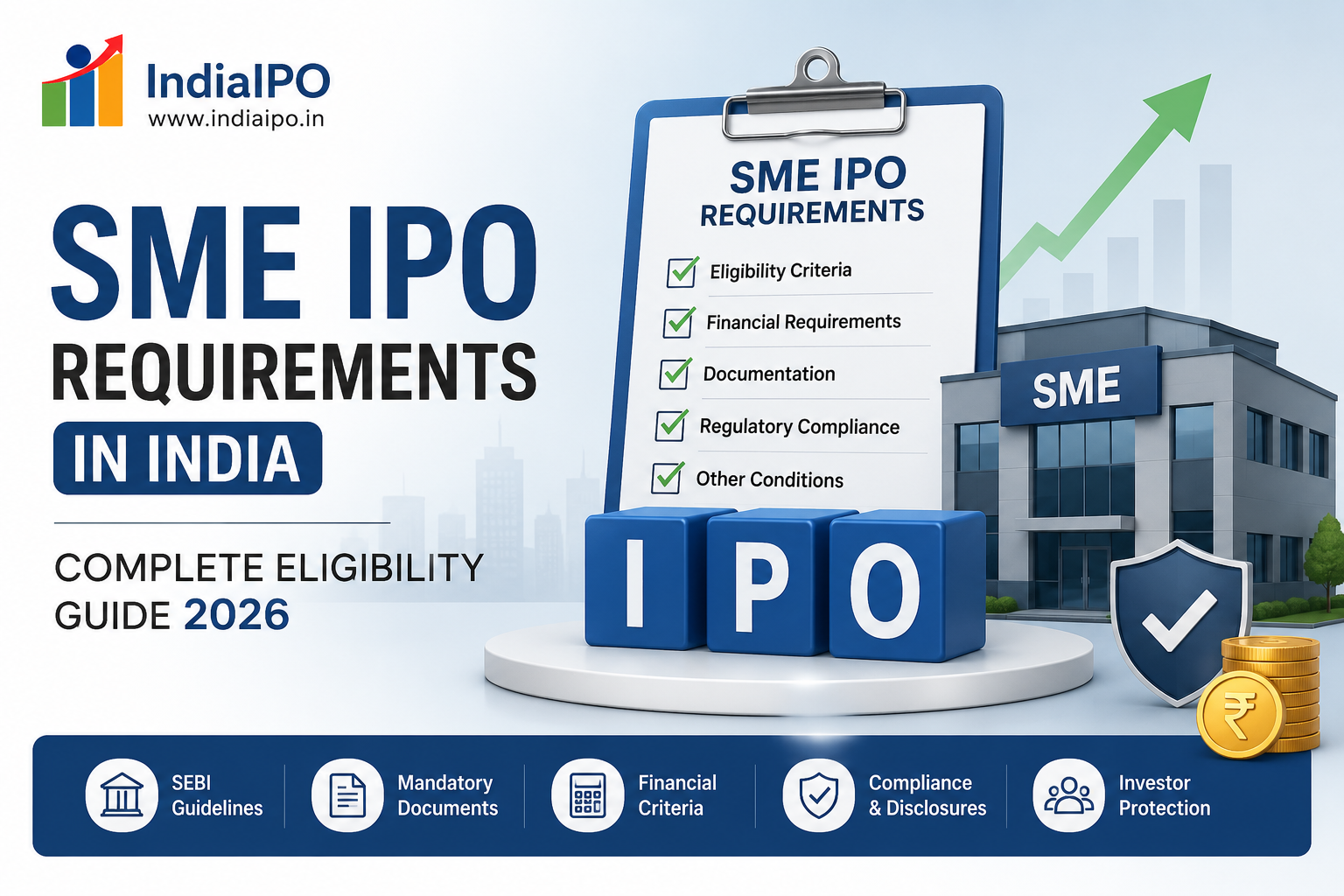
SME IPO Requirements: Complete Guide to Eligibility, Process & Listing in India
Introduction
For many growing businesses, expanding operations requires access to substantial capital. While bank loans and private investments are common funding options, an SME IPO (Small and Medium Enterprise Initial Public Offering) offers an excellent opportunity to raise funds while enhancing business credibility and market visibility.
However, launching an SME IPO is not as simple as filing an application. Companies must meet several regulatory, financial, and compliance requirements before becoming eligible for listing on platforms like BSE SME and NSE Emerge. These requirements are governed by SEBI regulations and exchange-specific norms designed to protect investors and ensure only financially stable companies enter the public market.
If you're planning to list your business, understanding the complete SME IPO requirements is the first step toward a successful public issue.
What is an SME IPO?
An SME IPO is a public offering specifically designed for small and medium enterprises looking to raise capital from public investors.
Instead of listing on the main stock exchanges, eligible businesses are listed on:
-
BSE SME Platform
-
NSE Emerge
These platforms provide easier access to capital while offering relatively simplified compliance compared to mainboard IPOs.
Why Companies Choose an SME IPO
An SME IPO provides multiple advantages beyond fundraising.
Some key benefits include:
-
Business expansion
-
Better brand credibility
-
Easier access to institutional funding
-
Improved corporate governance
-
Liquidity for shareholders
-
Better valuation
-
Higher customer confidence
-
Increased transparency
Many businesses also use IPO funds for:
-
Working capital
-
Manufacturing expansion
-
Technology upgrades
-
Debt reduction
-
Market expansion
-
Business acquisitions
SME IPO Requirements in India
Before applying for an SME IPO, companies must satisfy several financial and regulatory requirements.
1. Company Incorporation
The company must be registered under the Companies Act, 2013 or Companies Act, 1956.
The company should have a proper corporate structure and comply with statutory regulations.
2. Operational Track Record
Generally, companies should have:
-
Around 3 years of operational history
-
Audited financial statements
-
Stable business operations
Certain exchange-specific relaxations may apply in limited situations.
3. Post-Issue Paid-up Capital
One of the most important SME IPO requirements is:
Post-Issue Paid-up Capital should not exceed ₹25 Crore.
If the paid-up capital exceeds this limit, the company generally falls under the Mainboard IPO category.
4. Financial Performance
Financial eligibility plays a major role during IPO approval.
Typically, companies are expected to demonstrate:
-
Positive operating performance
-
Healthy business growth
-
Stable revenue
-
Positive EBITDA in required financial years
-
Strong financial reporting
Exchange-specific financial benchmarks vary between BSE SME and NSE Emerge.
5. Net Worth Requirements
Companies should maintain adequate net worth.
For BSE SME, exchange norms generally require minimum net worth criteria for preceding financial years.
6. Net Tangible Assets
BSE SME also evaluates the company's tangible assets before granting listing approval.
This demonstrates financial stability and operational strength.
7. Promoter Contribution
Promoters must maintain the prescribed minimum contribution in the company after the IPO.
Additionally:
-
Promoter shares remain locked in for a specified period.
-
The objective is to ensure long-term commitment from promoters.
8. Demat Shareholding
Before filing the IPO:
-
100% promoter shareholding should be in Demat form.
-
Company records should be updated and compliant.
9. No Major Regulatory Defaults
The company and promoters should not have:
-
Serious SEBI actions
-
Stock exchange disciplinary proceedings
-
Significant regulatory violations
-
Major fraud cases
A clean compliance history significantly improves IPO approval chances.
10. Mandatory Underwriting
Unlike many Mainboard IPOs, SME IPOs require:
-
100% underwriting
-
Merchant banker participation
-
Market making arrangements
These requirements improve investor confidence and post-listing liquidity.
Financial Documents Required for SME IPO
Companies should prepare comprehensive documentation before initiating the IPO process.
Important documents include:
-
Audited financial statements
-
Income Tax Returns
-
GST records
-
Shareholding pattern
-
Board resolutions
-
Articles of Association
-
Memorandum of Association
-
Corporate governance records
-
Statutory compliance certificates
-
Material contracts
-
Litigation details
-
Business licenses
-
Intellectual property records
-
Bank statements
-
Business plan
-
Project reports
Accurate documentation speeds up due diligence and reduces delays.
Business Eligibility Requirements
Apart from financials, exchanges also evaluate the company's business fundamentals.
Important factors include:
-
Sustainable business model
-
Industry growth potential
-
Experienced management
-
Revenue visibility
-
Corporate governance
-
Risk management framework
-
Compliance systems
Companies with transparent operations generally receive stronger investor interest.
SME IPO Process
Understanding the IPO process helps businesses prepare efficiently.
Step 1: Initial Eligibility Assessment
Experts evaluate whether your company qualifies for SME listing.
Step 2: Appointment of Merchant Banker
A SEBI-registered Merchant Banker manages the IPO process.
Step 3: Due Diligence
Legal, financial, taxation, and business due diligence are conducted.
Step 4: Draft Prospectus Preparation
The Draft Red Herring Prospectus (DRHP) is prepared with all required disclosures.
Step 5: Exchange Review
The stock exchange reviews:
-
Financials
-
Compliance
-
Risk disclosures
-
Business operations
Step 6: IPO Approval
After satisfying all observations, approval is granted.
Step 7: Public Issue
The IPO opens for subscription.
Step 8: Share Allotment
Eligible investors receive allotment.
Step 9: Listing
The company's shares are listed on BSE SME or NSE Emerge.
Common Reasons Why SME IPO Applications Get Rejected
Many companies fail to qualify because of:
-
Weak financial performance
-
Poor compliance history
-
Inadequate documentation
-
Governance issues
-
Regulatory non-compliance
-
Unclear business model
-
Improper corporate structure
-
Pending legal disputes
Proper planning helps avoid these issues.
SME IPO vs Mainboard IPO
|
Feature |
SME IPO |
Mainboard IPO |
|
Company Size |
Small & Medium |
Large Companies |
|
Listing Platform |
BSE SME / NSE Emerge |
NSE / BSE Mainboard |
|
Capital Limit |
Up to ₹25 Crore |
Higher Capital Requirement |
|
Compliance |
Comparatively Simplified |
More Extensive |
|
Underwriting |
Mandatory |
May vary |
|
Market Making |
Mandatory |
Not Mandatory |
SME IPOs are designed to help growing businesses access public capital with a framework tailored to their scale, while still maintaining investor protection.
How an SME IPO Consultant Helps
Navigating IPO regulations can be complex.
An experienced SME IPO consultant assists with:
-
Eligibility assessment
-
Financial restructuring
-
IPO planning
-
Documentation
-
Merchant banker coordination
-
Legal compliance
-
Valuation support
-
Due diligence
-
Exchange communication
-
Post-listing compliance
Professional guidance significantly reduces errors and improves the chances of a successful listing.
Why Choose India IPO for SME IPO Consultation?
If your business is planning to raise capital through an SME IPO, choosing the right advisory partner can make the entire process smoother and more efficient.
India IPO offers end-to-end SME IPO consulting services, including:
-
SME IPO eligibility assessment
-
IPO strategy and planning
-
Financial readiness evaluation
-
Documentation support
-
Merchant banker coordination
-
Regulatory compliance guidance
-
Due diligence assistance
-
Listing support
-
Post-IPO compliance advisory
Whether you're a manufacturing company, technology startup, healthcare business, or service provider, expert guidance can help you prepare for a successful public issue.
Frequently Asked Questions (FAQs)
What are the minimum SME IPO requirements?
Key requirements include company incorporation, operational track record, financial eligibility, post-issue paid-up capital within SME limits, promoter contribution, regulatory compliance, underwriting, and exchange-specific eligibility norms.
Who regulates SME IPOs?
SME IPOs are governed by SEBI regulations and listed on BSE SME or NSE Emerge, with exchange-specific listing requirements.
Is underwriting compulsory for SME IPOs?
Yes. SME IPOs require mandatory underwriting as per applicable exchange norms.
How long does an SME IPO take?
Depending on the company's readiness, documentation, and regulatory approvals, the process typically takes several months from planning to listing.
Can startups apply for an SME IPO?
Yes, provided they meet the eligibility, operational, financial, and compliance requirements prescribed by the relevant exchange and SEBI.
Conclusion
An SME IPO is more than just a fundraising exercise—it is a strategic milestone that can accelerate business growth, improve corporate credibility, and unlock long-term opportunities. However, success depends on careful preparation, regulatory compliance, and meeting the prescribed SME IPO requirements.
From financial eligibility and documentation to due diligence and exchange approvals, every stage requires expertise and planning. Partnering with an experienced SME IPO consultant can simplify the process, reduce compliance risks, and help your business move confidently toward becoming a publicly listed company.

 English
 Arabic
 French
 Spanish
 Portuguese
 Deutsch
 Dutch
Dutch
 Italiano
 Russian
 Romaian
 Portuguese (Brazil)
 Greek
Greek
