


ModelOps Market Set for Exceptional Growth Through 2036 Fueled by Enterprise AI Governance, MLOps Automation, and Responsible AI Adoption
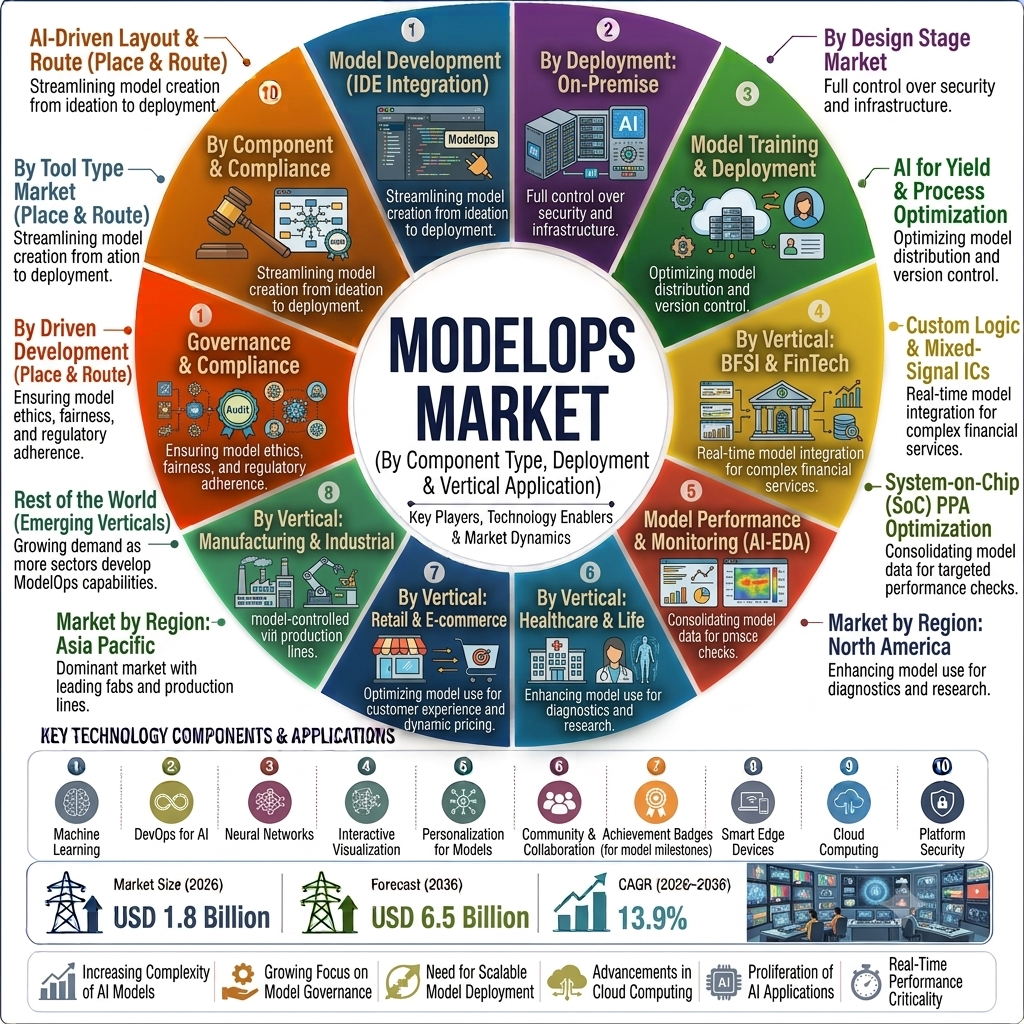
According to a landmark market research report published by Fact.MR, the global ModelOps market crossed an initial milestone valuation of USD 7.6 billion in 2025 as institutional AI environments grew past pilot stages. Driven by platform engineering demands and model risk requirements, the market is estimated to reach USD 10.7 billion in 2026.
Get detailed market forecasts, competitive benchmarking, and pricing trends: https://www.factmr.com/connectus/sample?flag=S&rep_id=15507
Looking toward the long-term forecast window, the global industry is projected to reach an absolute market valuation of USD 339.4 billion by 2036. This explosive multi-billion-dollar trajectory represents a compound annual growth rate (CAGR) of 41.3% over the 2026 to 2036 forecast period, generating an absolute dollar opportunity of USD 328.7 billion.
Key Market Highlights at a Glance
- Market Size in 2025 (Base Year): USD 7.6 billion
- Estimated Market Size in 2026: USD 10.7 billion
- Projected Market Size by 2036 (Forecast Year): USD 339.4 billion
- Compound Annual Growth Rate (CAGR): 41.3% between 2026 and 2036
- Absolute Dollar Opportunity: USD 328.7 billion over the forecast period
- Leading Component Segment: Software holding a 34.5% market share in 2026
- Leading Deployment Axis: Cloud infrastructure accounting for a 41.8% market share in 2026
- Dominant Organization Size: Small and Medium Enterprises (SMEs) capturing a 47.8% market share in 2026
- Leading Application Segment: Workflow Automation representing a 31% market share in 2026
- Primary End-Use Vertical: Banking, Financial Services, and Insurance (BFSI) holding a 30.4% market share in 2026
- Fastest-Growing National Market: India expanding at a 43.1% CAGR
- Report Volume: 170 comprehensive pages
Why Is the ModelOps Market Growing?
- Demand for Single Asset Inventories: Enterprise platform teams require a unified control plane to index diverse predictive systems, generative architectures, and autonomous business agents that enter production through split toolchains.
- Runtime Monitoring and Cost Controls: Production deployment of large language models exposes businesses to operational data drift, structural performance shifts, and unmanaged compute spending that cannot be isolated without dedicated monitoring frameworks.
- Traceable Policy and Compliance Evidence: Evolving regulatory environments require model risk officers to maintain unalterable, exportable validation evidence that traces AI asset changes from development to live automated decisioning.
"ModelOps is becoming the control record for AI estates that no single development platform owns," states Shambhu Nath Jha, Senior Analyst at Fact.MR. "Adoption is expected to favor systems that inventory every AI asset and connect approval evidence to runtime behavior. Providers should combine open integration and policy automation with clear operating cost visibility throughout production AI portfolios."
Component Breakdown: Software Drives Policy Automation Across Mixed AI Runtimes
The technological core of ModelOps operations is rooted in specialized enterprise software frameworks designed to integrate with diverse data science environments. The software component segment is expected to hold a 34.5% share of the global market in 2026. This leading position is sustained because organizations need centralized inventories, runtime evidence collection, and rule-based policy enforcement across automated operational layers. Enterprise software investments remain the primary mechanism for decoupling production governance from vendor-specific AI training platforms.
- Software Component Market Share: 34.5% of the overall market value in 2026
- Core Functionality Focus: Shared multi-framework indexing, automated policy integration, and execution tracing
- Services and Tooling: Professional implementation support handles custom legacy connectivity, while active software assets maintain permanent control layers
Deployment Segment Analysis: Cloud Environments Power Scalable Operational Controls
Distributing advanced machine learning systems across international business divisions requires a highly flexible, decentralized infrastructure layout. Cloud deployment options are projected to account for a 41.8% market share in 2026. This architecture leads the industry because it naturally supports elastic compute resource provisioning and simplifies remote software console accessibility for distributed engineering and validation teams. On-premise installations persist within isolated secure environments, but public and private cloud tools form the baseline for modern generative deployments.
- Cloud Deployment Market Share: 41.8% of global deployment choice in 2026
- Architectural Advantage: Native alignment with modern multi-cloud software stacks and containerized processing clusters
- Operational Impact: Lower setup barriers for engineering pipelines that interact with third-party application programming interfaces (APIs)
Organization Size Outlook: SMEs Capture Substantial Tooling Market Share
Lower technical barriers to entry for artificial intelligence models have enabled smaller enterprises to roll out complex, automated customer-facing systems. Small and Medium Enterprises (SMEs) are转 anticipated to capture a 47.8% share of the ModelOps market in 2026. This substantial market presence is driven by the rise of pre-packaged, managed orchestration tools that let smaller teams track production drift without investing in custom-built management systems. Large corporations manage massive, highly complex portfolios, but their buying cycles are more fragmented across internal business units.
- SME Market Share: 47.8% of the global market size in 2026
- Commercial Catalyst: Scalable subscription models that provide immediate production oversight with minimized engineering overhead
- Enterprise Context: Larger enterprises manage higher total model complexity but face prolonged procurement and split ownership timelines
Application Insights: Workflow Automation Commands Core Enterprise Operations
Directing AI inputs and tracking autonomous system choices requires highly structured, auditable execution pathways across company databases. The workflow automation application segment is estimated to represent a 31% share of the total market space in 2026. This sector leads the market because modern agentic systems require rigorous validation checks before triggering tools, querying APIs, or sending final text prompts to clients. Centralized workflow software ensures that every automated action conforms to pre-established risk tolerances and compliance limits.
- Workflow Automation Market Share: 31% of the application landscape in 2026
- Primary Application Task: Scripting and tracking agent execution paths, prompt variables, and tool invocation limits
- Supporting Applications: Governance and analytics software components track baseline cost exposures and runtime variance trends
End-Use Dynamics: BFSI Commands strict Risk and Control Markets
Regulated financial systems demand meticulous operational oversight, which makes automated model tracking software an absolute institutional requirement. The Banking, Financial Services, and Insurance (BFSI) sector is forecast to account for a 30.4% market share in 2026. This significant share position is directly attributable to established model risk governance practices and heavy documentation standards surrounding credit scoring, automated trading, and fraud prevention engines. Industrial manufacturing and retail applications are expanding rapidly, but BFSI remains the primary commercial spending driver due to compliance mandates.
- BFSI Segment Market Share: 30.4% of total end-use volume in 2026
- Segment Drivers: Institutional requirements for audit trails, automated model risk reviews, and financial validation compliance
- Alternative Sectors: High-growth industrial engineering and digital commerce clusters utilize specialized runtime analytics tracking
Market Dynamics: Drivers, Restraints, and Trends
Key Market Drivers
The primary driver accelerating global enterprise adoption is the fast expansion of hybrid, multi-cloud AI infrastructure configurations alongside agentic operational frameworks. Organizations are utilizing models from dozens of distinct upstream vendors. This diversification requires an independent, neutral software layer to monitor baseline performance, costs, and data drift across all corporate platforms simultaneously.
Core Market Restraints
A persistent restraint impacting immediate enterprise-wide rollouts is the lack of standardized communication protocols across fragmented data science frameworks. When development environments utilize disconnected monitoring fields and mismatched logging formats, platform teams must spend significant time normalizing basic output files before central compliance rules can be applied.
Prominent Industry Trends
The most influential trend shaping the current market is the expansion of autonomous agentic workflows inside live business operations. Modern systems do not just score static data points; they independently query external enterprise applications. ModelOps tools are adapting by embedding live policy enforcement mechanisms directly into active software execution environments to catch bad instructions instantly.
Regional/Country Outlook: Rapid Technical Infrastructure Scaling Across Major Economic Hubs
The global requirement for structured machine learning oversight is generating high double-digit compound growth rates across both developing and mature digital economies.
- India Forecasted Market Growth: 43.1% CAGR from 2026 to 2036
- China Forecasted Market Growth: 42.4% CAGR from 2026 to 2036
- Australia Forecasted Market Growth: 41.1% CAGR from 2026 to 2036
- United Kingdom Forecasted Market Growth: 40.8% CAGR from 2026 to 2036
- United States Forecasted Market Growth: 40.6% CAGR from 2026 to 2036
India is expected to record a 43.1% CAGR between 2026 and 2036, leading the global market in growth speed. This trajectory is supported by broad national initiatives for open compute access and an expanding base of corporate software integration hubs.
China is projected to post a 42.4% CAGR over the ten-year forecast window. Growth is driven by large-scale industrial AI deployments and extensive technical application frameworks embedded directly within major national digital clusters.
Australia is anticipated to advance at a 41.1% CAGR during the forecast decade. Steady growth is reinforced by rapid SME platform procurement and evolving compliance expectations regarding consumer data protection.
The United Kingdom is estimated to record a 40.8% CAGR across the 2026 to 2036 period. The local market is propelled by fast corporate software adoption alongside preparation for formalized regional artificial intelligence governance guidelines.
The United States is forecast to post a 40.6% CAGR over the forecast horizon. This steady growth is shaped by massive historical model volumes and concentrated spending in knowledge-intensive sectors like enterprise finance, defense, and healthcare.
Competitive Landscape: Platforms Prioritize Multi-Vendor Integration Capabilities
The vendor environment within the ModelOps sector is highly competitive and rapidly evolving, marked by significant software portfolio expansions from major data management providers.
- DataRobot: Expanded its enterprise AI governance frameworks in July 2026 to deliver deeper multi-framework oversight and comprehensive runtime policy monitoring.
- ModelOp: Specializes in pure-play enterprise ModelOps technology, providing production asset indexing and automated risk management across massive scale banks.
- IBM: Integrates ModelOps capabilities into its broader cloud data platform ecosystems to serve heavily regulated corporate institutions.
- SAS: Provides advanced operational frameworks optimized for high-volume analytics modeling and real-time statistical control tracking.
Competitive dynamics show a clear shift toward open integration. The market is moving away from restrictive single-vendor development platforms and embracing neutral tracking systems that interface smoothly with any open-source or proprietary AI framework.
Read the Comprehensive Industry Report: https://www.factmr.com/report/modelops-market
Frequently Asked Questions
What is the projected global value of the ModelOps market by 2036?
The global ModelOps market is projected to reach an absolute valuation of USD 339.4 billion by the year 2036.
What is the expected compound annual growth rate of the global ModelOps market?
The global ModelOps market is expected to expand at a compound annual growth rate (CAGR) of 41.3% from 2026 to 2036.
Which component segment holds the largest share within the ModelOps market?
The software segment dominates the component axis, holding a projected 34.5% share of the global market in 2026.
What application segment leads the overall ModelOps industry?
The workflow automation segment leads the application space, capturing an estimated 31% market share in 2026.
Which vertical industry represents the dominant end-use customer for ModelOps software?
The banking, financial services, and insurance (BFSI) sector represents the leading end-use vertical, holding a 30.4% market share in 2026.
What country is recorded as the fastest-growing market for ModelOps solutions?
India is the fastest-growing national market for ModelOps software, expanding at a projected 43.1% CAGR between 2026 and 2036.
Who are the prominent enterprise technology vendors listed within the ModelOps market report?
The prominent players operating within the global ModelOps market space include DataRobot, ModelOp, IBM, and SAS.
To View Related Report:
AI in Mining Market: https://www.factmr.com/report/ai-in-mining-market
AI Generated Content Market: https://www.factmr.com/report/ai-generated-content-market
AI in Gaming Market: https://www.factmr.com/report/ai-in-gaming-market
Space Cybersecurity Market: https://www.factmr.com/report/space-cybersecurity-market

 English
 Arabic
 French
 Spanish
 Portuguese
 Deutsch
 Turkish
 Italiano
 Russian
 Romaian
 Portuguese (Brazil)
 Greek
Greek
