


Telehealth App Development Company: Cost, Compliance, and Development
Telehealth has moved from a pandemic-era workaround to a permanent part of how care gets delivered, and patients now expect virtual visits as a standard option alongside in-person care. That shift has made choosing the right telehealth app development company one of the most consequential decisions a healthcare organization or startup can make, because a platform built without compliance, security, and clinical workflow in mind rarely survives contact with real patients, real regulators, or a real audit.
This guide breaks down what these companies actually build, why compliance has to be a first decision rather than a retrofit, and what cost and timeline benchmarks look like in practice.
What Does a Telehealth App Development Company Actually Build?
A telehealth software development company typically works across four categories of solutions: doctor booking and consultation apps for scheduling and video visits, medicine order and delivery apps connected to pharmacy fulfillment, clinic and hospital management systems for multi-provider administration, and remote patient monitoring platforms that stream vitals and device data to care teams.
Underneath these categories, the core capabilities that matter most are visit scheduling with automated reminders, secure doctor-patient communication (encrypted video, chat, and speech-to-text), treatment planning and e-prescribing, billing and insurance verification, and analytics that turn monitoring data into real-time alerts. Experienced telehealth app developers build these as one connected system rather than as separate bolted-on features, which is what keeps a platform usable for both patients and clinical staff.
Why Compliance Can't Be an Afterthought
The biggest difference between a generic app vendor and a genuine telehealth app development company is where compliance sits in the build process. HIPAA, HL7, FHIR, DICOM, ICD-10, and CPT alignment need to be architecture decisions made at the start, not gaps a vendor review flags right before launch. Multi-factor authentication and standards-based data exchange also need to be built into the system core, since retrofitting security after a platform is already live is significantly more expensive and risk-prone than designing for it from day one.
This is also why regulatory exposure is one of the most common reasons healthcare organizations go looking for a new development partner in the first place: patchwork compliance tools stop scaling once patient volume or audit scrutiny increases.
How Much Does Telehealth Software Development Cost?
Cost depends primarily on platform count, feature scope, and compliance requirements, and most reputable telehealth software development companies now offer fixed-price models instead of open-ended hourly billing. Typical 2026 budgeting benchmarks break down into three tiers:
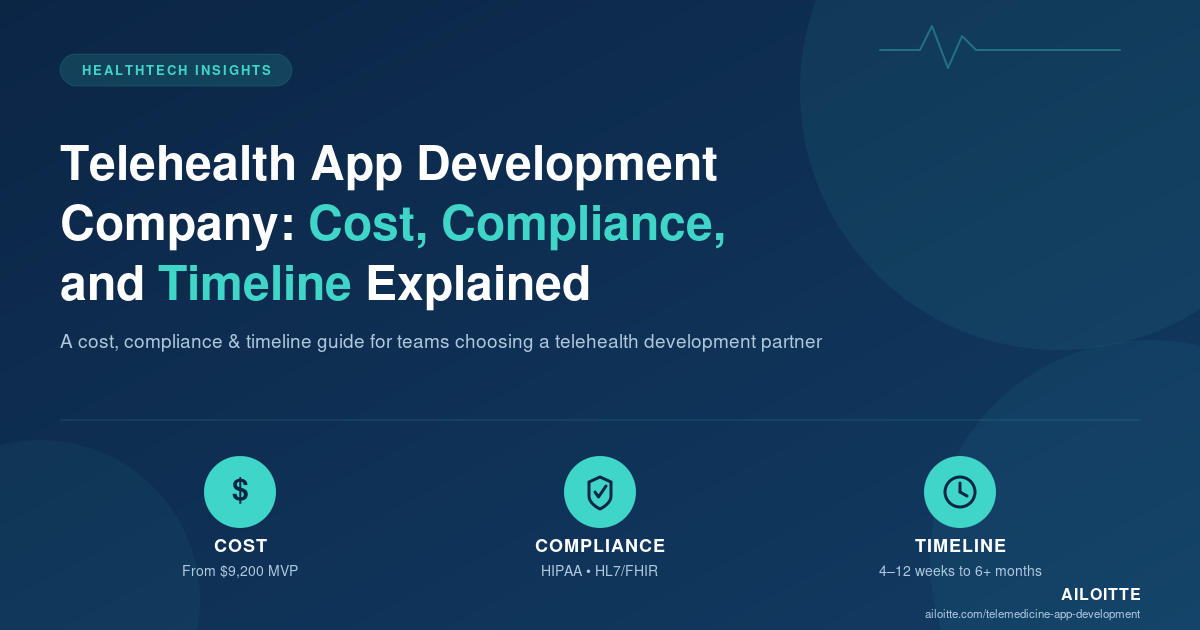
A single-platform MVP, such as a doctor booking and video consultation app, generally starts around $9,200 and launches in roughly 4 to 12 weeks. A multi-role platform that adds patient, doctor, and clinic admin roles along with billing and e-prescribing typically runs $15,000 to $40,000 over a 3 to 6 month build. Enterprise-grade builds with EHR integration, remote patient monitoring device support, and multi-region compliance start at $40,000 and generally take 6 months or more.
These figures are industry benchmarks for budgeting rather than a quote, since an exact fixed price is normally set only after a scoped discovery call covering clinical workflow, compliance needs, integration requirements, and platform scope.
How Long Does the Development Timeline Actually Take?
Beyond the tier-based estimates above, the development timeline itself usually runs through four phases: discovery and scoping to define compliance and platform requirements, design and architecture covering clinical workflow and EHR/RPM integration points, agile development delivered in tested sprints with regular demos, and launch and support that includes ongoing maintenance and compliance updates. Teams that track builds against clear KPIs, such as time to first demo, defect rate, and compliance sign-off, tend to hit these windows more predictably than teams working without staged milestones.
What Makes an Experienced Telehealth App Development Company Different?
Domain expertise is the differentiator that's hardest to fake. A company with 70+ healthcare and telemedicine apps delivered and dozens of healthcare domain experts on staff will catch workflow and compliance issues that a generalist app shop simply won't anticipate. ISO 27001 and ISO 9001 certification are also reasonable proxies for whether security and quality processes are audit-ready by default rather than added reactively.
The more advanced telehealth app developers are also moving past chatbot-level AI, building agents directly into clinical workflows for intake triage, image recognition on X-rays and MRIs, and predictive analytics on remote monitoring data, so issues surface before they become emergencies rather than after.
How to Choose the Right Telehealth App Developers
Look for three things before signing on: a fixed-price engagement model with transparent tiers, demonstrated HIPAA/HL7/FHIR experience rather than generic security claims, and flexibility across engagement types, whether that's an end-to-end build, a compliance-focused upgrade to an existing app, or team augmentation for an in-house group that needs extra capacity. A partner that offers all three is far more likely to deliver a platform patients, providers, and regulators can actually trust.

 Arabic
 French
 Spanish
 Portuguese
 Deutsch
 Turkish
 Dutch
Dutch
 Italiano
 Russian
 Romaian
 Portuguese (Brazil)
 Greek
Greek
