


Low‑loss Dielectrics Market
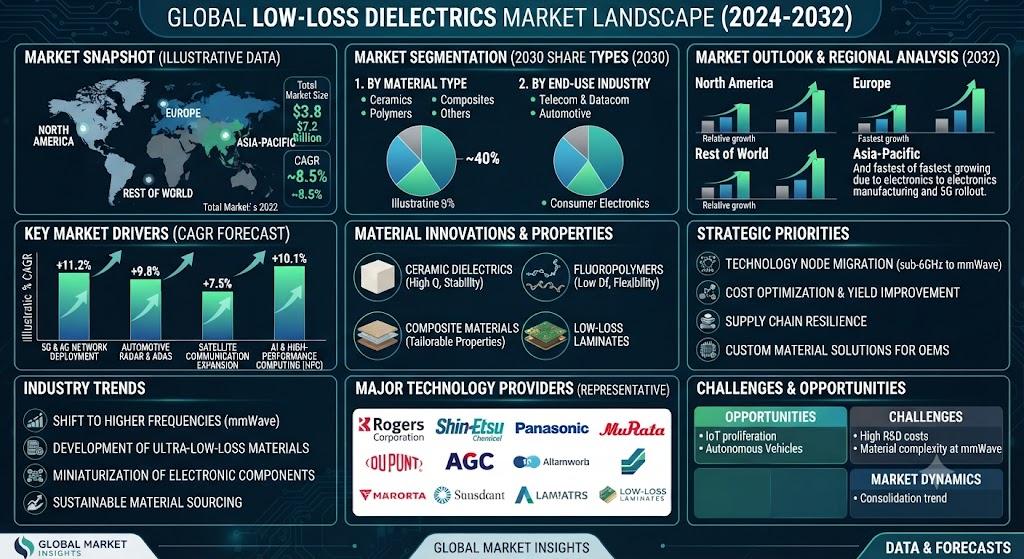
Low‑loss Dielectrics Market is gaining momentum as next‑generation wireless, aerospace, and quantum‑computing applications demand ever‑lower dielectric loss and higher thermal stability. Industry analysts note that the convergence of 5G/6G roll‑out, autonomous‑vehicle radar proliferation, and the rise of high‑frequency satellite constellations is creating a sustained demand pipeline for ultra‑low tan δ materials across the RF and microwave spectrum.
Low‑loss dielectrics, characterized by exceptionally low dissipation factors (tan δ < 0.002), are essential for preserving signal integrity in high‑frequency substrates, antenna radomes, resonators, and advanced capacitors. Their unique combination of dielectric strength, thermal resilience, and processing flexibility enables manufacturers to miniaturize components while meeting stringent performance standards demanded by telecom operators, defense contractors, and automotive OEMs.
Download FREE Sample Report:
Low‑loss Dielectrics Market - View in Detailed Research Report
Telecommunications Infrastructure: The Core Growth Engine
The explosive expansion of global telecommunications infrastructure stands out as the primary catalyst for market growth. The migration from 4G to 5G-and the early planning stages for 6G-require substrates that can operate at millimeter‑wave frequencies (30‑300 GHz) with minimal signal attenuation. Network operators are investing heavily in massive‑MIMO antenna arrays, small‑cell densification, and spectrum‑efficient beam‑forming technologies, all of which rely on low‑loss dielectric materials to achieve the required bandwidth and latency targets.
Beyond terrestrial networks, the surge in low‑Earth‑orbit (LEO) satellite constellations for broadband connectivity is adding a parallel demand stream. Satellite manufacturers need dielectrics that can sustain high‑frequency performance in the harsh space environment, where thermal cycling and radiation tolerance are critical. Consequently, material suppliers are accelerating R&D programs focused on radiation‑hard polymer‑ceramic hybrids and high‑purity oxide ceramics.
In the automotive sector, the transition to advanced driver‑assistance systems (ADAS) and fully autonomous vehicles has amplified the need for high‑frequency radar modules operating in the 76‑81 GHz band. Low‑loss dielectrics enable compact, high‑gain antenna systems that meet the strict size, weight, and power (SWaP) constraints of modern vehicle designs.
Quantum‑computing hardware also contributes to the market’s upward trajectory. Superconducting qubit platforms and cryogenic microwave resonators demand dielectric substrates with ultra‑low loss at cryogenic temperatures to minimize decoherence and energy dissipation.
Segment Analysis:
By Type
-
Ceramic‑Polymer Composites
-
Pure Ceramic Dielectrics
-
Polymer‑Based Low‑Loss Materials
By Application
-
High‑Frequency Substrates
-
Antenna Radomes
-
Resonators
-
Advanced Capacitors
By End User
-
Telecommunications Infrastructure
-
Aerospace & Defense
-
Automotive Radar
-
Quantum Computing Hardware
By Material Composition
-
Oxide‑Based Ceramics
-
Fluorine‑Containing Polymers
-
Hybrid Nanocomposites
-
Others
By Frequency Range
-
Microwave (1‑30 GHz)
-
Millimeter‑Wave (30‑300 GHz)
-
Terahertz (>300 GHz)
-
Others
The table below consolidates the segment categories, sub‑segments, and key insights derived from the latest industry research:
Segment Analysis:
|
Segment Category |
Sub‑Segments |
Key Insights |
|
By Type |
|
Ceramic‑Polymer Composites dominate growth because they blend the ultra‑low loss of ceramics with the processing flexibility of polymers, enabling high‑frequency 5G/6G substrates, compact RF modules, and robust thermal performance.
|
|
By Application |
|
High‑Frequency Substrates remain the primary focus, delivering essential signal‑loss mitigation for dense 5G/6G networks, satellite‑ground links, and emerging 6G prototypes.
|
|
By End User |
|
Telecommunications Infrastructure leads due to the massive rollout of high‑frequency networks, reinforcing demand for ultra‑low loss dielectrics that meet stringent bandwidth and latency criteria.
|
|
By Material Composition |
|
Oxide‑Based Ceramics are the backbone of premium dielectric solutions, valued for intrinsic low loss, high thermal conductivity, and resistance to harsh environments.
|
|
By Frequency Range |
|
Millimeter‑Wave applications are emerging as the key demand catalyst, especially for autonomous‑vehicle radar, satellite back‑haul, and next‑gen wireless links.
|
COMPETITIVE LANDSCAPE
Key Industry Players
Low‑loss Dielectrics Market Competitive Overview
The Low‑loss Dielectrics market is dominated by a handful of large technology manufacturers that have built extensive RF‑substrate and advanced ceramic‑polymer portfolios. Rogers Corporation leads with a strong presence in 5G antenna radomes and aerospace‑grade resonators, leveraging its proprietary “Rogers RT” family to capture premium pricing. TDK Corporation, through its EPCOS subsidiary, offers a broad spectrum of ceramic and polymer dielectrics, anchoring its market share in automotive radar and satellite communications. Murata Manufacturing and Kyocera Corp. complement the top tier with aggressive R&D pipelines focused on ultra‑low tan δ materials, enabling high‑frequency modules for quantum‑computing and millimeter‑wave applications. Collectively, these four firms account for roughly 55 % of global revenue, and their strategic partnerships with chipset producers reinforce a consolidated supply chain that shapes pricing and technology standards.
Niche yet strategically important players enrich the competitive landscape with specialised chemistries and regional strengths. AVX Corporation supplies low‑loss polymer blends for consumer electronics, while Sumitomo Chemical and Mitsubishi Gas Chemical differentiate through proprietary fluoropolymer formulations targeting automotive radar. CeramTec GmbH and Cooper Advanced Materials excel in high‑performance ceramic composites for aerospace radomes. Additional contributors such as Taiyo Yuden, Fujitsu, Arlon LLC, and 3M provide niche portfolio extensions that support miniaturised RF modules and emerging 6G prototypes, ensuring a diversified ecosystem that can respond quickly to evolving performance specifications.
List of Key Low‑loss Dielectrics Companies Profiled
-
AVX Corporation
-
EPCOS (TDK Group)
-
Sumitomo Chemical Co., Ltd.
-
CeramTec GmbH
-
Cooper Advanced Materials
-
Mitsubishi Gas Chemical Company
-
Taiyo Yuden Co., Ltd.
-
Fujitsu Limited
-
Arlon LLC
-
3M Company
These companies are accelerating technology adoption through the integration of IoT‑enabled monitoring, AI‑driven material design, and strategic geographic expansion into high‑growth regions such as Asia‑Pacific and the Middle East. Partnerships with leading chipset manufacturers and participation in standard‑setting bodies further solidify their market positions.
Emerging opportunities abound in the electric‑vehicle (EV) battery manufacturing chain, where low‑loss dielectrics can improve the efficiency of high‑frequency power‑conversion modules, and in renewable‑energy grid‑interconnection equipment that relies on high‑frequency communication links.
Get Full Report Here:
Low‑loss Dielectrics Market, Trends, Business Strategies 2026‑2034 - View in Detailed Research Report
About Semiconductor Insight
Semiconductor Insight is a leading provider of market intelligence and strategic consulting for the global semiconductor and high‑technology industries. Our in-depth reports and analysis offer actionable insights to help businesses navigate complex market dynamics, identify growth opportunities, and make informed decisions. We are committed to delivering high-quality, data‑driven research to our clients worldwide.
🌐 Website: https://semiconductorinsight.com/
📞 International: +91 8087 99 2013
🔗 LinkedIn: Follow Us

 English
 Arabic
 French
 Spanish
 Portuguese
 Deutsch
 Turkish
 Dutch
Dutch
 Italiano
 Romaian
 Portuguese (Brazil)
 Greek
Greek
