


Peyronie’s Disease: A Complete In-Depth Guide
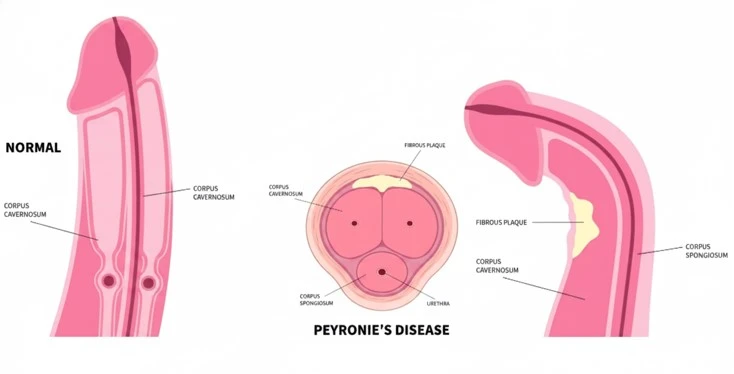
Peyronie's Disease is a condition in which fibrous scar tissue (called plaques) develops inside the penis, causing it to bend or curve abnormally during erections. While a slight natural curve is normal, Peyronie’s disease leads to a more pronounced, often painful curvature that can interfere with sexual function and overall quality of life.
This condition is often underreported due to embarrassment, but studies suggest it affects a significant number of men—particularly those over 40.
Understanding Peyronie’s Disease
Peyronie’s disease is not just about curvature—it is a disorder of wound healing. Normally, when tissue is injured, the body repairs it smoothly. In this condition, healing becomes abnormal, leading to thickened, non-elastic scar tissue.
When the penis fills with blood during an erection, the scarred area cannot stretch properly. This results in bending, indentation, or shortening.
Anatomy Behind the Condition
The penis contains two sponge-like tubes called the corpora cavernosa. These are surrounded by a tough elastic sheath known as the tunica albuginea.
- In a healthy penis: the tunica stretches evenly
- In Peyronie’s disease: scar tissue prevents uniform expansion
This imbalance causes curvature toward the side where the plaque is located.
Causes of Peyronie’s Disease
The exact cause is not always identifiable, but several contributing factors are well recognized:
1. Microtrauma and Injury
Repeated minor injuries during sexual activity are considered the most common cause. These injuries may go unnoticed but can lead to internal bleeding and scar formation.
Examples include:
- Vigorous intercourse
- Accidental bending during erection
- Sports-related trauma
2. Genetic Predisposition
Men with a family history are more likely to develop the condition. It is often associated with other fibrotic disorders such as Dupuytren’s contracture.
3. Poor Wound Healing Response
Some individuals have abnormal collagen production, causing excessive scar tissue formation.
4. Age-Related Changes
As men age:
- Tissue elasticity decreases
- Healing becomes slower
- Risk of fibrosis increases
5. Associated Health Conditions
Certain conditions increase risk:
- Diabetes
- High blood pressure
- Erectile dysfunction
- Smoking
Symptoms of Peyronie’s Disease
Symptoms can vary widely depending on severity and stage:
Common Signs
1. Penile Curvature
- Upward, downward, or sideways bending
- Can be mild or severe (sometimes >30–60 degrees)
2. Palpable Plaques
- Hard lumps under the skin
- Usually painless when touched
3. Pain
- Most common in early stages
- Occurs during erection or even at rest
4. Erectile Dysfunction
- Due to reduced blood flow or psychological stress
5. Penile Shortening
- Caused by inelastic scar tissue
6. Indentation or “Hourglass” Shape
- Narrowing at a specific point
Stages of Peyronie’s Disease
1. Acute (Active) Phase
- Lasts 6–18 months
- Pain is common
- Curvature worsens progressively
- Plaque formation is ongoing
2. Chronic (Stable) Phase
- Pain usually subsides
- Curvature stabilizes
- Scar tissue becomes permanent
Diagnosis
A proper diagnosis is essential for effective treatment.
Medical History
Doctors assess:
- Onset of symptoms
- Degree of curvature
- Pain levels
- Sexual function
Physical Examination
- Palpation of plaques
- Assessment of penile shape
Imaging Tests
Ultrasound
Most commonly used to:
- Detect plaque size and location
- Evaluate blood flow
- Identify calcification
Erection Assessment
Sometimes medication is used to induce an erection for accurate curvature measurement.
Treatment Options
Treatment depends on severity, stage, and impact on quality of life.
Non-Surgical Treatments
1. Oral Medications
Though commonly prescribed, results are mixed. These may include:
- Vitamin E
- Potassium para-aminobenzoate
- Anti-inflammatory drugs
2. Injectable Therapy
One of the most effective non-surgical approaches.
Collagenase Injections
Break down plaque tissue and improve curvature.
Verapamil or Interferon
Help reduce scar formation.
3. Penile Traction Therapy
Devices are used to stretch the penis gradually:
- Can reduce curvature
- Helps restore length
- Requires consistent use over months
4. Shockwave Therapy
Low-intensity shockwaves:
- Reduce pain
- Limited effect on curvature
Surgical Treatments
Recommended when:
- Curvature is severe
- Sexual activity is difficult
- Condition has stabilized
1. Plication Surgery
- Shortens the longer side
- Simple and effective
- May slightly reduce length
2. Plaque Incision and Grafting
- Removes or cuts plaque
- Replaces with graft material
- Preserves length better
3. Penile Implants
Best for patients with severe erectile dysfunction:
- Straightens penis
- Restores erectile function
Complications
If left untreated, Peyronie’s disease may lead to:
- Permanent penile deformity
- Severe erectile dysfunction
- Painful intercourse
- Emotional distress
- Relationship challenges
Psychological and Emotional Impact
This condition can significantly affect mental health:
- Anxiety and depression
- Loss of confidence
- Avoidance of intimacy
Open communication with a partner and counseling can help manage these effects.
When to See a Doctor
Seek medical advice if you notice:
- New or worsening curvature
- Pain during erections
- Lumps in the penis
- Difficulty in sexual activity
Early treatment leads to better outcomes.
Prevention and Risk Reduction
While not entirely preventable, the following steps may help:
- Avoid excessive force during intercourse
- Use adequate lubrication
- Manage chronic conditions (like diabetes)
- Quit smoking
- Maintain overall vascular health
Living With Peyronie’s Disease
Many men live normal lives with proper treatment and support. Early diagnosis, realistic expectations, and adherence to treatment plans are key to improvement.
Final Thoughts
Peyronie's Disease is a complex but treatable condition. With advancements in medical therapy and surgical techniques, most patients can achieve significant improvement in both function and appearance.
If you suspect symptoms, consulting a qualified urologist early can make a major difference in recovery and long-term outcomes.

 English
 Arabic
 French
 Spanish
 Portuguese
 Deutsch
 Turkish
 Dutch
Dutch
 Italiano
 Romaian
 Portuguese (Brazil)
 Greek
Greek
