


A Quick Guide to Ninja Swords
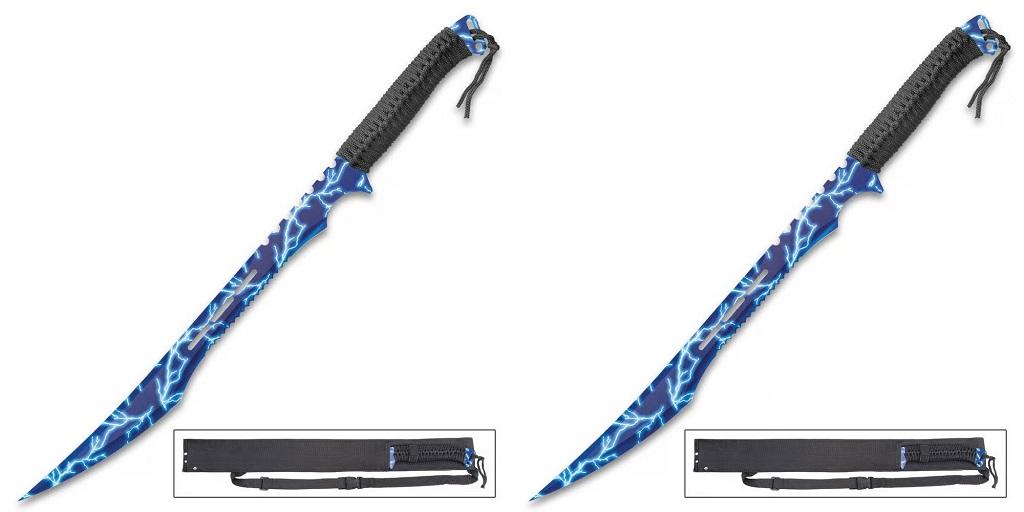
Have you ever seen a sword that looks like a katana in pretty much all respects, but which has a straight blade instead of a curved blade?
You’re probably looking at a ninja sword pattern, known as a ninjato. Here’s your primer on what these traditional Japanese swords were.
What Is Ninjutsu?
Ninjutsu is a discipline practiced by a ninja, also known as a shinobi. A practitioner of ninjutsu would prioritize stealth and espionage as an infiltrator either for the purpose of gathering intelligence, laying traps, or developing military strategy.
What Are the Characteristics of a Ninja Sword (Ninjato)?
First, a disclaimer: there is no strong historical evidence that the sword about to be described was actually used by practitioners of ninjutsu in feudal Japan, and it might be a modern invention. All the same, because of how it is portrayed so commonly in the media, the following is what defines a ninja sword.
Also known as a ninjato, a ninja sword was a short sword with a blade generally around 19 to 24 inches. It was sharpened only on one edge, just like many other traditional Japanese swords, and had a traditional kissaki, a “tanto point” as well.
Another indicator of the ninjato is that the tsuba is typically presented as square instead of round, which is another calling card of the pattern. In other respects, the fittings and trappings of the ninjato are effectively the same as they might be in a katana.
In typical representations the blade is fixed in the hilt using the same bamboo pin, the tsuka is rayskin-wrapped, and the saya, or scabbard, is of lacquered wood.
Some have also noted that the ninjato is a slightly heavier, stockier sword than a katana or wakizashi, although the reason for this is not always given.
And, again, historical examples are effectively unheard of, so it is possible that this conception of a ninjato is an entirely modern fabrication. All the same, these are the details to look for to determine if a pattern is ninjato-adjacent or not.
How to Tell If a Ninja Sword Is Real?
Regardless of the historical attestability of the ninjato, what you should look for to determine whether it is “real” or battle-ready is the same as what you should look for in any other traditional Japanese sword.
To be considered battle ready, a ninja sword must:
- Be made from an appropriate steel alloy.
- Have an appropriate temper.
- Be fixed in the tsuka with a full nakago, using a bamboo pin called a mekugi.
There are some other items that qualify Japanese swords. A ninjato therefore should:
- Be clay tempered, which produces a differential hardness, harder along the edge and softer along the spine.
- Be made with a traditional rayskin-wrapped tsuka.
- Have a lacquered wood saya.
However, the three first items are the most important, as no sword can be considered either real or battle ready unless it is made from a suitable steel alloy that is appropriately tempered so that the sword can stand up to real use, and that it is constructed with a full tang that is appropriately fixed to the hilt. It just so happens that traditional Japanese swords use different protocols, but the effect is the same.
Looking for Battle Ready Ninja Swords?
If you landed here because you are looking for a real or battle ready ninja sword, the first place you should look is True Swords. In keeping to their name, they sell plenty of real, battle ready swords, including swords that look very much like a ninjato pattern. Visit their website for more details or get in touch with them directly for assistance if you are still looking.
For more information about Axe Blade and Wakizashi Katana Please visit: True Swords.

 English
 Arabic
 French
 Spanish
 Portuguese
 Deutsch
 Dutch
Dutch
 Italiano
 Russian
 Romaian
 Portuguese (Brazil)
 Greek
Greek
