


How to Add Multi-Crypto Support in Your CoinPayments Clone Platform
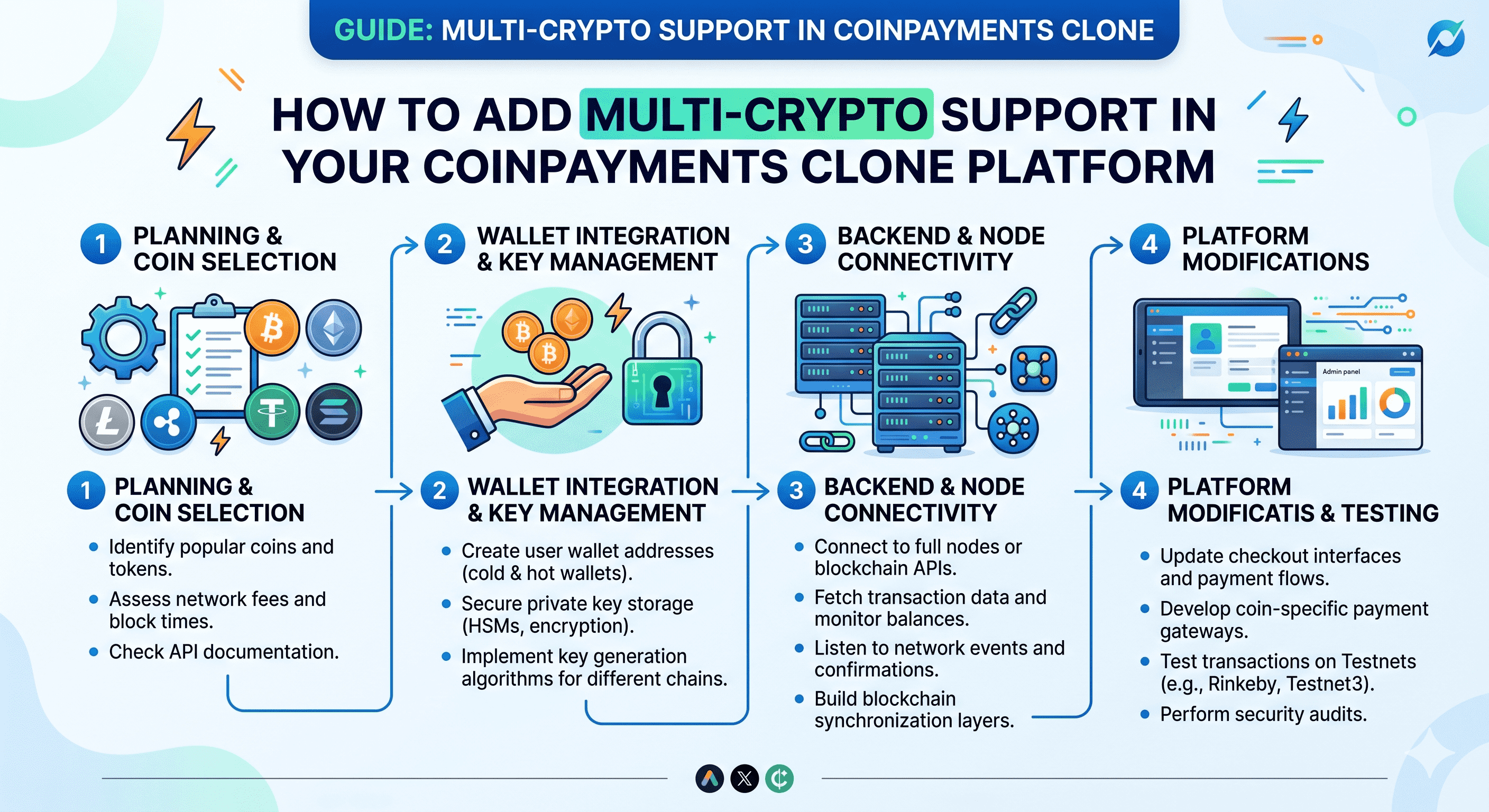
Introduction
If you're building a CoinPayments clone platform, supporting just one cryptocurrency is a limitation. Today’s users expect flexibility—whether it’s Bitcoin, Ethereum, or stablecoins.
Adding multi-crypto support in your CoinPayments clone platform is not just a feature—it’s a competitive advantage. It helps you attract more users, increase transactions, and scale globally.
In this guide, you’ll learn exactly how to implement it—clearly, efficiently, and with long-term scalability in mind.
Why Multi-Crypto Support Is Essential
A CoinPayments clone platform with multi-crypto support positions your product for real-world usage.
Key Benefits:
-
More users: Different users prefer different coins
-
Higher conversions: Flexible payment options reduce drop-offs
-
Global reach: Enable payments across regions without restrictions
-
Revenue growth: More transactions = more fees
If your goal is multi-currency crypto payment gateway development, this is your foundation.
Core Components You Need
1. Multi-Wallet System
Each cryptocurrency requires its own wallet infrastructure.
You need:
-
Hot wallets (for instant transactions)
-
Cold wallets (for secure storage)
-
HD wallets (for scalable address generation)
👉 Without this, your CoinPayments clone platform won’t handle multiple assets reliably.
2. Blockchain Integration Layer
To enable multi-crypto support in your CoinPayments clone platform, you must connect to multiple blockchains.
Two approaches:
-
Run your own nodes (full control, higher cost)
-
Use APIs like Infura or Alchemy (faster and scalable)
For most builders, APIs are the fastest way to launch.
3. Smart Payment Routing
Your system must:
-
Detect selected cryptocurrency
-
Generate unique wallet addresses
-
Validate blockchain confirmations
This is critical for secure crypto payment gateway development.
Step-by-Step Implementation
Step 1: Select the Right Cryptocurrencies
Start with high-demand coins:
-
BTC, ETH
-
Stablecoins like USDT, USDC
Avoid overloading your system early. Scale gradually.
Step 2: Integrate Wallet APIs Securely
Use trusted APIs or SDKs to:
-
Generate wallets
-
Sign transactions
-
Store keys securely
Security tip: Always encrypt private keys and use multi-signature authentication.
Step 3: Add Real-Time Price Conversion
Crypto prices are volatile. Your platform must:
-
Fetch live exchange rates
-
Convert crypto to fiat (or base currency)
-
Prevent underpayment issues
This improves trust and user experience.
Step 4: Build Transaction Monitoring
Each blockchain behaves differently.
Your system should:
-
Track confirmations
-
Send instant notifications
-
Handle failed or delayed transactions
This ensures a smooth CoinPayments clone platform with multi-crypto support.
Step 5: Optimize for Scale
As your platform grows, performance matters.
Best practices:
-
Use microservices architecture
-
Implement queue systems
-
Cache frequently accessed data
This is essential for scalable crypto payment solutions.
Common Challenges (Solved)
Security Risks
Use multi-signature wallets + cold storage
Network Delays
Optimize gas fees and use fallback nodes
Integration Complexity
Start with APIs, then scale to full-node infrastructure
Real-World Insight
Platforms like CoinPayments support thousands of cryptocurrencies today. But they started small—focusing on stability first, then scaling.
That’s the exact approach you should follow when adding multi-crypto support in your CoinPayments clone platform.
Conclusion
Adding multi-crypto support in your CoinPayments clone platform is a high-impact upgrade. It improves usability, boosts conversions, and prepares your platform for global adoption.
Start with a few strong cryptocurrencies, build a secure foundation, and scale strategically.
👉 If you're planning to build or upgrade your platform, now is the time to implement multi-crypto support the right way.
Final Takeaway
A well-built CoinPayments clone platform with multi-crypto support isn’t just future-ready—it’s what users already expect. Build it right, and you’ll create a platform that scales with the crypto economy. 🚀
FAQ Section
1. What is multi-crypto support in a CoinPayments clone platform?
It allows users to make payments using multiple cryptocurrencies like BTC, ETH, and stablecoins within one system.
2. How many cryptocurrencies should I support initially?
Start with 3–5 popular coins. Expand based on user demand and performance.
3. Is multi-crypto support secure?
Yes, if you use encryption, cold storage, and multi-signature wallets.
4. Do I need separate wallets for each crypto?
Yes. Each blockchain requires its own wallet infrastructure.
5. Can I build this without running blockchain nodes?
Yes. APIs from providers like Infura or Alchemy make integration faster and easier.

 English
 Arabic
 French
 Spanish
 Portuguese
 Deutsch
 Turkish
 Dutch
Dutch
 Italiano
 Romaian
 Portuguese (Brazil)
 Greek
Greek
