


Monitoring the Real World High-Density Sensing with a Raspberry Pi 5 HAT Featuring 8 Analog Inputs
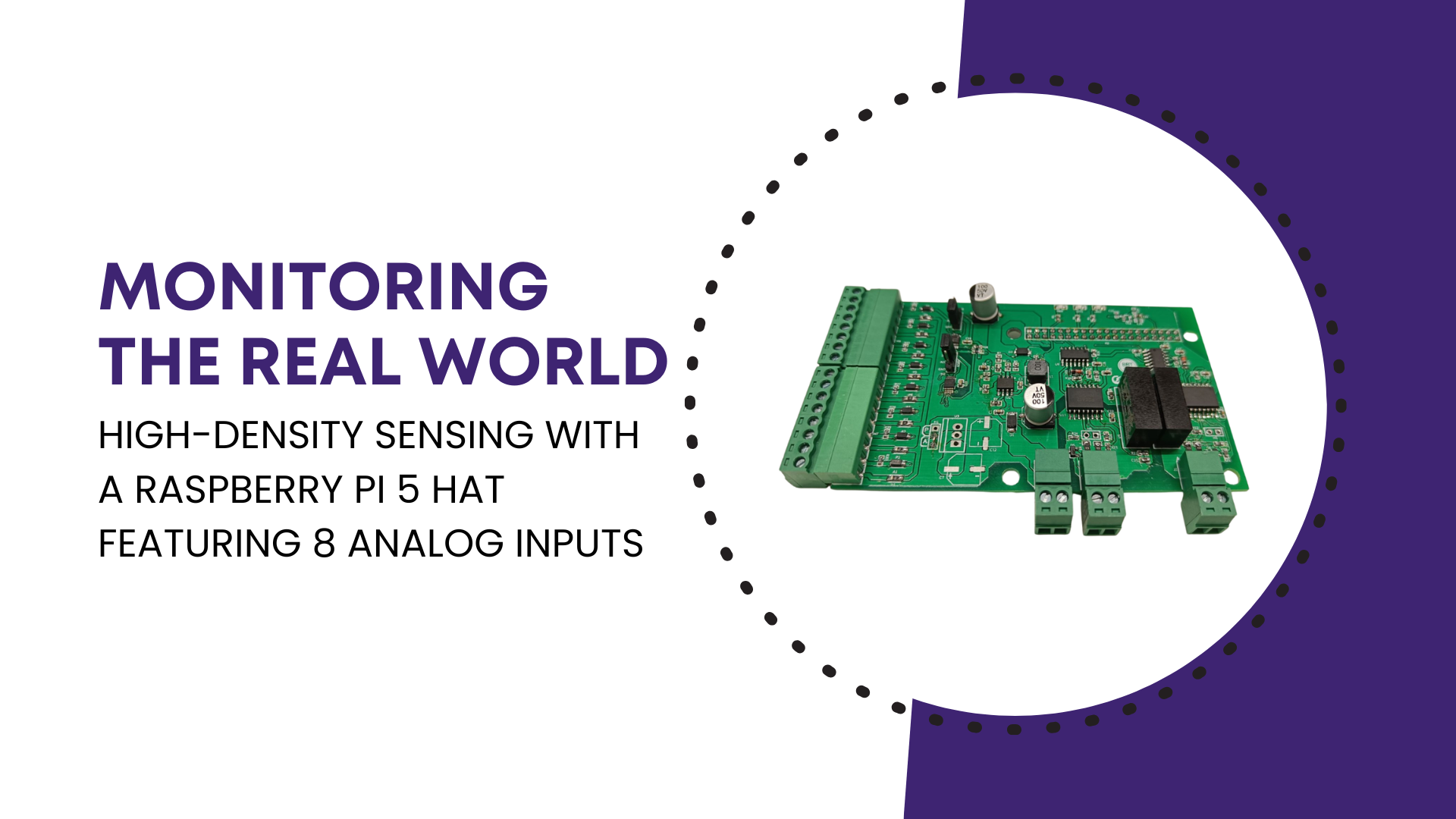
Monitoring the Real World: High-Density Sensing with a Raspberry Pi 5 HAT Featuring 8 Analog Inputs
Real-world signals are analog. Temperature, pressure, light, and vibration do not arrive as clean digital numbers. They arrive as continuous voltages that a microcontroller or single-board computer must convert into usable data. The Raspberry Pi 5 solves compute problems well, but it lacks native analog inputs. This gap is where a dedicated Raspberry Pi 5 HAT with 8 Analog Inputs becomes a practical tool for engineers, hobbyists, and industrial integrators.
This article explains how this class of HAT works, why it matters for dense sensing projects, and how to use it effectively in real deployments.
Why the Raspberry Pi 5 Needs an Analog Expansion Board
The Raspberry Pi 5 ships with a fast quad-core processor and improved I/O bandwidth. It supports I2C, SPI, UART, and 28 GPIO pins. None of these pins read analog voltage directly. Every GPIO pin on the board reads only high or low states.
This limitation forces developers to add an external analog-to-digital converter (ADC) whenever a project needs to measure a physical quantity like voltage, resistance, or current. A Raspberry Pi 5 HAT with built-in analog channels removes this extra wiring step and gives the board a direct path to sensor data.
Common Signals That Require Analog Input
-
Temperature from thermistors or analog temperature ICs
-
Light intensity from photoresistors or photodiodes
-
Soil moisture from resistive or capacitive probes
-
Gas concentration from analog gas sensors
-
Pressure from analog pressure transducers
-
Current sensing from shunt-based analog sensors
Each of these sensors outputs a voltage that changes with the measured condition. Without an ADC, the Raspberry Pi cannot interpret that voltage.
What an 8-Channel Analog HAT Actually Does
A Raspberry Pi 5 HAT with 8 Analog Inputs sits directly on top of the 40-pin GPIO header. It contains an ADC chip, signal conditioning circuitry, and a communication interface, usually I2C or SPI, that talks to the Pi's processor.
The board converts up to eight separate analog voltages into digital values the Raspberry Pi can read through software. Most boards in this category use a 12-bit or 16-bit ADC resolution.
Resolution and What It Means in Practice
-
A 12-bit ADC produces 4,096 discrete voltage steps across its input range.
-
A 16-bit ADC produces 65,536 discrete steps, giving far finer measurement precision.
-
On a 0–5V reference, a 12-bit ADC resolves about 1.22 mV per step.
-
A 16-bit ADC on the same range resolves about 0.076 mV per step.
Higher resolution matters most in applications like load cell weighing or precision temperature logging, where small voltage shifts carry real meaning.
Core Hardware Specifications to Check
Not every analog HAT performs the same way. Before choosing one, an engineer should review a short list of specifications.
-
Channel count: eight single-ended inputs, or four differential pairs on some designs
-
ADC resolution: 12-bit, 16-bit, or in rare cases 24-bit for lab-grade accuracy
-
Sampling rate: typically between 860 samples per second (SPS) and 3.3 million SPS depending on chip and interface
-
Input voltage range: common ranges include 0–3.3V, 0–5V, and 0–10V with attenuation
-
Communication protocol: I2C for simplicity, SPI for speed
-
Power draw: most boards use under 50 mA in active mode
A board with SPI communication and a fast ADC chip suits vibration monitoring or audio-frequency sampling. A simpler I2C board suits slow-changing signals like room temperature or humidity.
Practical Applications for 8-Channel Analog Sensing
An 8-channel board allows a single Raspberry Pi 5 to monitor multiple conditions at once. This density reduces hardware cost and simplifies wiring compared to using several single-channel ADC modules.
1. Environmental Monitoring Stations
A weather or greenhouse station can combine temperature, humidity, soil moisture, and light sensors on one board. Eight channels allow room for four sensor types with redundant probes for accuracy checks.
2. Industrial Equipment Monitoring
Factories often track vibration, current draw, and temperature on rotating machinery. A Raspberry Pi 5 HAT with analog inputs lets a technician build a low-cost condition monitoring system instead of buying a proprietary industrial data logger, which often costs several hundred dollars more.
3. Home and Building Automation
Analog light sensors, water level sensors, and gas detectors fit naturally into a smart building system. Eight channels support a small automation hub without needing multiple expansion boards stacked on the Pi.
4. Agricultural Sensing Networks
Soil moisture and nutrient sensors output analog signals across a field. A Raspberry Pi 5 with an analog HAT can serve as a field gateway, collecting data from several probes before sending it to a cloud dashboard.
Accuracy and Calibration Considerations
Raw ADC readings rarely match real-world values without adjustment. Two main sources of error affect accuracy.
1. Reference Voltage Drift
The ADC compares input voltage against an internal or external reference. If that reference drifts due to temperature, every reading shifts slightly. Quality boards use a stable voltage reference chip to reduce this problem.
2. Sensor Nonlinearity
Many analog sensors, such as thermistors, do not produce a linear voltage-to-measurement relationship. Developers typically apply a lookup table or a polynomial formula to convert raw voltage into an accurate reading.
3. Calibration Checklist
-
Test each channel against a known reference voltage source.
-
Record offset and gain error for each channel.
-
Apply correction factors in software before logging data.
-
Repeat calibration every few months in industrial settings.
A study from the National Institute of Standards and Technology notes that ADC calibration drift of even 0.1% can cause measurable error in precision instrumentation over time. This makes periodic calibration a standard practice rather than an optional step.
Comparing Analog HATs to Standalone ADC Modules
Some developers choose standalone ADC breakout boards instead of a full HAT. Both approaches work, but they differ in convenience and scale.
|
Feature |
8-Channel Analog HAT |
Standalone ADC Module |
|
Wiring complexity |
Low, direct GPIO mount |
Higher, requires jumper wires |
|
Channel count per board |
Up to 8 |
Often 1 to 4 |
|
Mechanical stability |
High, fixed mount |
Lower, prone to loose wires |
|
Cost per channel |
Generally lower |
Generally higher at scale |
|
Setup time |
Faster with standard libraries |
Varies by chip |
For projects needing more than four analog channels, a single HAT often costs less and takes less time to assemble than several separate ADC breakout boards.
Power and Signal Integrity Tips
Analog signals are sensitive to electrical noise. A few practices improve reading stability on a Raspberry Pi 5 setup.
-
Keep analog signal wires short, ideally under 30 cm for unshielded cable.
-
Route analog wires away from motor cables and power supply lines.
-
Add a small capacitor, around 0.1 µF, near each sensor input to filter noise.
-
Use shielded cable for runs longer than one meter.
-
Power sensitive sensors from a separate regulated supply when possible.
These steps reduce noise-induced errors, which commonly appear as random voltage spikes in raw sensor logs.
Data Logging and Visualization Options
Once the HAT reads stable data, the next step is storage and display. A Raspberry Pi 5 handles this comfortably given its processing power.
1. Local Storage Options
-
SQLite database for lightweight local logging
-
CSV files for simple, portable data export
-
InfluxDB for time-series data at higher sampling rates
2. Visualization Tools
-
Grafana dashboards connected to InfluxDB or SQLite
-
Node-RED for quick visual flow-based monitoring
-
Custom Python scripts using Matplotlib for offline analysis
A typical setup samples each channel once per second, logs the value with a timestamp, and displays a rolling graph on a local dashboard. This configuration suits most environmental and industrial monitoring needs without overloading the Pi's resources.
Choosing the Right HAT for a Project
Selecting the correct Raspberry Pi 5 HAT with 8 Analog Inputs depends on three main factors.
-
Required precision: Choose 16-bit resolution for lab or financial-grade measurements. Choose 12-bit for general environmental sensing.
-
Sampling speed needs: Vibration or audio work needs a faster SPI-based ADC. Slow-changing signals work fine with I2C.
-
Voltage range compatibility: Match the board's input range to the sensor's output range, or add a voltage divider circuit if needed.
Buyers should also check community support and library availability. A board with an active GitHub repository and clear documentation saves significant development time.
Conclusion
A dedicated analog expansion board turns the Raspberry Pi 5 into a capable data acquisition system. It closes the gap between digital computing and analog reality, giving engineers a direct way to measure temperature, pressure, light, and dozens of other physical quantities on one compact board.
For anyone building an environmental station, an industrial monitor, or a smart agriculture system, a Raspberry Pi 5 HAT with eight analog channels offers a practical, cost-effective path from raw sensor voltage to actionable data. With proper calibration, clean wiring, and the right software stack, this hardware combination delivers reliable, high-density sensing for both hobby and professional projects.

 Arabic
 French
 Spanish
 Portuguese
 Deutsch
 Turkish
 Dutch
Dutch
 Italiano
 Russian
 Romaian
 Portuguese (Brazil)
 Greek
Greek
