


Fermented Legume Protein Market to Cross USD 3.6 Billion by 2036
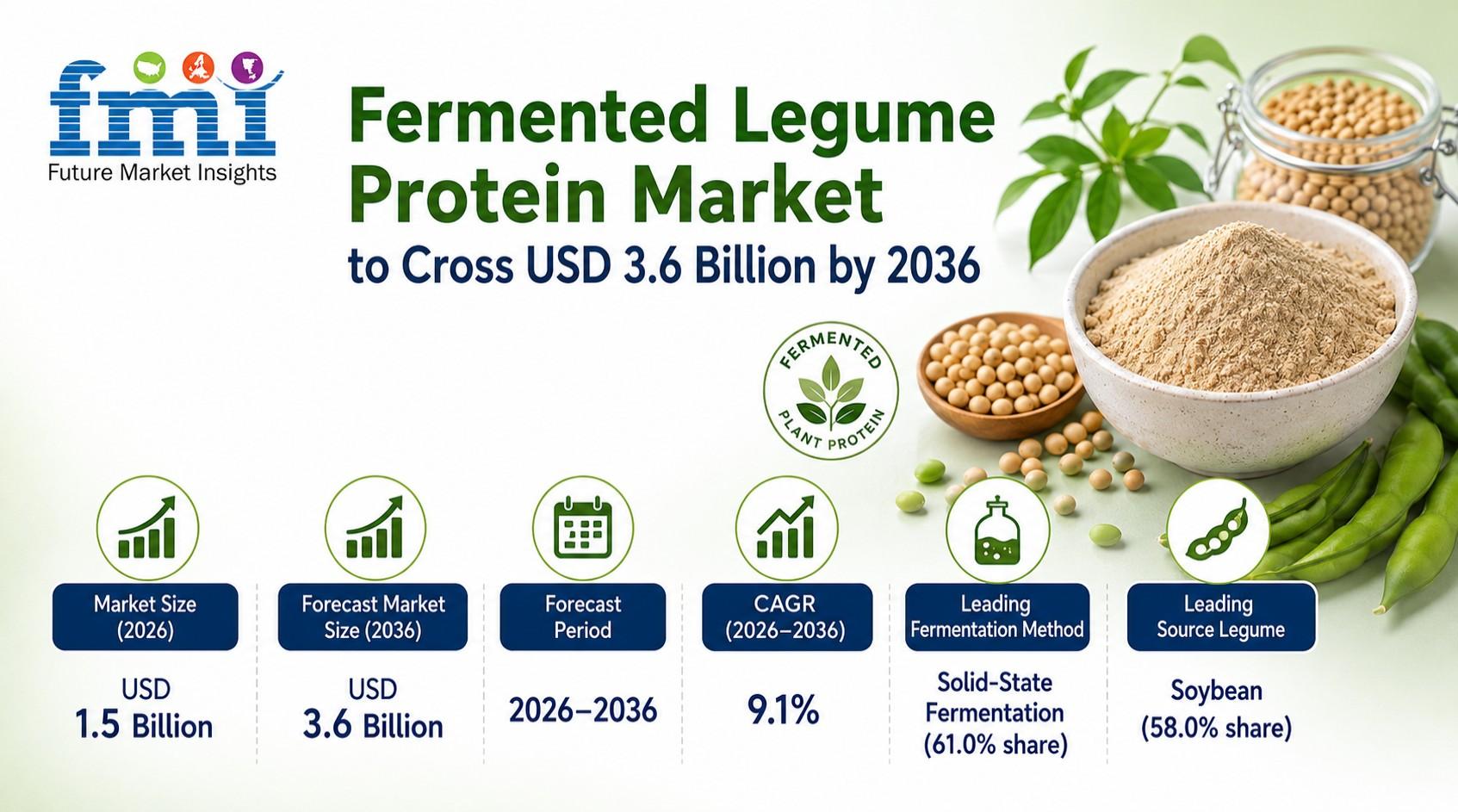
The global fermented legume protein market is experiencing a significant structural shift, emerging as a clean-label correction to the first wave of highly processed plant-based meat alternatives. Driven by consumers demanding shorter ingredient lists, better digestibility, and superior flavor profiles, food manufacturers are turning to microbial fermentation to overhaul raw pulse bases. According to comprehensive industry insights by Future Market Insights, the global market is projected to reach USD 1.5 billion in 2026 and surge to USD 3.6 billion by 2036, expanding at an impressive Compound Annual Growth Rate (CAGR) of 9.1%. This expansion represents an absolute dollar opportunity of USD 2.1 billion over the ten-year forecast period.
Request a Sample Report: https://www.futuremarketinsights.com/reports/sample/rep-gb-33410
Key Market Highlights at a Glance
· Market Size (2026): USD 1.5 Billion
· Forecast Market Size (2036): USD 3.6 Billion
· Forecast Period: 2026–2036
· CAGR (2026–2036): 9.1%
· Leading Fermentation Method: Solid-State Fermentation (61.0% share)
· Leading Source Legume: Soybean (58.0% share)
· Leading Product Format: Whole-Bean Blocks (52.0% share)
· Primary Application Segment: Meat Alternatives (44.0% share)
· Primary Distribution Channel: Retail Chilled (46.0% share)
· Fastest-Growing Country Market: India (10.8% CAGR)
Why Is the Fermented Legume Protein Market Growing?
The rapid double-digit expansion of the fermented legume protein sector is propelled by flavor chemistry breakthroughs, texturizing innovations, and culinary versatility.
Key Growth Drivers
· Microbial Taste Optimization: Legumes like pea, fava, chickpea, and lentil natively carry volatile organic compounds (such as hexanal) that cause unwanted "beany" off-notes. Specialized lactic acid and fungal fermentation systems break down these compounds, creating a clean, neutral substrate that reduces the need for masking agents and chemical sweeteners.
· The Rise of Whole-Food Transparency: Whole-bean blocks sell as whole, recognizable foods rather than industrial powders. Consumers can see the grains and cultures on short, easy-to-read labels, boosting consumer trust in the refrigerated aisle.
· Foodservice and Kitchen Reliability: Multi-channel food operations are testing tempeh-style blocks because they maintain structural shape, hold marinades, and stand up well to commercial slicing, dicing, and high-heat stir-frying without breaking down.
“Fermented legume protein is a correction to the first wave of plant-based meat. Buyers ask whether a product tastes clean and digests well. They also check whether it fits a short label. That favors tempeh blocks and okara ferments. Pulse protein fermentates can reduce beany notes before the recipe bench.” Nandini Roy Choudhury, Principal Consultant at FMI
Solid-State Fermentation Underpins Processing; Soy Remains the Volume Baseline
Solid-State Fermentation (SSF) is the dominant production pathway, projected to hold a 61.0% share of the global method matrix in 2026. Low-moisture pulse substrates, whole beans, and agricultural side-streams (such as okara) natively suit SSF biocultures. Soybean remains the top source legume with a 58.0% market share, drawing on deeply institutionalized global supply chains for traditional natto and tempeh. Concurrently, non-soy alternatives led by chickpea, pea, fava, and lupin are expanding rapidly to support allergen-free product claims.
Whole-Bean Blocks Lead Retail Formats; Meat Alternatives Drive Consumption
Whole-bean blocks stand as the premier layout format, capturing an estimated 52.0% share of product demand in 2026. This dominance is driven by high-volume retail listings where shoppers can quickly understand a visible block format over B2B powders. Meat alternatives serve as the primary destination for these proteins, commanding a 44.0% market application share. Supermarket retail chilled aisles serve as the primary launchpad, handling 46.0% of market sales due to high product visibility next to legacy meat-free items and prepared tofu lines.
Market Dynamics
· Market Drivers: Increased consumer demand for clean-label plant options, rising institutional adoption of stable meat alternatives in foodservice menus, and advanced micro-scale taste correction breakthroughs.
· Market Restraints: Process execution requires precise climate and culture management. Shorter ambient shelf lives mean smaller, independent producers face high operational risks without cold-chain infrastructure and disciplined temperature monitoring.
Custom Research Available: https://www.futuremarketinsights.com/customization-available/rep-gb-12671
Regional and Country Outlook
Country Growth Rates (CAGR through 2036)
· India — 10.8% CAGR
· United Kingdom — 9.7% CAGR
· United States — 9.5% CAGR
· Germany — 9.3% CAGR
· France — 8.9% CAGR
· China — 8.6% CAGR
· South Korea — 8.4% CAGR
· Japan — 7.8% CAGR
India is emerging as the premier global growth engine, projected to register a 10.8% CAGR through 2036. This performance is sustained by massive domestic pulse production, government programs like the Mission for Aatmanirbharta in Pulses, and an urban consumer base looking for premium, high-protein options through quick-commerce apps. The United Kingdom follows with an exceptional 9.7% CAGR, driven by major supermarket groups allocating dedicated refrigerated space to local plant-based brands. The United States tracks closely at a 9.5% CAGR, supported by natural retail networks and deep B2B ingredient research.
Competitive Landscape
The global market features competition between retail-ready branded whole-food processors and advanced business-to-business ingredient fermenters.
Key Companies:
Mainstream chilled retail branding and packaging are led by Better Nature, Tiba Tempeh, The Tofoo Co (recently backed by Comitis Capital), Noble Bean, and Plant Power Foods. Specialized B2B ingredient optimization and microbial technology scaling are fiercely driven by MycoTechnology, Ferm Food, European Protein, NextFerm, and upcycled side-stream pioneers Luya Foods and Yellow Sunshine.
Exclusive Discounts on Full Report: https://www.futuremarketinsights.com/reports/fermented-legume-protein-market
Frequently Asked Questions
How big is the fermented legume protein market in 2026?
The global fermented legume protein market is estimated to be valued at USD 1.5 billion in 2026.
What will be the size of the fermented legume protein market in 2036?
The industry revenue is predicted to cross USD 3.6 billion by 2036, expanding at a CAGR of 9.1%.
Which fermentation method segment holds the dominant position?
Solid-state fermentation leads the processing landscape, accounting for 61.0% of the market share in 2026 because low-moisture environments match whole-bean blocks and side-stream inputs.
What is the primary product format driving retail consumer sales?
Whole-bean blocks lead the product formatting field, commanding a 52.0% share in 2026 because they offer visible cooking cues and clean labels that consumers easily recognize.
Who are the main companies leading the global market space?
The value chain is led by retail brands Better Nature, Tiba Tempeh, and The Tofoo Co, alongside advanced ingredient technology platforms MycoTechnology and Ferm Food.
FMI Custom Research: Strategic Intelligence for Confident Decision-Making
In today's rapidly evolving business environment, leadership teams need more than market data they need clear, actionable intelligence tailored to their strategic objectives. FMI's Custom Research solutions are designed around the specific business questions organizations need answered, enabling executives to evaluate growth opportunities, validate investments, assess competitive dynamics, and reduce uncertainty before making critical decisions.
Key Executive Benefits
• Decision-Ready Insights tailored to business priorities
• Reduced Strategic Risk through validated market intelligence
• Market Entry Confidence with detailed competitive analysis
• Competitive Advantage supported by proprietary research
• Faster Growth Decisions through customized strategic insights
• Primary Market Validation from industry stakeholders
• Global Industry Expertise across diverse sectors
• Proven Track Record with thousands of consulting engagements
Business Impact
FMI helps organizations transform market complexity into strategic clarity, enabling leadership teams to identify growth opportunities faster, optimize resource allocation, strengthen competitive positioning, and make high-stakes business decisions with confidence.
To explore how FMI Custom Research can support your strategic priorities, please connect with our team at - sales@futuremarketinsights.com
Why Choose FMI: https://www.futuremarketinsights.com/why-fmi
Explore More Related Studies Published by FMI Research
Feed Grade Oils market : https://www.futuremarketinsights.com/reports/feed-grade-oils-market
Ethylhexyl Palmitate Market : https://www.futuremarketinsights.com/reports/ethylhexyl-palmitate-market
Explore In-Depth Food & Beverage Market Insights : https://www.futuremarketinsights.com/industry-analysis/food-and-beverage
About Future Market Insights (FMI)
Future Market Insights, Inc. is an ESOMAR-certified, ISO 9001:2015 market research and consulting organization trusted by Fortune 500 companies. With a global presence across the U.S., UK, India, and Dubai, FMI delivers data-driven insights across 30+ industries and 1200 markets worldwide.
Contact Us
Future Market Insights Inc.
Christiana Corporate, 200 Continental Drive,
Suite 401, Newark, Delaware – 19713, USA
T: +1-347-918-3531
For Sales Enquiries: sales@futuremarketinsights.com
Website: https://www.futuremarketinsights.com

 English
 Arabic
 French
 Spanish
 Portuguese
 Deutsch
 Turkish
 Dutch
Dutch
 Italiano
 Russian
 Portuguese (Brazil)
 Greek
Greek
