


AI Agents vs Agentic AI vs Generative AI: Use Cases Explained
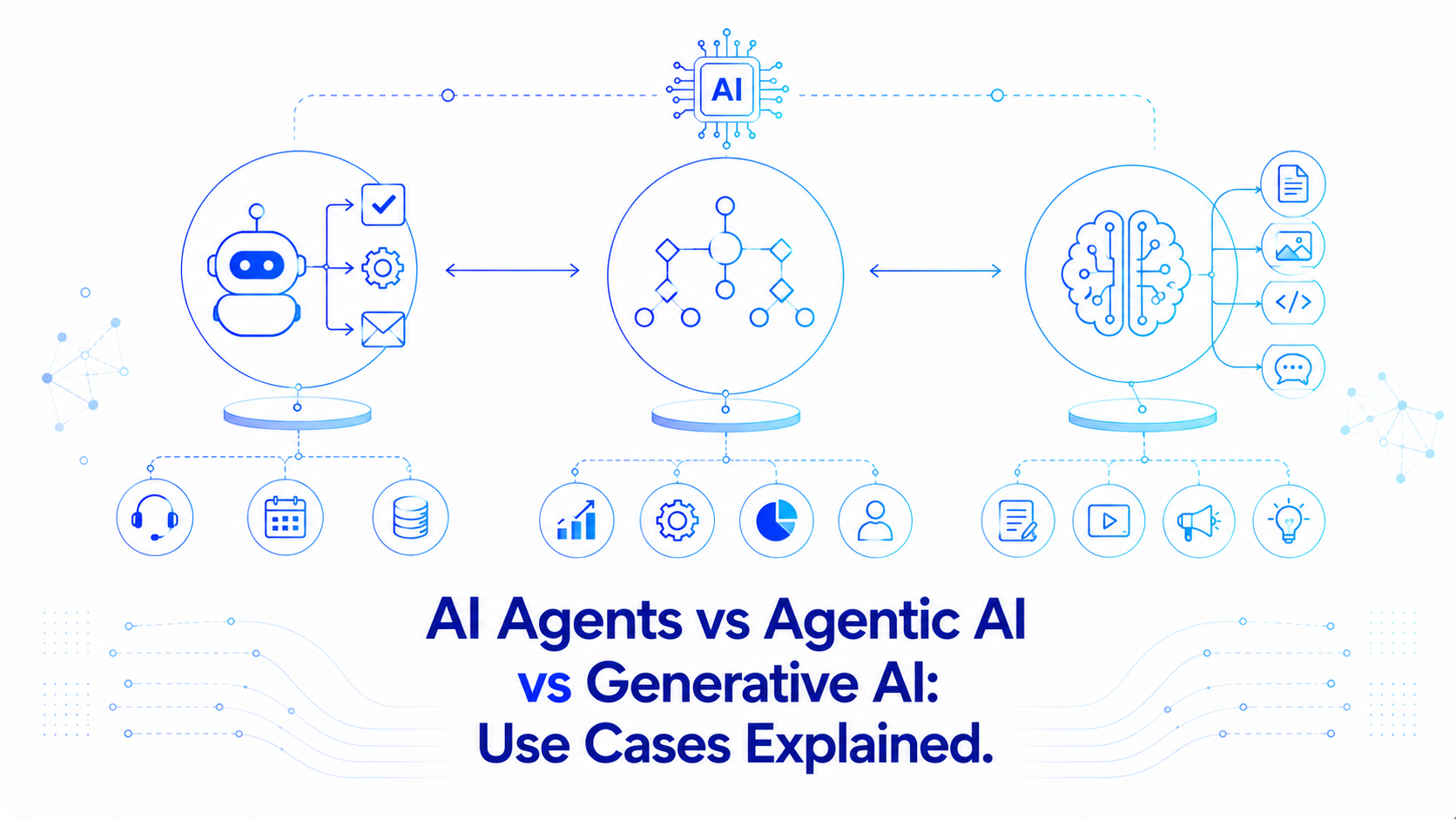
Artificial intelligence has advanced beyond the level of simple automation and introduced many powerful approaches. Understanding AI Agents vs Agentic AI vs Generative AI has become necessary for every business that wants to implement these intelligent solutions and measure their value in business terms. Although these terms can be deemed similar or even interchangeable, they each carry their own strengths and offer various solutions that can vary from one another in many ways. This article will describe each approach, how they work, and their use cases in business.
Understanding the Core Concepts of AI Agents, Agentic AI, and Generative AI
AI Agents are autonomous or semi-autonomous systems that can be used for carrying out a certain task by viewing their surroundings, making decisions, and performing operations to meet a predetermined aim. These types of systems function under strictly defined rules or constraints. When comparing AI Agent vs Generative AI, one must consider that AI agents primarily perform actions and make decisions, while generative AI works on generating new material like text, pictures, audio, and code.
Generative AI employs the use of large models and deep learning to create novel responses to given data in the form of output. Generative AI systems perform well in terms of creativity and understanding natural languages but perform poorly in the actions of self-directed behavior. It was the poor performance in tasks that involve autonomous behavior for a specified goal that resulted in the advent of the agentic paradigm of AI.
Agentic AI represents a step beyond traditional automation by enabling systems to define goals, adapt strategies, and execute multi-step tasks without constant human input. The comparison of Agentic AI vs AI Agent highlights how agentic AI is not limited to predefined actions but can dynamically adjust its behavior based on outcomes, context, and feedback.
Differences Between Gen AI vs AI Agents vs Agentic AI
The differences between Gen AI vs AI Agents vs Agentic AI become clearer when viewed through functionality and autonomy. Generative AI specializes in producing content and responses but depends heavily on user prompts. AI agents execute specific tasks and decisions but usually operate within narrow boundaries. Agentic AI blends both capabilities while adding long-term planning, self-reflection, and tool orchestration.
In practical terms, generative AI is ideal for content creation, AI agents are best for structured automation, and agentic AI excels in complex, goal-driven environments. Businesses comparing AI Agent vs Generative AI often discover that combining these approaches leads to more intelligent and adaptive systems. Accessing the right AI solution development helps organizations identify which combination best suits their operational goals.
Use Cases of AI Agents, Agentic AI, and Generative AI Across Industries
Use Cases of AI Agents in Business Operations
AI agents find applications in enterprise automation activities and customer support. In the context of eCommerce applications, AI agents handle inventory and user activity tracking and the automation of ordering processes. In customer service support systems, they operate as intelligent robots in the form of chatbots that can provide immediate solutions to customers. The finance sector employs AI agents for detecting fraud and algo trading.
When breaking down use cases of AI Agents, Agentic AI, and Generative AI, it is clear that AI agents have come out as a game-changer in efficiency and minimizing costs. To implement these systems effectively, many organizations choose to hire dedicated developer specialists who ensure that processes are scaled without extra effort or operational disruption.
Use Cases of Generative AI for Creativity and Productivity
The impact of Generative AI was felt in various industries that are related to content, design, and communication. Marketing professionals now use this technology to write blog posts, copy for advertisements, and content for their social media pages. Developers also use this technology to write code and to solve bugs. Healthcare professionals now use this technology to write documentation and summaries of reports.
Although the capabilities offered are vast, generative AI is not autonomous. This is because many companies choosing Agentic AI vs AI Agent vs Generative AI incorporate the generative capability into the agents for greater productivity with control and precision intact.
Use Cases of Agentic AI for Intelligent Decision-Making
Agentic AI systems have immense applications in situations that demand planning, adaptability, and continuous learning. In the field of supply chains, agentic AI systems track the dynamics of demand, refine logistics, and also negotiate the decisions made by the suppliers. In cybersecurity, agentic AI systems automatically detect threats, implement counter-strategies, and also learn from patterns.
In software development and DevOps, agentic AI can analyze and control the whole process of system deployment, check system and application health, and fix problems without human assistance and intervention. Understanding the full picture of AI Agents vs Agentic AI vs Generative AI reveals why all these sophisticated functions reflect the increasing investment of organizations in agentic solutions, often sourced through reliable AI development services that understand the process's requirements and nuances.
Choosing the Right AI Approach for Your Business
Whether to pick between AI agents, Agentic AI, and generative AI depends on the aims and requirements of the business. Some businesses might aim at automating processes and will therefore prefer AI agents, while some might prefer generative AI for its creative processes and content generation. Others might look for full autonomy and will therefore use Agentic AI frameworks.
Collaboration with professional Generative AI development services providers ensures smooth amalgamation, ethical AI, and future-proof scalability. Companies that provide best-in-class AI development support are instrumental in enabling organisations to effectively align these AI paradigms for unlocking better returns and innovative results.
Conclusion
Agentic AI, AI Agent, or Generative AI — the debate amongst the three is not to choose amongst them, but to comprehend the bigger picture that the three create in the context of an AI plan. AI agents provide the foundation for the automation process, generative AI powers creative tasks, and agentic intelligence ties both together for complex, goal-driven outcomes.
Organizations that invest in the right AI development solutions gain the structural advantage needed to deploy these approaches effectively — ensuring each system aligns with business objectives, scales with demand, and delivers measurable results over time.

 English
 Arabic
 French
 Spanish
 Portuguese
 Deutsch
 Turkish
 Dutch
Dutch
 Italiano
 Russian
 Romaian
 Portuguese (Brazil)
