


On-Page SEO Services for E-commerce Websites: Best Practices
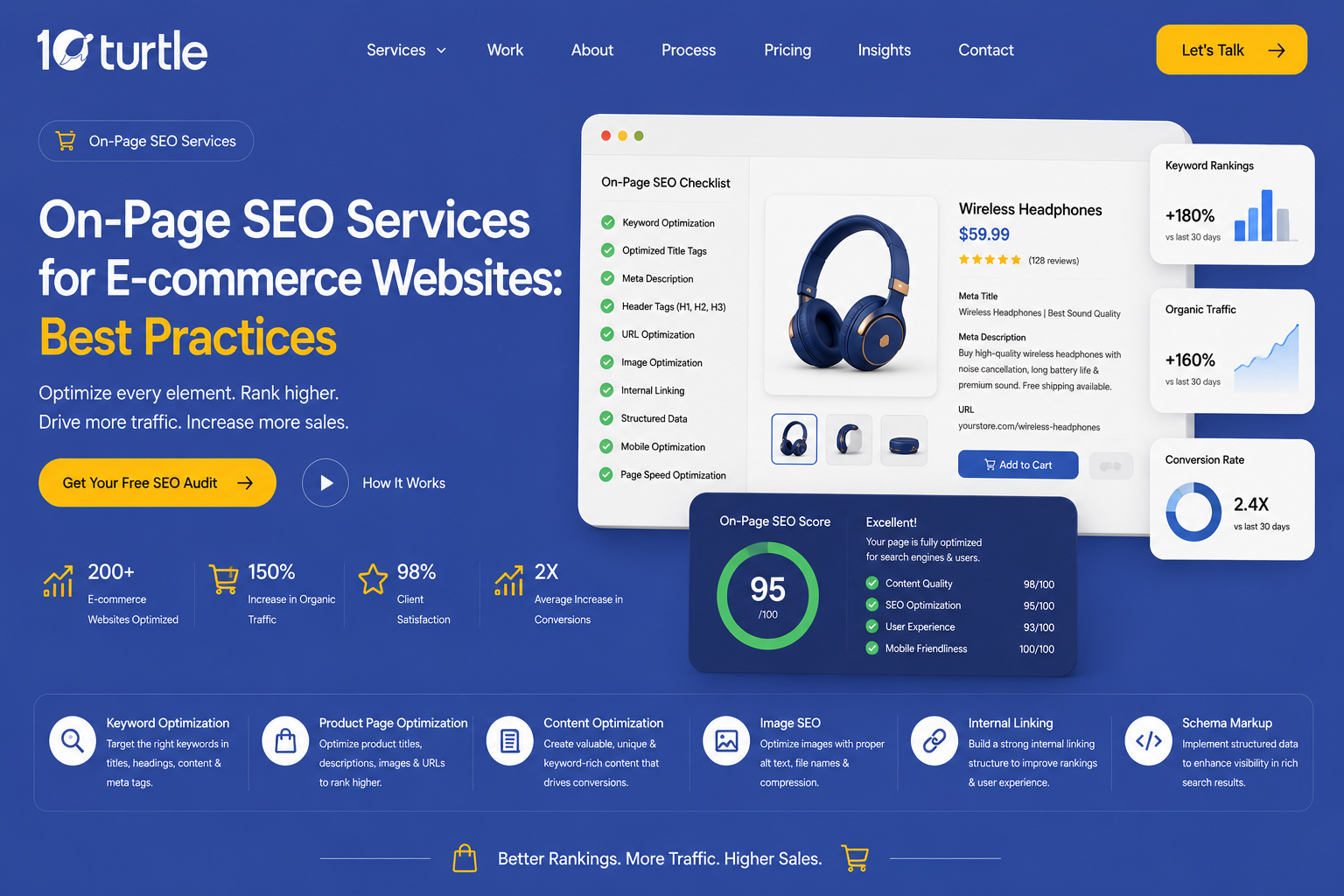
If you run an online store in the US, you already know that traffic doesn't show up by accident. Working with experienced on-page SEO services for e-commerce websites helps you fix product page structure, speed, and content so search engines actually understand what you sell. In this guide, we'll walk through the exact best practices that top US online retailers use in 2026 to rank higher, convert more visitors, and stay ahead of AI-powered search results.
What Is On-Page SEO, and Why Does It Matter for Online Stores?
On-page SEO is everything you control directly on your website your titles, your content, your images, your internal links, and your technical setup that helps search engines like Google understand and rank your pages. For e-commerce specifically, this isn't just about blog posts. It's about product pages, category pages, collection pages, and even your cart and checkout flow.
Unlike a blog or a service-based business, an online store often has thousands of pages. A shoe retailer might have 50 product variations across 10 categories. A supplement brand might have hundreds of SKUs. Without a solid on-page SEO strategy, most of those pages will never rank for anything, no matter how good your products are.
This is exactly why so many US-based brands from small Shopify stores in Austin to large multi-category retailers in New Jersey invest in ongoing on-page SEO instead of treating it as a one-time task.
Short-Tail vs. Long-Tail Keywords for E-commerce
Before touching a single page, keyword strategy needs to be clear.
- Short-tail keywords (like "running shoes" or "office chairs") have huge search volume but are extremely competitive. Ranking for these usually takes months or years, and typically only category pages should target them.
- Long-tail keywords (like "best waterproof running shoes for wide feet" or "ergonomic office chair for lower back pain") have lower volume but much higher purchase intent. These convert better and are far easier to rank for, especially for newer stores.
- LSI keywords (Latent Semantic Indexing terms) are related words and phrases that give search engines context. For a page about "running shoes," LSI terms might include "cushioning," "breathable mesh," "trail running," "arch support," or "marathon training." Including these naturally throughout your copy signals topical depth to Google.
A smart e-commerce SEO strategy blends all three: short-tail terms on your homepage and top-level category pages, long-tail terms on product and subcategory pages, and LSI keywords woven throughout the actual content to add depth and relevance.
Best On-Page SEO Practices for E-commerce Websites
1. Optimize Title Tags and Meta Descriptions
Every product and category page needs a unique title tag under 60 characters and a meta description under 155-160 characters. Avoid generic titles like "Product 1234." Instead, include your primary keyword, brand name, and a value proposition. For example: "Men's Waterproof Trail Running Shoes | Free US Shipping – BrandName."
Meta descriptions don't directly boost rankings, but they heavily influence click-through rate, which is a strong indirect ranking signal.
2. Use Clean, Descriptive URL Structures
URLs like yourstore.com/product/sku-4821-x tell search engines nothing. Compare that to yourstore.com/mens-trail-running-shoes. Clean, keyword-rich URLs are easier for Google to understand and easier for shoppers to trust when they see the link in search results.
3. Structure Header Tags Properly (H1, H2, H3)
Each page should have exactly one H1 that clearly states what the page is about. Use H2 and H3 tags to break up sections like "Features," "Sizing Guide," "Materials," and "Customer Reviews." This structure helps both users and search engine crawlers scan the page quickly.
4. Write Unique, Detailed Product Descriptions
This is one of the biggest mistakes US e-commerce sites make: copying manufacturer descriptions word-for-word across hundreds of products. Google flags this as duplicate content, and it kills rankings. Instead, write original descriptions of at least 150-300 words per product that cover use cases, materials, sizing, and benefits — not just specs.
5. Optimize Images and Alt Text
Product images should be compressed for fast loading (WebP format is ideal) and named descriptively for example, blue-suede-oxford-shoes.jpg instead of IMG_2938.jpg. Alt text should describe the image naturally while including relevant keywords where it makes sense, which also improves accessibility for visually impaired shoppers using screen readers an increasingly important compliance factor for US retailers under ADA web accessibility guidelines.
6. Improve Page Speed and Core Web Vitals
Google's Core Web Vitals Largest Contentful Paint (LCP), Interaction to Next Paint (INP), and Cumulative Layout Shift (CLS) directly affect rankings and user experience. For e-commerce, this usually means compressing images, using a content delivery network (CDN), minimizing third-party scripts (like too many marketing pixels), and enabling browser caching.
7. Build a Strong Internal Linking Structure
Link from category pages to relevant products, from blog content to related products, and from product pages to complementary items ("You may also like"). This spreads link equity across your site and keeps users browsing longer, which reduces bounce rate.
8. Implement Schema Markup (Structured Data)
Product schema allows search engines to display rich results star ratings, price, and stock availability directly in search listings. This is one of the highest-impact, most underused on-page tactics for e-commerce. Review schema, FAQ schema, and breadcrumb schema also help pages stand out in crowded search results.
9. Use Breadcrumb Navigation
Breadcrumbs (Home > Men's Shoes > Running Shoes > Trail Running) improve navigation, reduce bounce rate, and show up directly in Google search snippets when paired with schema markup, giving your listing more visual real estate.
10. Handle Duplicate Content and Canonical Tags
E-commerce sites often generate duplicate URLs through filters, sorting options, and size/color variations (e.g., ?color=red&size=medium). Use canonical tags to tell Google which version is the "master" page, preventing your own pages from competing against each other in search results.
11. Optimize for Mobile-First Indexing
Google indexes the mobile version of your site first. Since most US online shopping now happens on mobile devices, your product pages, cart, and checkout must load fast and function flawlessly on smaller screens.
12. Optimize Category and Collection Pages
Category pages should include a short block of unique, keyword-rich content (200-400 words) above or below the product grid. This gives Google enough text to understand the page's topic, since product grids alone don't provide much crawlable text.
What's New in E-commerce On-Page SEO
A few shifts are reshaping on-page SEO for US e-commerce brands right now:
AI-generated search summaries. Google's AI-powered search overviews now pull directly from well-structured product and FAQ content. Pages with clear, direct answers near the top of the page are more likely to be featured in these AI summaries, which makes structured FAQ sections and concise product answers more valuable than ever.
Voice search optimization. With more shoppers using voice assistants to search for products ("find affordable wireless earbuds under $50"), writing in a natural, conversational tone with long-tail, question-based phrases helps capture this traffic.
Seasonal and holiday-specific pages. US shoppers search heavily around Black Friday, Cyber Monday, and back-to-school seasons. Creating dedicated, on-page-optimized landing pages for these events rather than just slapping a banner on the homepage captures significant seasonal search volume.
Local inventory and "near me" searches. For US brands with physical stores alongside their online shop, optimizing for "buy [product] near me" searches using local business schema and location-specific landing pages is an increasingly effective on-page tactic.
Accessibility as an SEO factor. ADA compliance and accessible design (proper alt text, readable contrast, keyboard navigation) are being treated more seriously by search engines as part of overall page quality and user experience signals.
Common On-Page SEO Mistakes E-commerce Sites Make
- Thin or duplicate product descriptions copied from suppliers
- Missing or generic alt text on product images
- Slow-loading pages due to unoptimized images and excessive scripts
- No internal linking strategy between related products and categories
- Ignoring out-of-stock product pages instead of redirecting or updating them
- Overstuffing keywords unnaturally instead of writing for real shoppers
- Not updating title tags and meta descriptions as products or pricing change
How Professional On-Page SEO Services Help E-commerce Brands
Handling all of this manually across hundreds or thousands of pages is time-consuming, which is why many US e-commerce businesses bring in dedicated SEO specialists or agencies. A good on-page SEO service typically includes:
- A full site audit identifying duplicate content, broken links, and technical issues
- Keyword mapping across category and product pages
- Content rewrites for product descriptions and category pages
- Technical fixes for page speed, schema markup, and mobile usability
- Ongoing monitoring of rankings, click-through rates, and conversion data
The goal isn't just higher rankings it's more qualified traffic that actually converts into sales, which is the real measure of e-commerce SEO success.
Frequently Asked Questions
1. What is the difference between on-page and off-page SEO for e-commerce?
On-page SEO covers everything on your website you control directly content, titles, structure, speed, and schema. Off-page SEO involves external factors like backlinks, brand mentions, and social signals. Both matter, but on-page SEO is the foundation that off-page efforts build on.
2. How long does it take to see results from on-page SEO?
Most e-commerce sites start seeing measurable improvements in traffic and rankings within 3 to 6 months, though highly competitive short-tail keywords can take longer. Long-tail product pages often show results faster.
3. Do I need unique content on every single product page?
Yes. Even small changes different phrasing, added use cases, or unique customer benefit angles help avoid duplicate content penalties and improve individual page relevance.
4. How important is page speed for e-commerce SEO?
Very important. Studies consistently show that even a one-second delay in page load time can significantly reduce conversion rates, and Google factors Core Web Vitals directly into rankings.
5. Should I optimize for keywords or for the customer?
Both, but the customer comes first. Write naturally, answer real questions, and include keywords where they fit organically. Google's algorithms are built to reward genuinely helpful content over keyword-stuffed pages.
Final Thoughts
On-page SEO for e-commerce isn't a one-time checklist it's an ongoing process that grows alongside your product catalog. Title tags, unique product descriptions, image optimization, schema markup, and page speed all work together to help search engines and shoppers find exactly what they're looking for on your site.
For US-based online retailers competing in an increasingly AI-driven search landscape, the brands that treat on-page SEO as a core part of their growth strategy not an afterthought are the ones that will keep winning organic traffic and sales in 2026 and beyond.

 English
 Arabic
 French
 Spanish
 Portuguese
 Deutsch
 Turkish
 Dutch
Dutch
 Italiano
 Russian
 Romaian
 Greek
Greek
