


Liquid Egg Market to Reach USD 10.7 Billion by 2036
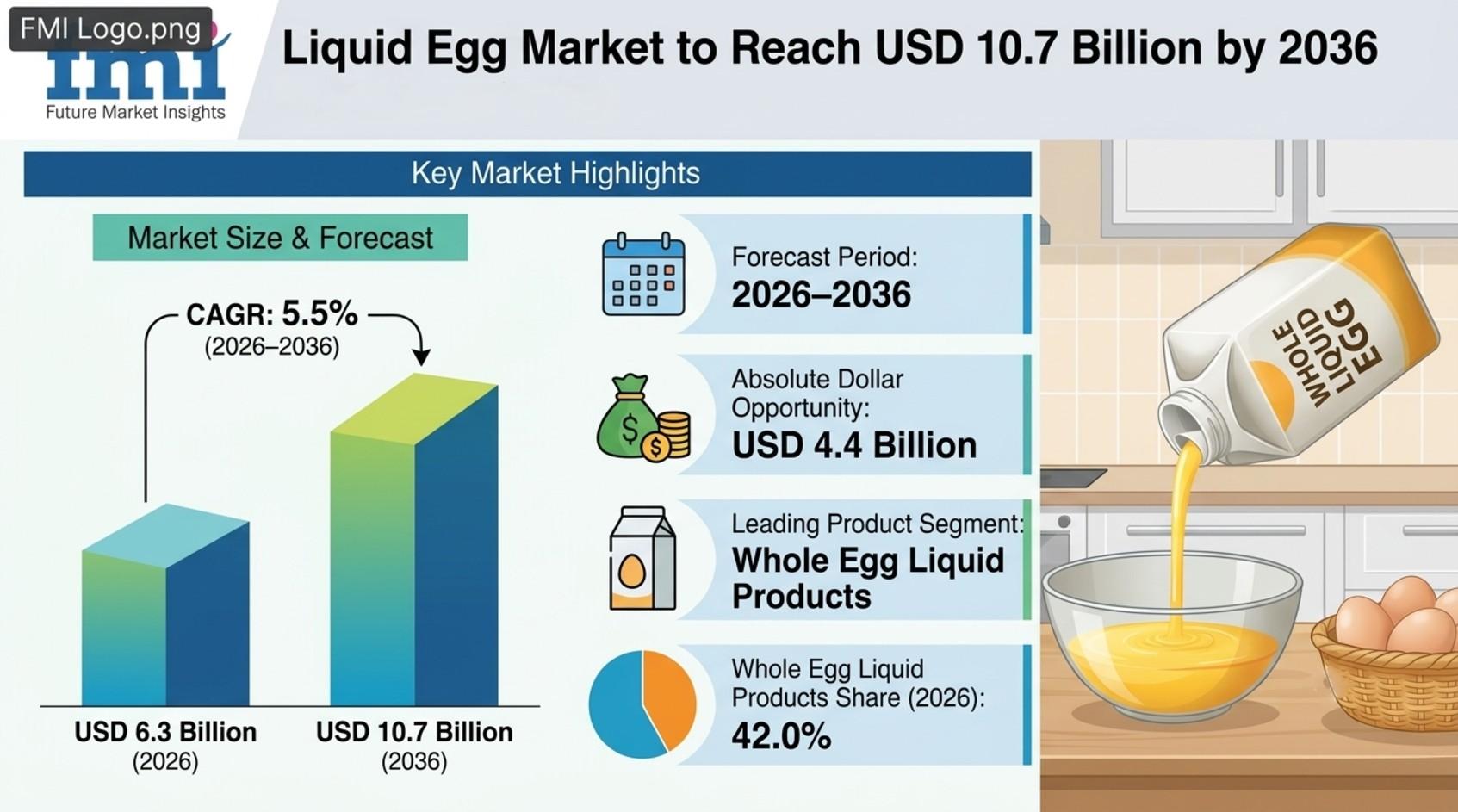
The global liquid egg market is entering a new phase of major expansion as commercial kitchens, wholesale bakeries, and industrial food manufacturers rapidly shift away from handling traditional shell eggs. According to latest insights by future market insights, the market is projected to grow from USD 6.3 billion in 2026 to USD 10.7 billion by 2036, registering a robust 5.5% CAGR during the forecast period. The category is quickly evolving from a standard food manufacturing input into a critical operational efficiency tool driven by rising foodservice labor costs, tightening institutional food safety regulations, and expanding cold-chain infrastructure across emerging economies.
Request a Sample Report: https://www.futuremarketinsights.com/reports/sample/rep-gb-14337
Key Market Highlights at a Glance
· Market Size (2026): USD 6.3 Billion
· Forecast Market Size (2036): USD 10.7 Billion
· Forecast Period: 2026–2036
· CAGR (2026–2036): 5.5%
· Absolute Dollar Opportunity: USD 4.4 Billion
· Leading Product Segment: Whole Egg Liquid Products
· Whole Egg Liquid Products Share (2026): 42.0%
· Leading Form Segment: Frozen Liquid Egg Products
· Frozen Liquid Egg Products Share (2026): 67.0%
Why Is the Liquid Egg Market Growing?
Several structural shifts across the global food processing and commercial hospitality landscapes are driving sustained demand for processed liquid egg formats.
Key Growth Drivers
· Widespread commercial kitchen conversion from manual shell egg cracking to pre-processed liquid formats, reducing operational labor hours and eliminating kitchen waste metrics.
· Tighter institutional food safety mandates across schools, hospitals, and corporate cafeterias that require pasteurized egg lines to completely eliminate salmonella and shell contamination risks.
· High-volume procurement demand from automated bakery, pasta, and confectionery production lines requiring consistent liquid viscosity, lipid ratios, and protein content.
· Substantial scaling of commercial sub-zero logistics and cold-chain networks, unlocking previously inaccessible geographic demand corridors in developing regions.
"Liquid egg processors that combine efficient pasteurization capacity with reliable cold chain distribution and food safety traceability are likely to gain share as the food industry shifts from shell egg handling to pre-processed formats." Nandini Roy Choudhury, Principal Consultant at FMI
Which Product Segment Leads the Liquid Egg Market?
Whole Egg Liquid Products continue to lead the market matrix because they offer an unmatched combination of functional properties needed across both retail baking and mass food manufacturing.
Whole egg liquids serve as the default baseline formulation for commercial bread production, packaged cake lines, and hotel breakfast catering due to their balanced mix of proteins and lipids.
Product Segment Highlights
· Whole Egg Liquid Products command 42.0% of the entire product landscape in 2026.
· Deeply institutionalized as a primary raw material for automated packaged food assembly lines.
· Streamlines inventory management for large-scale foodservice caterers by replacing individual yolk and white lines.
· Egg White and Egg Yolk liquid lines function as high-value secondary segments, with whites expanding rapidly into functional sports nutrition and low-cholesterol dietary products.
Why Do Frozen Liquid Egg Products Capture the Top Form Tier?
Frozen Liquid Egg Products command nearly two-thirds of the total form matrix due to their substantial logistical benefits and extended storage stability.
While fresh refrigerated liquid eggs are highly preferred for local, high-frequency baking setups where fresh texture is critical (accounting for a vital secondary market value), bulk industrial processors prefer blast-frozen liquid blocks.
Form Segment Highlights
· Frozen Liquid Egg configurations command a dominant 67.0% share of the industry form baseline in 2026.
· Drastically lowers absolute product waste metrics across high-volume commercial baking operations.
· Essential for supporting international cross-border shipments from large agricultural hubs to processing centers.
· Refrigerated liquids (33.0% share) continue to grow across metropolitan quick-service chains prioritizing rapid pour-and-cook preparation.
Why Does the Food Industry Anchor Bulk Consumption?
Industrial Food Processing operations act as the primary engine for industry volume, absorbing nearly half of all processed liquid egg outputs globally.
The bulk of this baseline industrial procurement is concentrated in wholesale bakery lines, large-scale confectionery factories, and automated pasta extrusion plants. Because these advanced processing systems rely on maintaining clean hold times, constant viscosity metrics.
End Use Application Highlights
· Food Industry applications capture 46.0% of total global demand in 2026.
· Wholesale bread and pastry manufacturing represent the largest volume category.
· Foodservice operations (such as quick-service restaurants and transit catering) function as the fastest-growing end-use sector.
· Industrial procurement is dominated by Business-to-Business (B2B) sales, which control 58.0% of total distribution volume.
Packaging Metrics: Bulk Formats Lead Commercial Logistics
Bulk packaging configurations including multi-gallon industrial bladders, intermediate bulk containers (IBCs), and automated tanker links dominate the shipping landscape.
By focusing on mass volume units, processors can integrate delivery lines directly into a factory's automated mixing systems, reducing material handling costs. For foodservice setups, intermediate food-service pouches and carton systems help kitchen staff maintain portions easily while keeping food preparation clean.
Custom Research Available: https://www.futuremarketinsights.com/customization-available/rep-gb-14337
Market Dynamics
Market Drivers
The structural conversion of international quick-service restaurant (QSR) menus toward standardized breakfast sandwiches and pre-portioned egg items provides an automatic, multiplying foundation for demand.
Market Restraints
The absolute reliance on unbroken, sub-zero cold-chain transportation networks presents a continuous logistical challenge for expanding distribution channels into developing or tropical regions. Because any breakdown in temperature control can cause rapid bacterial growth or ruin protein functionality, areas with less-developed refrigerated infrastructure often favor dried or powdered substitutes instead.
Market Trends
Processing and structural alignments continue to evolve.
Major trends include:
· Commercial scaling of extended shelf life (ESL) processing systems to reach distant retail markets.
· Growing implementation of advanced ultra-pasteurization methods to protect delicate, heat-sensitive proteins.
· Shifting consumer retail packaging choices toward eco-friendly cartons and easy-pour recyclable plastic bottles.
· Proactive manufacturing investments by leading processing brands to track egg batches directly from the farm to the processing floor.
· Launch of specialized, pre-seasoned scrambled mix product variants built for fast-paced commercial kitchens.
Regional and Country Outlook
Country Growth Rates
· United States — 5.6% CAGR
· South Korea — 5.6% CAGR
· European Union — 5.5% CAGR
· United Kingdom — 5.4% CAGR
· Japan — 5.4% CAGR
The United States represents the premier country growth corridor through 2036, advancing at a 5.6% CAGR. This rapid advance is heavily anchored by strict USDA pasteurization mandates for commercial egg formats, a highly consolidated processed food infrastructure.
South Korea matches this growth velocity with a 5.6% CAGR, propelled by an unprecedented wave of convenience food manufacturing expansions and a rapid roll-out of modern quick-service franchise networks.
The European Union expands steadily at a 5.5% CAGR, powered by dense, bakery-intensive production landscapes across France, Germany, and the Netherlands, alongside strict regional Ecodesign.
The United Kingdom tracks a steady 5.4% CAGR, where adherence to strict British Lion Code pasteurization benchmarks drives institutional procurement, while processors navigate post-Brexit trade arrangements to secure steady raw inputs.
Japan advances at a 5.4% CAGR, supported by exceptionally high per-capita egg consumption habits and an automated convenience food manufacturing sector that relies on pre-processed liquid formats to offset an aging industrial workforce.
Competitive Landscape
The competitive space features high corporate consolidation across egg-breaking and pasteurization infrastructure, led by a powerful group of multi-national poultry and agricultural processors, balanced by regional cooperatives that secure localized manufacturing accounts.
Key Companies
Cal-Maine Foods, Inc., Michael Foods, Inc., Rose Acre Farms, Inc., Rembrandt Foods, Cargill, Incorporated.
Competitive Benchmarking: Global Liquid Egg Market
Corporate development paths moving forward are intensely focused on upgrading to energy-efficient continuous pasteurizers, expanding localized distribution infrastructure in fast-growing Asian centers, deploying extended shelf life ultra-pasteurization lines, and locking in direct farm supply contracts to guarantee raw volume inputs.
Exclusive Discounts on Full Report: https://www.futuremarketinsights.com/reports/liquid-egg-market
Frequently Asked Questions
How big is the liquid egg market in 2026?
The global liquid egg market is estimated to be valued at USD 6.3 billion in 2026.
What will be the size of the liquid egg market in 2036?
The market size for the liquid egg market is projected to reach USD 10.7 billion by 2036.
How much will the liquid egg market grow between 2026 and 2036?
The liquid egg market is expected to grow at a 5.5% CAGR between 2026 and 2036.
What are the key products in the liquid egg market?
The key products in the liquid egg market are Whole Egg Liquid Products, Egg White Liquid Products, Egg Yolk Liquid Products, and Scrambled Mix Products.
Which form segment is expected to contribute a significant share in the liquid egg market in 2026?
In terms of form, the frozen liquid egg products segment is expected to command a 67.0% share in the liquid egg market in 2026.
FMI Custom Research: Strategic Intelligence for Confident Decision-Making
In today's rapidly evolving business environment, leadership teams need more than market data they need clear, actionable intelligence tailored to their strategic objectives. FMI's Custom Research solutions are designed around the specific business questions organizations need answered, enabling executives to evaluate growth opportunities, validate investments, assess competitive dynamics.
Key Executive Benefits
• Decision-Ready Insights tailored to business priorities
• Reduced Strategic Risk through validated market intelligence
• Market Entry Confidence with detailed competitive analysis
• Competitive Advantage supported by proprietary research
• Faster Growth Decisions through customized strategic insights
• Primary Market Validation from industry stakeholders
• Global Industry Expertise across diverse sectors
• Proven Track Record with thousands of consulting engagements
Business Impact
FMI helps organizations transform market complexity into strategic clarity, enabling leadership teams to identify growth opportunities faster, optimize resource allocation, strengthen competitive positioning, and make high-stakes business decisions with confidence.
To explore how FMI Custom Research can support your strategic priorities, please connect with our team at - sales@futuremarketinsights.com
Why Choose FMI: https://www.futuremarketinsights.com/why-fmi
Explore More Related Studies Published by FMI Research
Fish Collagen Market : https://www.futuremarketinsights.com/reports/fish-collagen-market
Gut Health Supplement Market : https://www.futuremarketinsights.com/reports/gut-health-supplement-market
Explore In-Depth Food & Beverage Market Insights : https://www.futuremarketinsights.com/industry-analysis/food-and-beverage
About Future Market Insights (FMI)
Future Market Insights, Inc. is an ESOMAR-certified, ISO 9001:2015 market research and consulting organization trusted by Fortune 500 companies. With a global presence across the U.S., UK, India, and Dubai, FMI delivers data-driven insights across 30+ industries and 1200 markets worldwide.
Contact Us
Future Market Insights Inc.
Christiana Corporate, 200 Continental Drive,
Suite 401, Newark, Delaware – 19713, USA
T: +1-347-918-3531
For Sales Enquiries: sales@futuremarketinsights.com
Website: https://www.futuremarketinsights.com

 English
 Arabic
 French
 Portuguese
 Deutsch
 Turkish
 Dutch
Dutch
 Italiano
 Russian
 Romaian
 Portuguese (Brazil)
 Greek
Greek
