


Cloud Migration with Security Compliance Made Practical
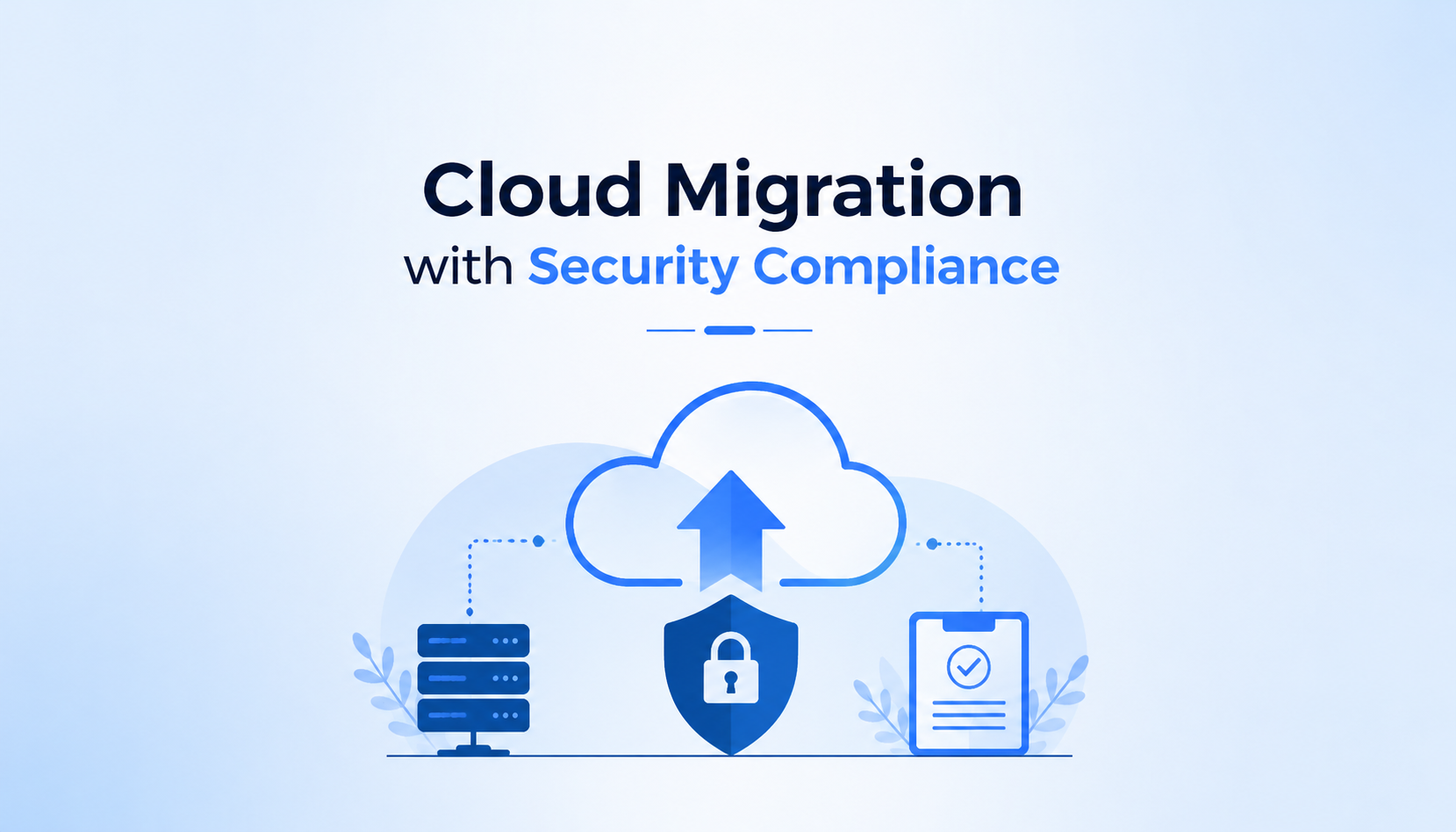
Cloud Migration with Security Compliance
Most cloud migration projects don't fail because of the cloud platform. They fail because security planning starts after workloads have already begun moving. By then, identity permissions, data classifications, and compliance requirements have already become difficult to correct. I've seen teams complete a technically successful migration only to delay production for weeks because audit controls weren't considered during planning. If your organization is pursuing cloud migration with security compliance, security cannot be treated as a final checklist. It has to influence architecture, migration sequencing, governance, and operational processes from day one. Organizations that approach migration this way usually spend less time fixing security gaps after deployment and more time realizing business value.
Key Takeaways
-
Security architecture should be designed before workloads are migrated.
-
Compliance failures usually originate from poor governance rather than poor technology.
-
Identity and access management deserve the same attention as infrastructure.
-
Long-term monitoring is as important as the migration itself.
-
Selecting experienced cloud migration partners reduces operational and regulatory risks.
Why Security Should Drive the Migration Strategy
Many organizations begin migration discussions around infrastructure costs or application performance. Security often enters the conversation much later.
That sequence creates avoidable problems.
One recurring issue is that teams migrate applications exactly as they exist on-premises without reviewing existing security weaknesses. Legacy permission models, outdated encryption methods, and unnecessary administrator accounts simply move into the cloud.
The technical work is rarely the hardest part.
The challenge is identifying which applications process sensitive information, who owns them, what regulations apply, and how security responsibilities change after migration.
Organizations implementing cloud migration with security compliance should build security requirements directly into migration planning instead of treating compliance as a post-migration activity.
This usually includes:
-
Identity and Access Management (IAM)
-
Data encryption
-
Network segmentation
-
Security logging
-
Backup policies
-
Disaster recovery planning
-
Continuous compliance monitoring
Competitor articles often explain these technologies individually but overlook how they affect migration sequencing. Security controls frequently determine the order in which workloads should be migrated.
Compliance Requirements That Often Create Unexpected Delays
Compliance is rarely about installing security software.
It is primarily about demonstrating control.
I've seen teams finish infrastructure migration on schedule while spending additional weeks collecting documentation required for internal audits.
Documentation gaps often become visible only after implementation.
For example, businesses may successfully encrypt customer data but fail to document key rotation procedures or access approval workflows.
That creates audit findings despite technically secure systems.
Organizations using cloud migration consulting services should ensure compliance documentation is produced alongside technical implementation.
The most common governance areas include:
|
Compliance Area |
Why It Matters |
|
Identity Management |
Controls user permissions and privileged access |
|
Data Encryption |
Protects information both in transit and at rest |
|
Logging & Monitoring |
Provides evidence during security investigations |
|
Backup Governance |
Supports recovery and regulatory requirements |
|
Change Management |
Demonstrates controlled infrastructure modifications |
A practical decision framework is simple:
Use strict governance when migrating regulated workloads containing financial, healthcare, or customer information.
Avoid unnecessary compliance complexity for temporary development environments, but never compromise baseline security controls.
The trade-off is straightforward. More governance increases implementation effort initially but significantly reduces operational and regulatory risk later.
Why Architecture Decisions Influence Security More Than Security Tools
Security tools receive significant attention during procurement.
Architecture receives far less.
Yet architecture determines how effective every security control becomes.
One recurring issue appears when organizations migrate applications into flat cloud networks where production, testing, and administrative resources share the same environment.
That design simplifies migration but increases long-term security exposure.
Experienced cloud migration service providers usually separate environments early, implement least-privilege access, and automate infrastructure deployment through version-controlled templates.
Those architectural choices improve consistency while reducing configuration drift.
I've seen organizations manually configure hundreds of cloud resources during migration.
Months later, no one could confidently explain which security settings had changed or why.
Automation solves much of this problem.
Infrastructure as Code allows security configurations to remain repeatable, reviewable, and recoverable.
Competitors frequently discuss automation for deployment speed.
They rarely emphasize its value in maintaining compliance consistency over several years.
Choosing the Right Migration Model for Security and Business Needs
Not every migration requires the same approach.
Migration strategy should match business priorities, application maturity, and compliance obligations.
|
Migration Approach |
Best Used When |
Trade-Offs |
|
Rehosting (Lift and Shift) |
Fast migration with minimal application changes |
Existing security weaknesses often remain |
|
Replatforming |
Moderate modernization with limited redevelopment |
Requires additional testing and governance |
|
Refactoring |
Long-term scalability and stronger security architecture |
Higher investment and longer implementation timeline |
|
Hybrid cloud migration |
Regulatory or operational constraints require mixed environments |
More complex management and security policies |
For organizations evaluating cloud migration for small businesses in India, lift-and-shift can reduce project complexity when budgets are limited. However, security reviews should still be completed before migration begins.
Larger organizations typically benefit from enterprise cloud migration consulting India because governance, integrations, multiple business units, and regulatory obligations introduce operational complexity that smaller environments rarely encounter.
The decision should not be based only on migration speed.
It should balance operational impact, future scalability, maintenance effort, and security posture.
Long-Term Security Depends on Operations, Not the Migration Project
Many migration projects officially end after applications become available in the cloud.
Operational reality begins afterward.
This usually becomes visible after implementation.
Security monitoring generates alerts.
Permissions change.
Applications evolve.
Developers request new integrations.
Business units create additional workloads.
Without operational governance, cloud environments gradually become inconsistent.
Organizations using cloud-managed services in India often maintain stronger long-term security because dedicated operational teams continuously review vulnerabilities, monitor configurations, rotate credentials, and validate compliance policies.
Security should become part of daily operations rather than an annual audit exercise.
Another overlooked issue is ownership.
Migration teams eventually leave.
Operations teams inherit responsibility.
If documentation, monitoring dashboards, and governance processes are incomplete, operational risk increases immediately after project closure.
The most successful organizations treat migration as the beginning of cloud operations, not the finish line.
Conclusion
Successful cloud migration with security compliance is less about deploying advanced security tools and more about making disciplined decisions throughout planning, implementation, and operations. One industry mistake appears repeatedly: organizations prioritize migration deadlines while postponing governance discussions until the final stages of the project. That approach almost always creates unnecessary rework. A better strategy is to integrate security architecture, compliance documentation, operational ownership, and monitoring into every migration phase. As cloud adoption continues to expand across regulated industries, long-term resilience will depend on how well organizations manage cloud operations after migration rather than how quickly they complete the initial move.
1. What is cloud migration with security compliance?
Ans. It is the process of moving workloads to the cloud while ensuring security controls, governance policies, regulatory requirements, encryption, identity management, and monitoring are implemented throughout the migration lifecycle.
2. Why is security planning important before cloud migration?
Ans. Early planning prevents permission issues, compliance failures, insecure architectures, and costly remediation after production deployment.
3. Is hybrid cloud migration suitable for regulated industries?
Ans. Yes. Hybrid cloud migration is often appropriate when organizations must keep sensitive workloads on-premises while moving other applications to public cloud environments.
4. How can small businesses migrate securely to the cloud?
Ans. Organizations considering cloud migration for small businesses in India should begin with workload assessment, identity management, encryption, backup planning, and continuous monitoring instead of focusing only on infrastructure migration.
5. When should a business hire cloud migration consulting services?
Ans. Businesses should engage cloud migration consulting experts when migrations involve critical applications, compliance obligations, multiple integrations, or long-term modernization strategies.
6. What role do cloud-managed services play after migration?
Ans. Cloud-managed services India providers help maintain security through continuous monitoring, vulnerability management, compliance reporting, infrastructure maintenance, backup validation, and operational governance after the migration project is complete.

 English
 Arabic
 French
 Portuguese
 Deutsch
 Turkish
 Dutch
Dutch
 Italiano
 Russian
 Romaian
 Portuguese (Brazil)
 Greek
Greek
