


BCom One Sitting Degree: Course Details, Eligibility, Admission & Career Scope (2026 Guide)
Introduction
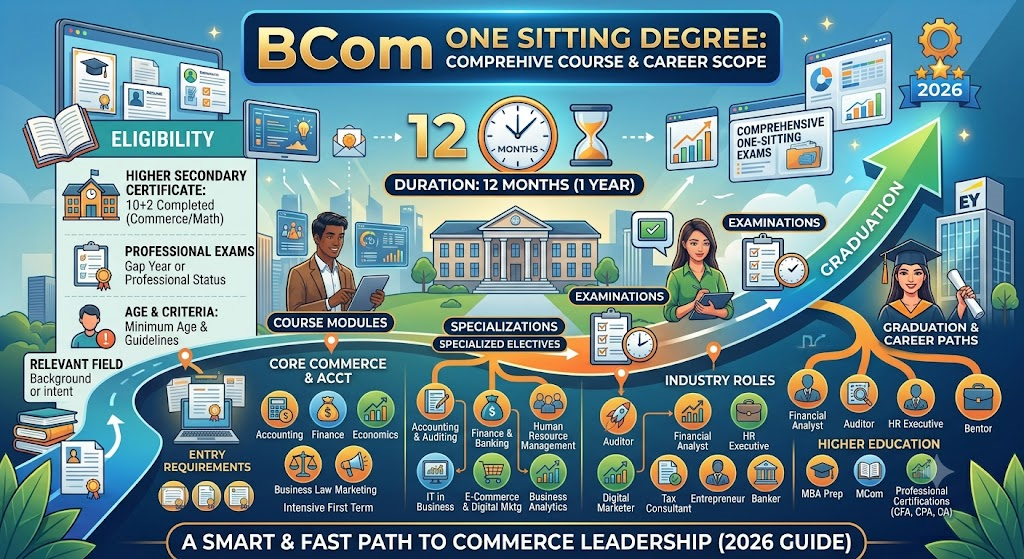
A Bachelor of Commerce (BCom) is one of the most popular undergraduate programs for students interested in accounting, finance, business, taxation, banking, and commerce-related careers. The course provides a strong foundation in financial concepts, business operations, and economic principles.
Many students and working professionals search for “BCom One Sitting Degree” because they want flexible options to continue their education, complete pending qualifications, or improve their career prospects. However, students should understand how BCom programs work, the importance of university recognition, and what factors to consider before admission.
This guide explains BCom course details, eligibility, specializations, admission process, benefits, and career opportunities.
What Is a BCom One Sitting Degree?
The term “BCom One Sitting Degree” is commonly searched online and used in educational advertisements. However, it is not a standard category of degree by itself.
The validity and acceptance of any BCom qualification depend on:
-
The university awarding the degree
-
Course structure
-
Eligibility criteria
-
Academic requirements
-
Applicable higher education guidelines
Students should verify program details and choose a recognized university before enrolling.
Flexible education options may include:
-
Credit transfer options (where permitted)
-
University-approved flexible learning pathways
What Is a BCom Course?
A Bachelor of Commerce (BCom) is an undergraduate degree designed to provide knowledge of commerce, accounting, finance, economics, and business management.
The course helps students develop skills in:
-
Accounting
-
Financial management
-
Business communication
-
Taxation concepts
-
Banking operations
-
Business laws
-
Economic analysis
BCom is suitable for students who want to build careers in finance, accounting, banking, business, and related fields.
BCom Eligibility Criteria
Eligibility requirements may vary depending on the university. Generally, candidates require:
-
Completion of 10+2 or equivalent qualification
-
Required marks as specified by the university
-
Necessary academic documents
Students should check the official admission criteria before applying.
Popular BCom Specializations
Depending on university offerings, students may choose from different commerce-related areas.
1. BCom Accounting and Finance
This specialization focuses on:
-
Accounting principles
-
Financial reporting
-
Auditing
-
Financial management
Career opportunities include:
-
Accountant
-
Finance Executive
-
Audit Assistant
2. BCom Banking and Insurance
Students learn about:
-
Banking operations
-
Insurance principles
-
Financial services
Career opportunities include:
-
Banking Associate
-
Insurance Advisor
-
Financial Services Executive
3. BCom Taxation
This specialization covers:
-
Tax systems
-
Tax planning
-
Financial compliance
Career opportunities include:
-
Tax Assistant
-
Accounts Executive
-
Tax Consultant
4. BCom General
A general BCom program provides broad knowledge of:
-
Commerce
-
Business
-
Economics
-
Accounting
It allows students to explore multiple career paths.
BCom Course Subjects
The curriculum may vary depending on the university but commonly includes:
-
Financial Accounting
-
Business Economics
-
Business Law
-
Corporate Accounting
-
Cost Accounting
-
Taxation
-
Marketing Management
-
Business Communication
-
Financial Management
-
Entrepreneurship Development
These subjects help students understand the fundamentals of business and finance.
Admission Process for BCom Programs
The admission process generally includes:
Step 1: Select a University
Choose a university based on recognition, course availability, and learning mode.
Step 2: Check Eligibility
Review the admission requirements for the selected BCom program.
Step 3: Complete Application
Submit the application form with accurate information.
Step 4: Submit Documents
Provide educational and identity documents for verification.
Step 5: Complete Enrollment
Pay applicable fees and complete admission formalities.
Documents Required for BCom Admission
Commonly required documents include:
-
Passport-size photographs
-
Identity proof
-
Class 10 and 12 certificates
-
Mark sheets
-
Address proof
-
Transfer certificate (if required)
-
Migration certificate (where applicable)
Requirements may differ depending on the university.
Benefits of Pursuing a BCom Degree
1. Strong Foundation in Commerce
BCom provides essential knowledge of accounting, finance, and business practices.
2. Career Opportunities
Graduates can explore opportunities in finance, banking, accounting, and business sectors.
3. Higher Education Options
After BCom, students can pursue:
-
MCom
-
MBA
-
Professional certifications
-
Finance-related courses
4. Skill Development
Students develop analytical, communication, and financial skills.
5. Business Knowledge
The course helps learners understand business operations and financial decision-making.
Career Scope After BCom
A BCom qualification can support careers in various sectors.
Accountant
Accountants manage financial records, reporting, and business transactions.
Financial Executive
Finance professionals assist organizations with budgeting, reporting, and financial activities.
Banking Professional
BCom graduates can explore roles in banking and financial services.
Tax Assistant
Graduates can work in taxation and compliance-related roles.
Business Administration Roles
Commerce graduates may work in:
-
Administration
-
Operations
-
Customer management
-
Business support
Higher Education Options After BCom
After completing BCom, students may consider:
Master of Commerce (MCom)
MCom provides advanced knowledge in commerce and finance.
Master of Business Administration (MBA)
MBA helps students develop management and leadership skills.
Professional Certifications
Students may pursue certifications in areas such as:
-
Accounting
-
Finance
-
Taxation
-
Banking
-
Data analysis
BCom for Working Professionals
Many working professionals choose flexible learning options to improve their qualifications while continuing their careers.
Benefits include:
-
Flexible study schedules
-
Career advancement opportunities
-
Ability to balance work and education
-
Development of professional skills
Before admission, professionals should verify the university, course structure, and eligibility requirements.
How to Choose the Right BCom Program
Before enrolling, consider:
-
University recognition
-
Course curriculum
-
Learning mode
-
Student support services
-
Fee structure
-
Career objectives
Students should prioritize academic quality and recognition rather than choosing a program only because of faster completion claims.
Conclusion
A BCom degree can provide valuable knowledge and skills for careers in finance, accounting, banking, and business. While many students search for “BCom One Sitting Degree” options, it is important to understand the role of university recognition, eligibility requirements, and academic structure.
Before taking admission, research the institution carefully, verify program details, and select an educational pathway that supports your long-term career goals. A recognized BCom qualification combined with practical skills can help students build a strong professional future.

 Arabic
 French
 Spanish
 Portuguese
 Deutsch
 Turkish
 Dutch
Dutch
 Italiano
 Russian
 Romaian
 Portuguese (Brazil)
 Greek
Greek
