


Why attendees stop using event apps and what organizers can do differently
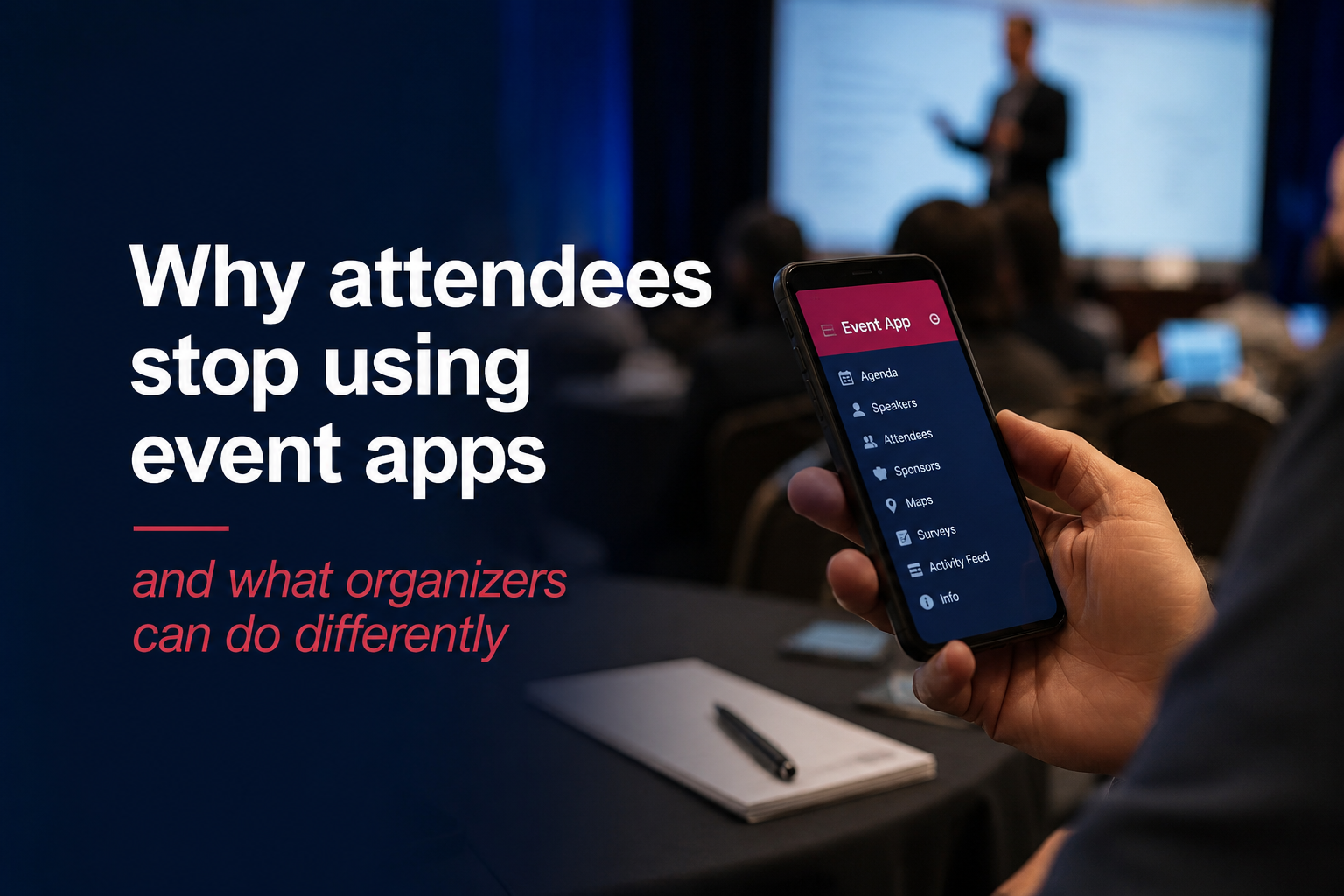
Many event organizers launch an event app with high expectations.
The app is promoted before the event. Attendees download it. Login numbers look promising.
Then activity begins to decline.
By the second day of a conference, some attendees may return to screenshots of the agenda, printed schedules, messaging apps, or simple conversations in the hallway.
The problem is not necessarily the idea of an event management app.
The problem is often how the app fits into the attendee experience.
Attendees need a reason to return
Downloading an app is a one-time action.
Using it repeatedly requires ongoing value.
If an event app only contains a static agenda and speaker list, attendees may have little reason to open it after their first visit.
Useful event apps support activities that happen throughout the event.
Personal schedules, event updates, networking, session information, polls, and interactive features can encourage attendees to return when they need information or want to participate.
Information should be easy to find
Events can generate a large amount of content.
Session details, speaker profiles, exhibitor information, venue maps, sponsor details, and event announcements may all compete for attention.
Poor navigation makes this information harder to use.
A mobile event app should help attendees find relevant information with minimal effort.
Clear categories, search functionality, and personalized agendas can make the app more practical during a busy event day.
Networking needs context
Networking is one of the main reasons professionals attend conferences and trade shows.
However, simply providing an attendee directory does not automatically create meaningful connections.
Attendees may need better ways to identify relevant people and start conversations.
Event networking features can help participants discover attendees based on professional information or shared interests, depending on the event's privacy settings and networking structure.
Event Management Platforms such as Eventify include mobile event app and attendee networking capabilities alongside registration, check-in, lead retrieval, and event analytics.
Connecting these functions can help organizers create a more consistent digital event experience.
Real-time updates make the app useful
Event schedules can change.
A session may move to another room. A speaker may be delayed. Organizers may need to share an important venue announcement.
Printed schedules cannot update themselves.
An event app gives organizers a direct channel for communicating event information.
When attendees know the app contains current event updates, they have a stronger reason to continue using it.
Engagement should support the event
Gamification, live polls, surveys, and social features can increase app activity.
However, these features should have a clear purpose.
A poll can support a session discussion. A survey can collect attendee feedback. Gamification can encourage participants to explore event activities.
Adding interactive features only to increase clicks may create short-term activity without improving the event experience.
Organizers should consider how each feature supports attendee goals.
Measure meaningful app activity
App downloads are an easy metric to track.
They are not always the best measure of engagement.
Organizers may also review agenda creation, session interactions, networking activity, poll participation, and other relevant event actions.
These signals can provide more context about how attendees actually use the event app.
The information can also help teams improve future events.
Build the app around attendee needs
Attendees do not use event technology simply because organizers provide it.
They use tools that make the event easier to navigate, help them access relevant information, or support valuable interactions.
A successful event app should be connected to the attendee journey rather than treated as a separate digital feature.
When organizers focus on practical value, relevant communication, and meaningful engagement, the event app has a better chance of remaining useful from the first session to the final event activity.

 English
 Arabic
 French
 Spanish
 Portuguese
 Deutsch
 Turkish
 Dutch
Dutch
 Italiano
 Russian
 Romaian
 Greek
Greek
