


AI Strategy Roadmap for Mid-Sized Businesses: The Practical Guide That Actually Works
Most CEOs feel caught between two pressures: boards demanding faster AI strategy roadmap execution while teams signal they're not ready. As a Strategic AI & Digital Transformation Advisor, Vaibhav Sharma has watched mid-sized companies burn through six-figure budgets on pilots that never scale — not because the technology failed, but because the approach was wrong.
Here's the reality most vendors won't tell you: 80% of AI investments fail to deliver measurable value. The problem isn't the technology. It's the strategy.
Why Mid-Sized Businesses Actually Have the Advantage
Mid-sized companies sit in a unique sweet spot — faster than enterprise bureaucracy, better resourced than startups. Yet 91% report using AI while only 25% have actually integrated it into core operations. That gap between "using" and "integrating" is exactly where most AI strategy roadmaps break down.
The companies closing this gap see real results: 38% productivity gains in finance, 70% of routine back-office tasks automated, and operational cost reductions of 30% within eight months — not through headcount cuts, but by redirecting people to higher-value work.
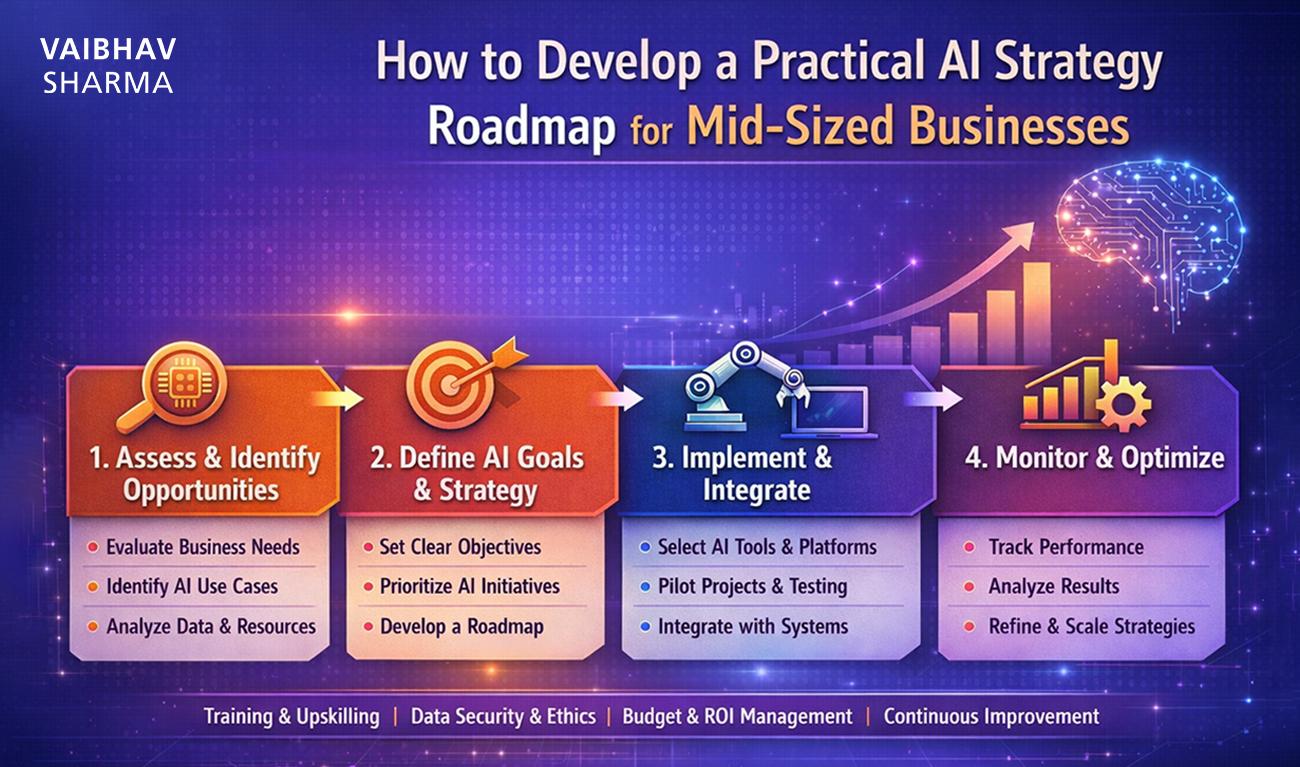
The 4-Phase Framework That Works
Phase 1 — Pick Your First Battle Carefully
Start with high-impact, low-difficulty use cases. Invoice processing automation is boring — but one client freed up 8 hours weekly for their accounting team and hit ROI in 6 weeks. Pilots should solve problems that keep someone awake at night, not interesting technical challenges.
Phase 2 — Scale What Works, Kill What Doesn't
Only 30% of pilots should move to full deployment. If a pilot doesn't deliver at least 25% time savings on routine tasks, it's not ready. Document everything — it becomes your playbook.
Phase 3 — Connect the Dots Across Departments
Isolated AI successes that don't talk to each other create new data silos. Monthly cross-functional reviews between sales, operations, and finance keep the AI roadmap integrated and compounding.
Phase 4 — Build for Continuous Improvement
AI systems degrade. Data shifts, models drift, processes evolve. Budget at least 15% of your AI investment for ongoing maintenance — and reassess performance quarterly, not annually.
The 3 Goal-Setting Mistakes That Kill AI Projects
- Asking "what can AI do?" instead of "what problems cost us the most?"
- Setting vague goals like "improve efficiency" instead of "reduce invoice processing time by 30%"
- Buying tools before understanding the actual bottleneck
Companies connecting AI initiatives to measurable business outcomes are 3x more likely to see financial benefits. The successful 20% don't have better technology — they have clearer goals and a structured AI strategy roadmap.
Get the Full Practical Framework
This summary covers the highlights — the full guide by Vaibhav Sharma includes the 6-area readiness assessment, phased implementation templates, budget planning frameworks, and real case studies from healthcare, manufacturing, and finance.
Read the full guide: How to Develop a Practical AI Strategy Roadmap for Mid-Sized Businesses

 Arabic
 French
 Spanish
 Portuguese
 Deutsch
 Turkish
 Dutch
Dutch
 Italiano
 Russian
 Romaian
 Portuguese (Brazil)
 Greek
Greek
