


RFID or More Hands? What Actually Stops Warehouse Downtime?
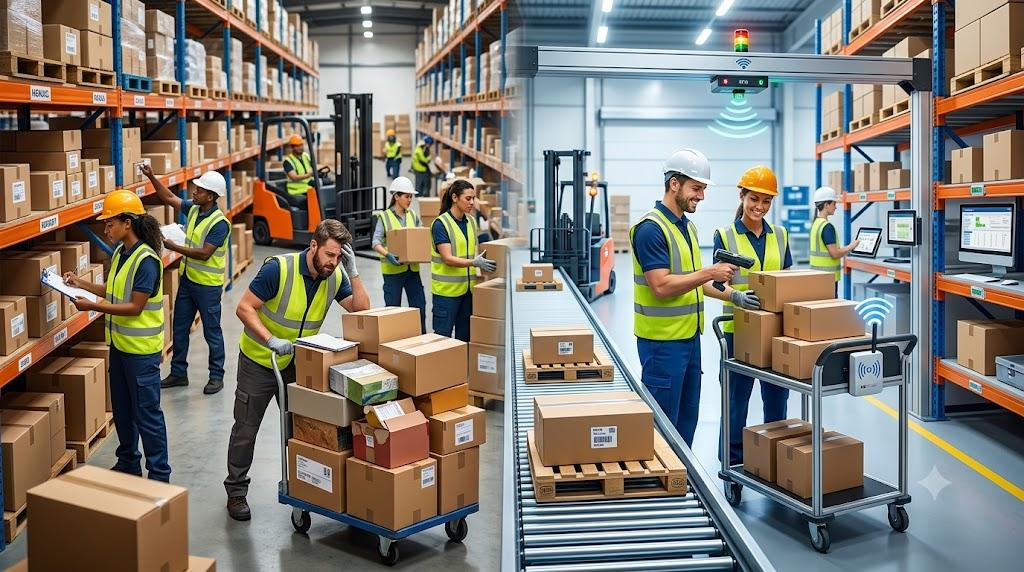
Every warehouse manager has had that moment. A shipment’s late; nobody can find the pallet that’s supposed to be in aisle 12, and the answer that comes up in the meeting is always the same: hire more people. It feels logical. More hands, more eyes, fewer gaps. But if you have actually tried that fix, you already know it doesn’t always work. The problem usually isn’t a shortage of people. It’s a shortage of visibility.
Where Does the Time Actually Go?
Downtime rarely comes from one big failure. It’s death by a thousand small ones. Someone spends twenty minutes hunting for a mislabeled box. A shipment gets double-counted, so the system says stock is available when it isn’t. A machine sits idle because nobody flagged that a part was due for maintenance.
None of these are staffing problems in the traditional sense. They are information problems. And you can’t out-hire an information problem. You can only slow it down with more bodies doing the same manual checks, a little faster, a little more often.
Why Adding Labor Only Buys You Time?
More staff can absorb some of the chaos, sure. But they're still working off the same incomplete picture everyone else has. A new hire doing a manual inventory count is just as likely to miss a misplaced item as the person who trained them, because the root issue, no real-time tracking, hasn't changed. You end up paying more for the same blind spots. It's a bit like adding a second person to search a dark room instead of just turning on the light.
What RFID Changes, Specifically?
RFID tags communicate automatically as items move through a facility. No scanning gun pointed at a barcode, no manual log entry. Gates, shelves, and handheld readers pick up tag signals the moment something passes by, and the system updates itself. That's the core difference. A well-implemented RFID warehouse management solution doesn't just track inventory faster, it removes the lag between something happening and someone knowing about it. When a pallet moves, the system knows in seconds, not at the next manual count.
That speed matters more than it sounds. A lot of downtime isn't caused by items actually being lost. It's caused by nobody knowing where they are until someone goes looking. Real-time location data collapses that search time from twenty minutes to twenty seconds.
A Quick Digression on Retail, Because It's the Same Story
RFID retail inventory tracking follows the same logic, just on the sales floor instead of the warehouse floor. Stores using it report fewer stockouts and fewer "phantom inventory" situations, where the system says an item is in stock but it's actually sitting in a back room nobody's checked in weeks. It's the same underlying fix: less guessing, more knowing.
Where the Extra Labor Argument Still Holds Up
To be fair, there are cases where more people genuinely is the right call. If your bottleneck is physical, like not enough hands to unload trucks during a rush, RFID isn't going to unload the truck for you.
Tagging also takes upfront setup, and if your inventory changes constantly with unique, one-off items, tagging every unit can get expensive. RFID solves visibility problems. It doesn't solve every capacity problem.
The Honest Tradeoff
Labor costs scale with time. Every extra shift, every overtime hour, adds up indefinitely. RFID has a real upfront cost for hardware and setup, but once it's running, the marginal cost of tracking one more item is close to zero.
Industry estimates commonly put inventory accuracy improvements from RFID adoption in the 95-99% range, compared to 65-75% for manual counts. That gap is where a lot of downtime quietly disappears.
Bottom Line
Adding labor treats the symptom. RFID treats the cause. If your downtime keeps coming back no matter how many people you throw at it, that's usually a sign the problem was never about headcount to begin with.

 Arabic
 French
 Spanish
 Portuguese
 Deutsch
 Turkish
 Dutch
Dutch
 Italiano
 Russian
 Romaian
 Portuguese (Brazil)
 Greek
Greek
