


Saber Certificate Cost in 2026
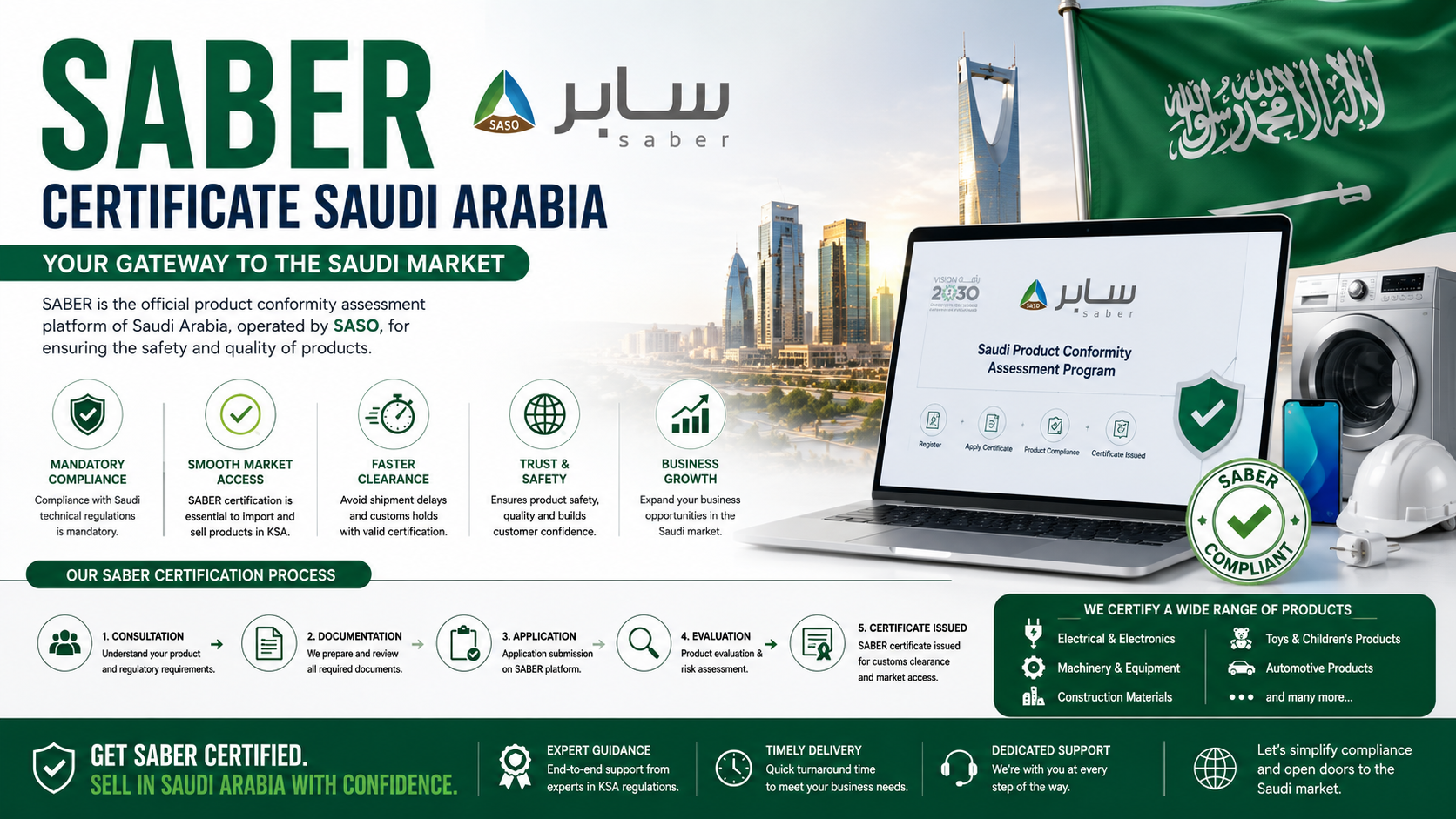
If you're planning to export products to Saudi Arabia, understanding the saber certificate cost is essential for budgeting and ensuring smooth customs clearance. The total cost of SABER certification depends on several factors, including product category, conformity assessment requirements, laboratory testing, shipment certificates, and certification body fees. Whether you're importing electronics, machinery, construction materials, or consumer goods, knowing the complete cost breakdown helps avoid unexpected expenses and shipment delays. In this guide, we'll explain the official fees, hidden charges, and factors that influence SABER certification costs in 2026.
What Is the SABER Certificate?
The SABER Certificate is a mandatory conformity certification system introduced by the Saudi Standards, Metrology and Quality Organization (SASO). It ensures imported and locally manufactured products comply with Saudi technical regulations before entering the Kingdom.
The SABER platform issues two primary certificates:
-
Product Certificate of Conformity (PCoC) – Valid for one year and linked to a specific product.
-
Shipment Certificate of Conformity (SCoC) – Required for every shipment entering Saudi Arabia.
Both certificates are essential for customs clearance and legal market entry.
Saber Certificate Cost Breakdown in 2026
The overall SABER certification cost isn't a single fixed fee. Instead, it consists of multiple components.
1. Product Certificate (PCoC) Fee
The Product Certificate is issued once a product successfully meets applicable Saudi technical regulations.
Typical costs include:
-
Government platform fee
-
Certification Body assessment fee
-
Technical documentation review
-
Product registration
For many standard products, the official platform fee is approximately SAR 500–575 per product, while certification body charges vary depending on product complexity.
2. Shipment Certificate (SCoC) Fee
Every shipment imported into Saudi Arabia requires a Shipment Certificate.
Typical official platform charges range between:
-
SAR 350–500 per shipment
This fee applies every time goods are imported, regardless of previous shipments.
3. Certification Body Charges
Certification Bodies accredited by SASO review technical documents and issue conformity certificates.
Their fees depend on:
-
Product category
-
Risk classification
-
Required evaluations
-
Engineering review
Typical service charges can range from several hundred to several thousand Saudi Riyals depending on the product type.
4. Laboratory Testing Fees
Not every product requires testing.
However, regulated categories often need laboratory reports from approved facilities.
Examples include:
-
Electrical appliances
-
Toys
-
Building materials
-
Automotive parts
-
Personal protective equipment
-
Chemicals
Testing costs vary widely based on product complexity and existing test reports.
5. Inspection Charges
Certain regulated products require:
-
Factory inspections
-
Product inspections
-
Quality audits
-
Production verification
Inspection costs depend entirely on the certification body's assessment requirements.
Hidden Charges Many Importers Overlook
Many businesses budget only for the official SABER fees and overlook additional expenses that can significantly increase the total project cost.
Product Testing
Products without valid laboratory reports often require fresh testing before certification.
These tests can become one of the largest expenses.
Product Classification Errors
Incorrect HS codes or inaccurate product descriptions may require:
-
Application resubmission
-
Additional reviews
-
Extra certification fees
Errors also delay customs clearance.
Multiple Product Variants
Each product model often requires separate registration.
For example:
Instead of registering one electric kettle, an importer may need separate registrations for:
-
1-liter model
-
1.5-liter model
-
2-liter model
Each registration increases certification costs.
Consultant Fees
Many businesses hire compliance consultants to manage:
-
Document preparation
-
Product registration
-
Technical file review
-
Communication with Certification Bodies
Consultancy charges vary depending on service scope.
Renewal Costs
Product Certificates generally remain valid for one year.
Businesses must renew them annually to continue importing.
Renewal may include:
-
Government renewal fee
-
Certification Body fee
-
Updated technical documents
Factors Affecting Saber Certificate Cost
Several variables determine the final certification expense.
Product Risk Level
Products are generally categorized as:
Low-Risk Products
Examples include:
-
Household items
-
Simple consumer products
These usually require minimal documentation.
Medium-Risk Products
Examples include:
-
Electrical equipment
-
Industrial tools
-
Lighting products
These often require additional technical evaluation.
High-Risk Products
Examples include:
-
Medical devices
-
Gas appliances
-
Children's products
These typically involve:
-
Extensive testing
-
More documentation
-
Additional inspections
Consequently, certification costs increase significantly.
Number of Shipments
Although the Product Certificate remains valid for one year, every shipment requires its own Shipment Certificate.
Businesses importing monthly will naturally incur higher annual certification expenses than companies importing only once or twice a year.
Existing Test Reports
Companies already holding internationally recognized laboratory reports often save money because some reports may be accepted by accredited certification bodies, reducing the need for repeat testing. Acceptance depends on the applicable Saudi technical regulation and the certification body's assessment.
Product Documentation Quality
Incomplete documentation often results in:
-
Delays
-
Revisions
-
Additional review charges
Preparing accurate technical files from the beginning minimizes unnecessary costs.
Sample Cost Estimate
Here's an illustrative example for a medium-risk imported product:
|
Cost Item |
Estimated Cost |
|
Product Registration Fee |
SAR 500–575 |
|
Shipment Certificate |
SAR 350–500 |
|
Certification Body Fee |
Varies by product |
|
Laboratory Testing |
If required |
|
Inspection |
If applicable |
|
Consultant Fee |
Optional |
Actual costs depend on the applicable technical regulation, certification body, and product requirements.
How to Reduce SABER Certification Costs
Although certification is mandatory, businesses can reduce expenses with proper planning.
Prepare Documents Early
Ensure you have:
-
Commercial invoice
-
Product specifications
-
User manuals
-
Product images
-
Test reports
-
Manufacturer declarations
Complete documentation reduces processing delays.
Use Existing Test Reports
If valid laboratory reports already exist, check whether they satisfy the applicable Saudi requirements before commissioning new tests.
Register Products Correctly
Proper HS code selection avoids:
-
Rejections
-
Duplicate registrations
-
Additional fees
Plan Shipments Efficiently
Since every shipment requires a Shipment Certificate, consolidating shipments where practical can help lower the number of certificates required.
Work with Experienced Professionals
Experienced compliance specialists can:
-
Identify applicable regulations
-
Prevent costly mistakes
-
Speed up approvals
-
Reduce overall compliance risks
Common Mistakes That Increase Costs
Many importers unknowingly increase certification expenses through avoidable errors.
Common mistakes include:
-
Registering incorrect products
-
Choosing the wrong HS code
-
Submitting incomplete technical files
-
Ignoring Saudi technical regulations
-
Missing annual renewals
-
Applying for certificates too late
-
Failing to verify testing requirements
Avoiding these mistakes can save both time and money.
Is the SABER Certificate Worth the Cost?
Absolutely.
Although obtaining SABER certification involves several costs, it provides significant benefits:
-
Faster customs clearance
-
Legal access to the Saudi market
-
Reduced shipment delays
-
Compliance with SASO regulations
-
Increased customer confidence
-
Lower risk of customs rejection
For businesses exporting regularly to Saudi Arabia, the investment in compliance is generally outweighed by the operational benefits.
Final Thoughts
Understanding the saber certificate cost in 2026 goes beyond knowing the official government fees. Importers should also budget for certification body services, laboratory testing, inspections, renewals, and potential consultancy support. By preparing complete documentation, correctly classifying products, and planning shipments strategically, businesses can minimize hidden charges while maintaining full compliance with Saudi import regulations.
Whether you're a first-time exporter or an established importer, having a clear picture of SABER certification costs allows you to plan your budget effectively, avoid customs delays, and ensure uninterrupted access to one of the Middle East's largest markets.

 English
 Arabic
 French
 Spanish
 Portuguese
 Turkish
 Dutch
Dutch
 Italiano
 Russian
 Romaian
 Portuguese (Brazil)
 Greek
Greek
