


Why the Right Starter Makes All the Difference for Your John Deere Backhoe Loader
There is a particular kind of frustration that hits hardest at the start of a job site morning: you climb into the cab, turn the key, and nothing happens. No crank, no engine bark, no hydraulic hum. Just silence. For operators running John Deere backhoe loaders, a failed starter is not just an inconvenience. It is a cascade of lost hours, delayed contracts, and mounting repair costs. If you have been in that position, or if you want to make sure you never are, understanding what goes into a quality replacement starter and where to source it is one of the smartest investments you can make in your equipment.
This article takes a close look at the Starter Fits John Deere Backhoe Loader series, what it covers, why it matters, and how Canadian operators can get their hands on a reliable unit without overpaying for an OEM part. We will cover the machines it supports, how a starter works in a heavy-duty diesel application, the signs that yours is failing, and why sourcing the right replacement early saves you far more than it costs.
The Machines This Starter Was Built For
John Deere's backhoe loader lineup has long been a benchmark in the construction and utility industries. Models in the 310, 315, 325, 410, and 710 series have spent decades digging footings, trenching utility corridors, loading dump trucks, and cleaning up demolition sites across Canada and the United States. These machines are workhorses designed to run hard in cold winters, muddy spring conditions, and scorching summer heat.
The John Deere Backhoe Loader 310G is one of the most widely recognized models in this family. Introduced as a rugged mid-size machine paired with John Deere's 4045D and 4045T diesel engines producing between 70 and 80 horsepower, the 310G became a staple on construction sites from British Columbia to Newfoundland. Its combination of digging reach, loader capacity, and relatively compact footprint made it the go-to choice for contractors who needed a machine that could do a bit of everything without breaking the bank.
But the 310G is far from alone. The replacement starter available through Denparts is designed to fit an extensive range of John Deere backhoe loader applications, including the following:
• 310G (1999 and later) — JD 4045D/T engine, 70–80 HP diesel
• 310J (2007 and later)—JD 4.5L engine, 84 HP diesel
• 310SG (1999 and later) — JD 4045T engine, 86 HP diesel
• 310SJ (2007 and later) — JD 4.5L engine, 93 HP diesel
• 310SJ TMC (2007 and later)—JD 4.5L engine, 93 HP diesel
• 315SG (1999 and later) — JD 4045T engine, 84 HP diesel
• 315SJ (2007 and later)—JD 4.5L engine, 92 HP diesel
• 325J (2007 and later) — diesel engine
• 410G (1996 and later) — JD 4045T engine, 92 HP diesel
• 410J (2007 and later) — JD 4.5L engine, 98 HP diesel
• 410J TMC (2007 and later)—JD 4.5L engine, 98 HP diesel
• 710J (2007 and later) — JD 6.8L engine, 125 HP diesel
That is a significant cross-section of John Deere's backhoe loader production spanning nearly three decades. If you are running one of these machines, this starter was engineered with your equipment in mind.
How a Diesel Starter Actually Works And Why It Matters
To appreciate why starter quality matters on a machine like the John Deere Backhoe Loader 310G, it helps to understand what the starter is actually asked to do. Unlike gasoline engines, which have relatively low compression ratios, diesel engines compress air to extreme ratios before injection typically somewhere between 16:1 and 23:1. That compression is what produces the heat needed to ignite the diesel fuel without a spark plug.
What this means in practice is that a diesel starter has to work considerably harder than one on a gas engine. It needs to overcome that high compression while simultaneously drawing enough current from the battery to spin the engine at a speed that allows fuel ignition to happen, typically somewhere around 150 to 250 RPM for a cold start. That is a tremendous amount of torque demanded from a relatively small electric motor, and it has to happen reliably in sub-zero Canadian winters.
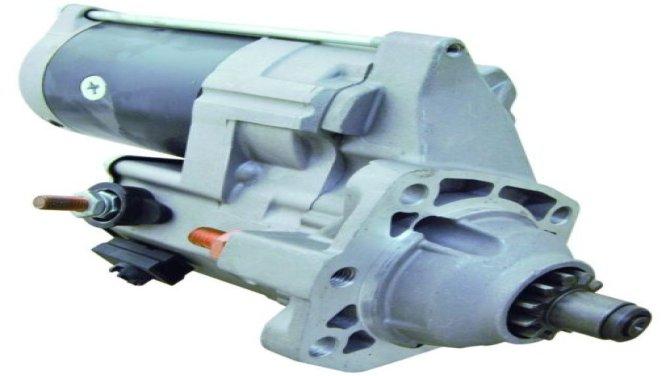
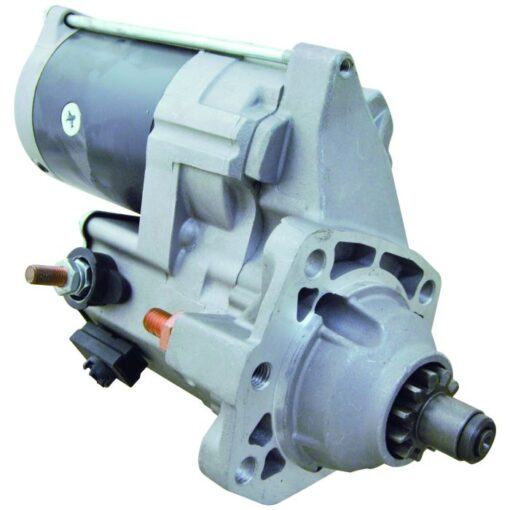
The unit available through Denparts is a 12-volt, 4 kW (5.36 HP) OSGR-type (Over-running Sprag Gear Reduction) starter. The gear reduction mechanism is the key here; it uses a planetary gear set to multiply the torque output of the motor before it reaches the flywheel ring gear. This allows a physically smaller, lighter motor to deliver the cranking force needed for a 4.5L or 4045-series John Deere diesel. The result is better starting performance, lower current draw on the battery, and longer service life compared to older direct-drive designs.
Five Signs Your Backhoe Loader Starter Is About to Fail
Starters rarely fail without warning. The challenge is that the early signs are easy to dismiss as battery issues or cold weather quirks. Knowing what to look for can mean the difference between catching the problem on your schedule and being stranded on a job site waiting for a service call.
Slow or Laboured Cranking
If your engine is turning over noticeably more slowly than usual when you hit the key, and your battery checks out fine, the starter's brushes or armature windings may be wearing. Cold weather exaggerates this symptom because both the battery and the motor deliver less performance in low temperatures.
Grinding or Clicking Sounds on Startup
A grinding sound during cranking typically indicates that the starter's drive gear is not engaging the flywheel ring gear cleanly. This could be a worn bendix gear, a damaged ring gear tooth, or a solenoid that is not pushing the gear fully into mesh. A series of clicks with no cranking usually points to a solenoid failure or a severely discharged battery.
Starter Motor Spins But Engine Does Not Crank
If you can hear the starter motor running freely but the engine is not turning, the one-way clutch in the drive assembly has likely failed. The motor is spinning, but the gear is freewheeling rather than engaging the flywheel.
Intermittent Starting
Sometimes it fires right up; other times it takes three or four attempts. Intermittent failure often traces back to worn brushes making inconsistent contact or a solenoid with a failing contact plate.
Smoke or Burning Smell from the Starter Area
This is a sign that the starter is drawing excessive current, usually because it is working extremely hard to overcome internal resistance or a seized engine component. Stop immediately and diagnose the root cause before attempting to start again.
Technical Specifications That Actually Matter
When comparing replacement starters, the spec sheet tells you a lot about whether a unit will hold up or fail prematurely. Here is what sets this unit apart:
Voltage: 12V matches the electrical system on all covered John Deere backhoe loader models.
Power output: 4kW / 5.36 HP adequate cranking force for the 4045 and 4.5L diesel engine families.
Starter type: OSGR (Over-running Sprag Gear Reduction) superior torque multiplication for high-compression diesel engines.
Rotation: Clockwise correct orientation for the John Deere applications listed.
Number of teeth: 11 matches the ring gear specification on covered models.
Gear OD: 1.567 in / 39.8mm precise fitment for clean ring gear engagement.
Mounting holes: Three mounting ears, each with 12.0mm unthreaded holes direct bolt-on replacement with no modification required.
Condition: New not remanufactured or refurbished.
Warranty: 1 year providing confidence in the unit's reliability over time.
The unit is also a direct replacement for several OEM and aftermarket part numbers, eliminating any guesswork about compatibility. It replaces Denso 228000-914 and 228000-9140, John Deere RE504244, RE506105, SE501853, and SE501866, as well as Lester 18568 and Wilson 91-29-5579. If you are currently holding one of those part numbers, this starter is your match.
Why Canadian Operators Trust Denparts for Starter Replacements
Sourcing replacement electrical components in Canada has historically meant choosing between expensive OEM parts with long lead times, or cheap offshore alternatives that fail after a season. Denparts was built to close that gap offering quality replacement starters, alternators, and related electrical components at prices that make sense for the Canadian market, shipped from within the country to avoid border delays and duty surprises.
The Starter Fits John Deere Backhoe Loader listing on Denparts carries a price of $239.31 CAD a fraction of what dealers typically charge for a genuine John Deere replacement, while offering equivalent fit, form, and function. This is not a grey-market unit or a stripped rebuild. It is a new starter built to the Denso R family specification, meeting or exceeding the original equipment standard for the covered applications.
Denparts also stocks parts across a wide range of industrial, agricultural, automotive, and powersports categories which means if you are managing a mixed fleet, you are not bouncing between half a dozen suppliers to keep everything running. The ability to consolidate sourcing to one trusted Canadian retailer has real value when you are trying to keep a crew productive and a billing cycle clean.
What to Expect During Installation
One of the practical advantages of a properly spec'd direct-replacement starter is that installation is straightforward. There is no custom fabrication, no adapter plates, and no wiring modifications required. The three mounting ears with 12.0mm unthreaded holes align directly with the engine block mounting points on the covered John Deere models, and the electrical connections follow the original wiring harness without modification.
Before beginning any starter replacement, always disconnect the negative battery cable first to eliminate any risk of accidental engagement. Label or photograph your wiring connections before removing the old unit. The battery cable, the solenoid S-terminal wire, and any ground straps need to go back in exactly the right positions. With the old unit out and the new starter torqued to spec, reconnect the battery and test the machine through several cold start cycles before returning it to service.
Conclusion
A backhoe loader is only earning money when it is working. The starter is the handshake between your battery and your engine, the first mechanical event of every single working day. Investing in a quality replacement that fits correctly, cranks reliably in cold weather, and comes backed by a one-year warranty is simply smart equipment management.
Whether you are keeping a veteran John Deere Backhoe Loader 310G in daily service or maintaining a newer model from the J series, the starter fit for a John Deere Backhoe Loader available through Denparts delivers the reliability and value that working machines demand. Do not wait for a breakdown to find this out. Get the right part on the shelf before you need it, and start every day with confidence.

 Arabic
 French
 Spanish
 Portuguese
 Deutsch
 Turkish
 Dutch
Dutch
 Italiano
 Russian
 Romaian
 Portuguese (Brazil)
 Greek
Greek
