


What Is Driving the Global Polysulfone Resin Market Toward USD 766 Million by 2032 at a 4.1% CAGR?
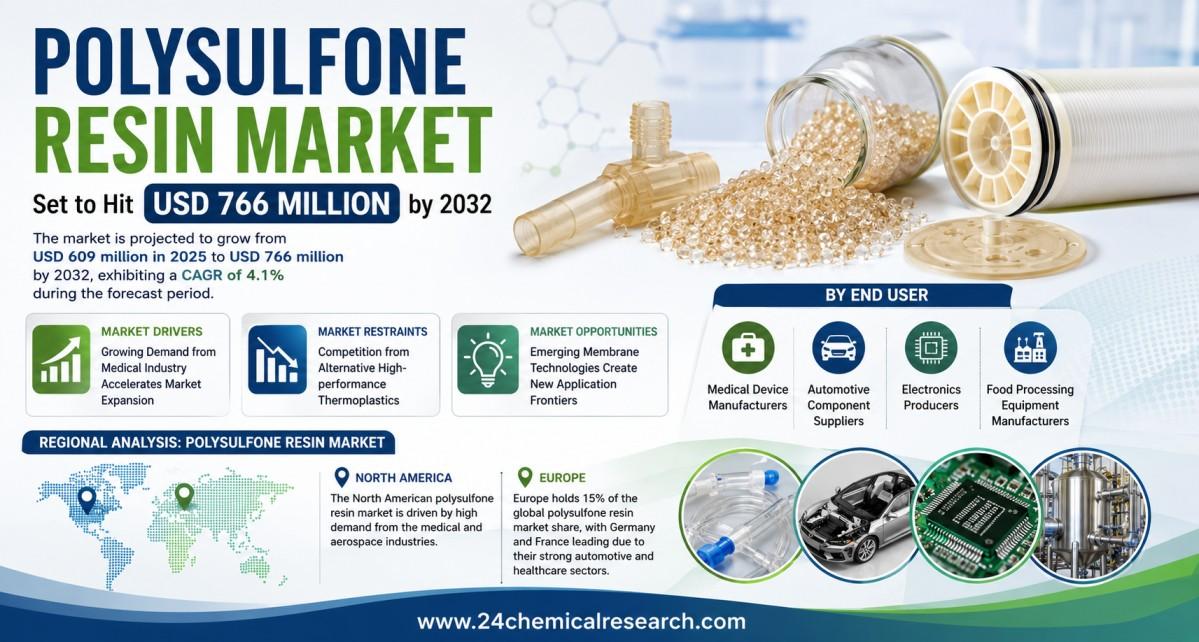
Global polysulfone resin market was valued at USD 581 million in 2024 and is projected to reach USD 766 million by 2032, exhibiting a steady CAGR of 4.1% during the forecast period.
Polysulfone resins represent a cornerstone of high-performance engineering thermoplastics, distinguished by the robust sulfone group in their polymer backbone. This chemical structure endows them with a rare combination of properties: exceptional thermal stability, allowing continuous use at temperatures up to 180°C, outstanding hydrolytic stability, and formidable resistance to a wide range of chemicals. These materials, including Polysulfone (PSU), Polyethersulfone (PES), and Polyphenylsulfone (PPSU), have transitioned from niche specialties to essential components in applications where failure is not an option. Their ability to withstand repeated sterilization cycles, coupled with inherent transparency and biocompatibility, makes them indispensable in the medical field, while their flame-retardant and electrical properties secure their place in advanced electronics.
Get Full Report Here: https://www.24chemicalresearch.com/reports/297748/global-polysulfone-resin-forecast-market-2025-2032-335
Market Dynamics:
The market's progression is governed by a dynamic balance of compelling growth drivers, persistent restraints that the industry is actively mitigating, and significant untapped potential across various sectors.
Powerful Market Drivers Propelling Expansion
-
Unprecedented Demand from the Healthcare Sector: The medical industry's reliance on polysulfone resins is a primary engine for market growth. These materials are fundamental to a vast array of medical devices, from intricate surgical instrument components and dental tools to the critical hollow fiber membranes used in dialysis machines. Their paramount advantage lies in their ability to endure repeated autoclaving, gamma radiation, and chemical sterilization without degrading, a non-negotiable requirement in modern healthcare. With the global medical device market surpassing $500 billion and continuously expanding due to aging demographics and rising health standards, the demand for reliable, medical-grade polysulfones is set for sustained growth. Recent advancements have focused on developing PPSU grades with enhanced flow properties for molding complex, thin-walled medical components.
-
Electrification and Lightweighting in Automotive and Aerospace: The global push towards vehicle electrification and fuel efficiency is creating substantial opportunities for polysulfone resins. In the burgeoning electric vehicle sector, these polymers are specified for under-the-hood components, battery housings, and sensor modules where their inherent flame retardancy (meeting UL94 V-0 standards) and dimensional stability at high temperatures are critical. The aerospace industry similarly leverages these properties for interior components, ducting, and fluid handling systems, demanding materials that are both lightweight and capable of withstanding extreme environmental conditions. As automotive OEMs and aerospace manufacturers increasingly prioritize performance and safety, polysulfone resins are becoming a material of choice.
Download FREE Sample Report: https://www.24chemicalresearch.com/download-sample/297748/global-polysulfone-resin-forecast-market-2025-2032-335
Significant Market Restraints Challenging Adoption
Despite their impressive performance profile, several factors moderate the pace of market expansion and present hurdles for wider adoption.
-
High Cost Structure and Processing Complexities: The sophisticated synthesis of polysulfone resins, involving expensive monomers like bisphenol-A and diphenyl sulfone, results in a significantly higher price point compared to commodity plastics like polycarbonate or ABS. This cost-conscious environment makes it challenging for polysulfones to penetrate price-sensitive applications. Furthermore, their high melt viscosity demands specialized processing equipment capable of maintaining precise, high temperatures (often above 300°C) and pressures, which can increase the capital expenditure for converters and limit design flexibility for complex parts.
-
Competition from Alternative High-Performance Polymers: The polysulfone resin market faces intense competition from other advanced thermoplastics such as Polyether Ether Ketone (PEEK), Polyetherimide (PEI), and Liquid Crystal Polymers (LCP). These materials often offer superior performance in specific areas—for instance, PEEK boasts higher continuous use temperatures and chemical resistance, while LCPs offer exceptional flow properties. In cost-driven segments, manufacturers may opt for high-temperature nylons (PPA) or enhanced blends that meet minimum specifications at a lower cost, thereby eroding potential market share for polysulfones.
Critical Market Challenges Requiring Innovation
The journey from laboratory-grade material to large-scale industrial adoption is fraught with technical and logistical challenges. Achieving consistent polymer quality and lot-to-lot uniformity at commercial production volumes is a persistent challenge for manufacturers, as minor variations in the complex polymerization process can significantly impact final product performance. This inconsistency can be a major deterrent for automotive and medical OEMs who require absolute reliability.
Moreover, the market contends with a complex and sometimes fragile supply chain. The specialty chemical feedstocks required are subject to price volatility influenced by energy costs and global demand shifts. The logistical challenges of transporting and storing these high-value resins, often requiring controlled conditions to prevent moisture absorption, add another layer of cost and complexity. Perhaps the most pressing challenge is the environmental aspect; the current recycling infrastructure for polysulfones is underdeveloped. Their high-performance nature makes mechanical recycling difficult, and the absence of widespread chemical recycling or dedicated take-back programs poses a significant barrier as end-users increasingly demand sustainable, circular solutions.
Vast Market Opportunities on the Horizon
-
Advanced Additive Manufacturing Applications: The development of polysulfone-compatible materials for 3D printing is opening exciting new frontiers. Specialized PSU and PPSU filaments for Fused Deposition Modeling (FDM) and powders for Selective Laser Sintering (SLS) enable the production of complex, high-temperature-resistant prototypes and end-use parts that are difficult or impossible to create with traditional methods. This is particularly valuable in aerospace, medical, and automotive industries for low-volume, high-value components. As industrial additive manufacturing continues its rapid growth, polysulfone resins are poised to capture a significant share of this innovative market.
-
Innovation in Membrane Technology: There is substantial untapped potential for polysulfone resins in next-generation membrane applications. Research is ongoing into developing membranes with tailored pore structures for advanced gas separation, such as carbon capture and hydrogen purification, which are critical for the energy transition. In biomedical applications, the precision control over membrane morphology offered by polysulfones is enabling new drug delivery systems and advanced tissue engineering scaffolds. These high-value applications represent a significant growth vector beyond traditional water filtration.
In-Depth Segment Analysis: Where is the Growth Concentrated?
By Type:
The market is segmented into Polysulfone (PSU), Polyethersulfone (PES), and Polyphenylsulfone (PPSU). Polysulfone (PSU) holds a significant share due to its well-balanced properties and established history in applications requiring high thermal and oxidative stability. Polyethersulfone (PES) is favored for its higher heat deflection temperature and exceptional clarity, making it ideal for medical and optical applications. Polyphenylsulfone (PPSU) is gaining traction due to its superior toughness, highest heat resistance among the sulfone polymers, and excellent hydrolytic stability, particularly in demanding medical and automotive environments.
By Application:
Application segments include Medical Devices, Automotive Components, Electronics, Membranes, and others. The Medical Devices segment is a dominant and high-growth area, driven by the critical need for sterilizable, biocompatible, and durable materials. However, the Automotive and Electronics segments are exhibiting robust growth rates, fueled by trends in electrification and miniaturization that demand high-temperature resistant and flame-retardant materials.
By End-User Industry:
The end-user landscape is diverse, encompassing Healthcare, Automotive, Electrical & Electronics, Industrial, and Water Treatment. The Healthcare industry accounts for a major portion of consumption, leveraging polysulfone's unique properties for life-saving devices. The Automotive and Electrical & Electronics sectors are rapidly emerging as key growth drivers, reflecting the ongoing technological shifts in transportation and digital infrastructure.
Download FREE Sample Report: https://www.24chemicalresearch.com/download-sample/297748/global-polysulfone-resin-forecast-market-2025-2032-335
Competitive Landscape:
The global polysulfone resin market is highly consolidated and characterized by the dominance of a few major chemical conglomerates. The top three companies—Solvay S.A. (Belgium), BASF SE (Germany), and Sumitomo Chemical Co., Ltd. (Japan)—collectively command a dominant share of the global market, estimated to be well over 80%. Their leadership is cemented by extensive intellectual property portfolios, decades of experience in high-performance polymer synthesis, and established global production and distribution networks.
List of Key Polysulfone Resin Companies Profiled:
-
Solvay S.A. (Belgium)
-
BASF SE (Germany)
-
Sumitomo Chemical Co., Ltd. (Japan)
-
Jiangmen Youju New Materials Co., Ltd. (China)
-
Shandong Horan Pharmaceutical Machinery Co., Ltd. (China)
-
Yanjian Technology Co., Ltd. (China)
-
Sino Polymer Co., Ltd. (China)
The competitive strategy among these players is heavily focused on research and development to create next-generation formulations with improved processability and targeted properties. Additionally, forming deep, strategic partnerships with leading OEMs across medical, automotive, and electronics sectors is a key tactic to secure long-term demand and co-develop innovative solutions.
Regional Analysis: A Global Footprint with Distinct Leaders
-
Asia-Pacific: Is the largest and fastest-growing market for polysulfone resins, driven by robust manufacturing activity in China, Japan, and South Korea. The region's strong electronics production base, expanding automotive sector, and growing healthcare infrastructure are primary demand drivers. China, in particular, is not only a major consumer but also an increasingly significant producer, with local manufacturers scaling up capacity.
-
North America and Europe: Together form a mature yet stable market characterized by high-value applications. These regions are leaders in demanding sectors like medical technology, aerospace, and specialty industrial equipment, where performance often outweighs cost considerations. Innovation and the development of premium grades are centered in these regions, supported by stringent regulatory standards and strong R&D capabilities.
-
South America, and Middle East & Africa: These regions represent emerging markets with significant long-term potential. Growth is currently driven by industrialization, infrastructure development, and increasing investment in healthcare and water treatment facilities. While the current market size is smaller, the growth trajectory is positive as these economies develop.
Get Full Report Here: https://www.24chemicalresearch.com/reports/297748/global-polysulfone-resin-forecast-market-2025-2032-335
About 24chemicalresearch
Founded in 2015, 24chemicalresearch has rapidly established itself as a leader in chemical market intelligence, serving clients including over 30 Fortune 500 companies. We provide data-driven insights through rigorous research methodologies, addressing key industry factors such as government policy, emerging technologies, and competitive landscapes.
-
Plant-level capacity tracking
-
Real-time price monitoring
-
Techno-economic feasibility studies
International: +1(332) 2424 294 | Asia: +91 9169162030
Website: https://www.24chemicalresearch.com/

 English
 Arabic
 French
 Spanish
 Portuguese
 Deutsch
 Turkish
 Italiano
 Russian
 Romaian
 Portuguese (Brazil)
 Greek
Greek
