


How One MSME Increased Team Productivity by 70% With Task Automation
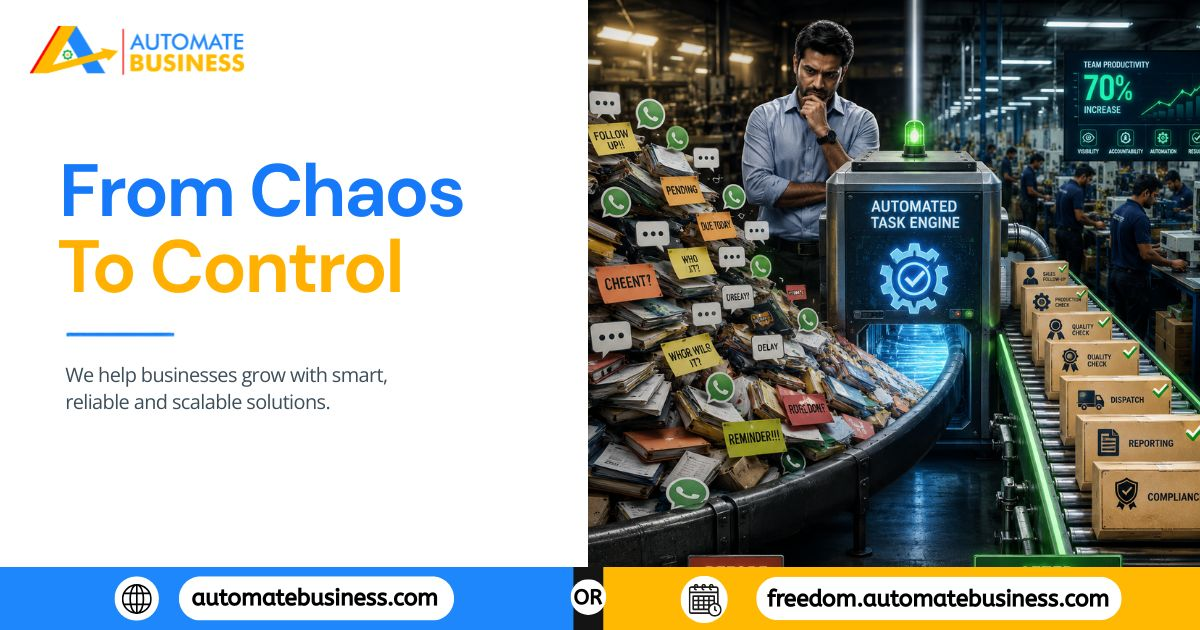
A mid-sized packaging manufacturer based in Pune had a problem most MSME owners will immediately recognize. Twelve employees. Three shifts. A sales team of four. And an operations manager who was spending the first two hours of every single day doing nothing but chasing updates.
Production teams missed handoffs. Sales follow-ups fell through. Recurring daily checks were done when someone remembered and skipped when they didn't. The business owner was reviewing WhatsApp groups at 9 PM every night trying to reconstruct what had actually happened that day.
The business was growing in revenue but shrinking in operational control. Every new order felt like it added chaos rather than confidence.
What changed wasn't headcount. It wasn't a new process consultant or an expensive ERP system. It was switching from WhatsApp groups and spreadsheets to a structured task management platform Automate Tasks and configuring it properly for how the team actually worked.
Twelve weeks later, task completion rates across the team had improved by 70%. The operations manager's morning catch-up time dropped from two hours to under twenty minutes. The owner stopped reviewing WhatsApp groups at night. And crucially, zero orders were missed or delayed in the following quarter.
Here's exactly what changed and how any MSME can replicate it.
The Before: What the Business Actually Looked Like
To understand why the results were so dramatic, it helps to understand just how broken the old system was — and how normal it looked on the surface.
Task assignment: Done verbally in the morning briefing or via WhatsApp message. No deadline field. No priority. No structured owner. Just instructions that existed in conversation and then depended entirely on individual memory.
Follow-up: The operations manager's job, all day, every day. Asking production staff whether the morning check was done. Messaging the sales team about client callbacks. Calling branch contacts to confirm deliveries. A constant, exhausting, manual loop.
Recurring work: Reset manually every cycle. Someone had to remember that the weekly stock reconciliation was due. Someone had to remember that Friday meant end-of-week reports. Often nobody did, and work was recreated on the fly or skipped entirely.
Visibility: Zero. The business owner had no live view of what was happening across the team. The only way to know was to ask the operations manager, who often didn't know either because they had been busy chasing something else.
Accountability: Opinion-based. When something wasn't done, the conversation always came back to "I thought someone else was handling it" or "I didn't see the message." There was no paper trail. No timestamps. No way to verify who was assigned what.
This is not an unusual situation. This is how most 10–20 person MSMEs in India run their operations. It works barely until it doesn't.
The Switch: What They Set Up and Why
The transition to Automate Tasks was done in three stages over the first two weeks, starting with the highest-impact areas first.
Stage 1: Structured Task Assignment for Operations (Week 1)
The first change was the most fundamental: every task had to live in the system before it was considered assigned.
The operations manager configured the production workflow as a series of sub-tasks machine pre-check, raw material confirmation, production run start, quality check, dispatch handoff — each assigned to a specific team member with a deadline and priority level. The morning briefing didn't change; what changed was that every instruction from the briefing became a task in the system rather than a message in a group chat.
Features activated:
- Structured task creation with title, assignee, due date, priority, and description
- Sub-tasks for multi-step production processes, each with their own owner and status
- AI task generation from prompts — rough instructions typed into the system generated fully structured tasks in seconds, making creation faster than WhatsApp
The result in week one alone: task clarity improved dramatically. "I thought someone else was doing it" disappeared almost immediately because every task now had exactly one named owner.
Stage 2: Automatic WhatsApp Reminders Replace Manual Follow-Up (Week 2)
The biggest time drain in the operations manager's day was manual follow-up. Stage 2 was designed to eliminate it entirely.
Every task in the system now had a reminder date set separately from the due date giving assignees an early warning before deadline day rather than a last-minute alert. Reminders went out automatically through WhatsApp the channel the team was already checking constantly without the operations manager sending a single message.
For recurring work daily startup checks, weekly stock counts, monthly compliance reports tasks were configured as recurring schedules with holiday-skip logic built in. These tasks now created themselves, assigned themselves, and sent their own WhatsApp reminders every cycle, permanently.
Features activated:
- Automatic WhatsApp and email reminders triggered by reminder date and overdue status
- Separate reminder and due dates for early warnings on critical tasks
- Recurring task scheduling daily, weekly, monthly, and custom intervals
- Holiday-skip logic preventing task creation and reminders on non-working days
- Overdue reminder sequences continuing automatically until tasks were marked complete
The operations manager's morning follow-up time dropped from two hours to under twenty minutes in the first week of this stage alone. The system was now doing what had been done manually — and doing it consistently, without forgetting, every single day.
Stage 3: Dashboard Visibility for the Founder (Week 3–4)
The final stage was giving the business owner the visibility needed without requiring constant check-ins with the operations team.
The dashboard was configured with filters that matched how the owner thought about the business: by team (production vs. sales), by status (pending vs. overdue vs. complete), and by priority (what needed attention today). The Kanban view gave a visual flow of work across stages; the List view gave a priority-sorted task list when scanning fast was needed.
Dashboard scoring automatically tracked each team member's completion rate and timeliness over time giving the owner data for monthly reviews that previously didn't exist. AI-generated summaries allowed reviewing the entire week's activity in two minutes before the Friday team meeting instead of spending the first twenty minutes asking "so what happened this week?"
Features activated:
- List and Kanban views with real-time filters by assignee, status, priority, and project
- Dashboard scoring showing completion rates and timeliness per team member
- AI-generated activity summaries for pre-meeting review
- Workspace activity logs creating a complete audit trail for every task
Role-based access — owner with admin-level full visibility, operations manager with manager-level control, team members seeing only their own tasks
The Results: 12 Weeks Later
The 70% productivity improvement wasn't measured by a consultant or a survey. It was visible in the data the platform generated automatically.
Task completion rate: Rose from an estimated 45–50% (based on what the operations manager could recall being done) to a consistent 85–90% tracked completion rate in the system a direct, measurable 70%+ improvement.
Manual follow-up time: The operations manager's daily follow-up routine dropped from approximately 120 minutes to under 20 minutes a saving of 100 minutes per day, five days a week.
Missed deadlines on client orders: Zero in the 12 weeks following implementation, compared to an average of 3–4 per month before.
Recurring task compliance: Daily startup checks went from being done roughly 60% of the time (when someone remembered to assign them) to a 97% completion rate as measured by the system — because they now ran automatically every day without manual intervention.
Founder evening review time: The owner stopped reviewing WhatsApp groups at night. The last operational action of the day moved from 9 PM WhatsApp scrolling to a two-minute dashboard check before leaving the office.
What Made the Difference: Three Shifts in How Work Was Managed
Looking back at the 12 weeks, the operations team identified three changes that drove the majority of the improvement:
- Structure replaced assumption. When every task had a named owner, a deadline, and a priority, "I didn't know it was my job" ceased to be a valid response. Ownership became undeniable.
- Reminders replaced memory. The single biggest productivity gain came from removing the dependency on human memory for follow-up. The system reminded people automatically no manager intervention required.
- Visibility replaced asking. Once the owner could see the dashboard, the informal information-gathering that had consumed evenings and meeting time disappeared. The information was always already there.
How Any MSME Can Replicate This
This story isn't unique to manufacturing. The same pattern WhatsApp chaos, manual follow-up, zero founder visibility — plays out identically in service businesses, retail chains, distribution companies, and multi-branch operations across India.
The replication path is the same regardless of industry:
Week 1: Move task assignment into the system. Every instruction becomes a structured task with one owner, one deadline, one priority.
Week 2: Activate WhatsApp reminders and configure recurring tasks for all repeating work. Let the system take over the follow-up role.
Week 3–4: Configure the founder and manager dashboard. Set up role-based access so each level of the team has the right visibility.
Month 2 onward: Review dashboard scoring monthly. Use the data for performance conversations. Let the system compound the longer it runs, the more accurate the performance data becomes.
A 70% productivity gain doesn't come from working harder. It comes from removing the friction the manual follow-ups, the missed recurring tasks, the zero visibility that quietly absorbs team capacity every single day.
The tools that create that friction (WhatsApp groups and spreadsheets) are free. The system that removes it costs less per month than a single missed client order.
If your business is running the way this packaging manufacturer was before the switch, the change is closer and simpler than it probably feels right now.
Start your first week of structured task management with Automate Tasks.

 English
 Arabic
 French
 Spanish
 Portuguese
 Deutsch
 Turkish
 Dutch
Dutch
 Italiano
 Russian
 Portuguese (Brazil)
 Greek
Greek
