


What are the 100+ most common words in Japanese?
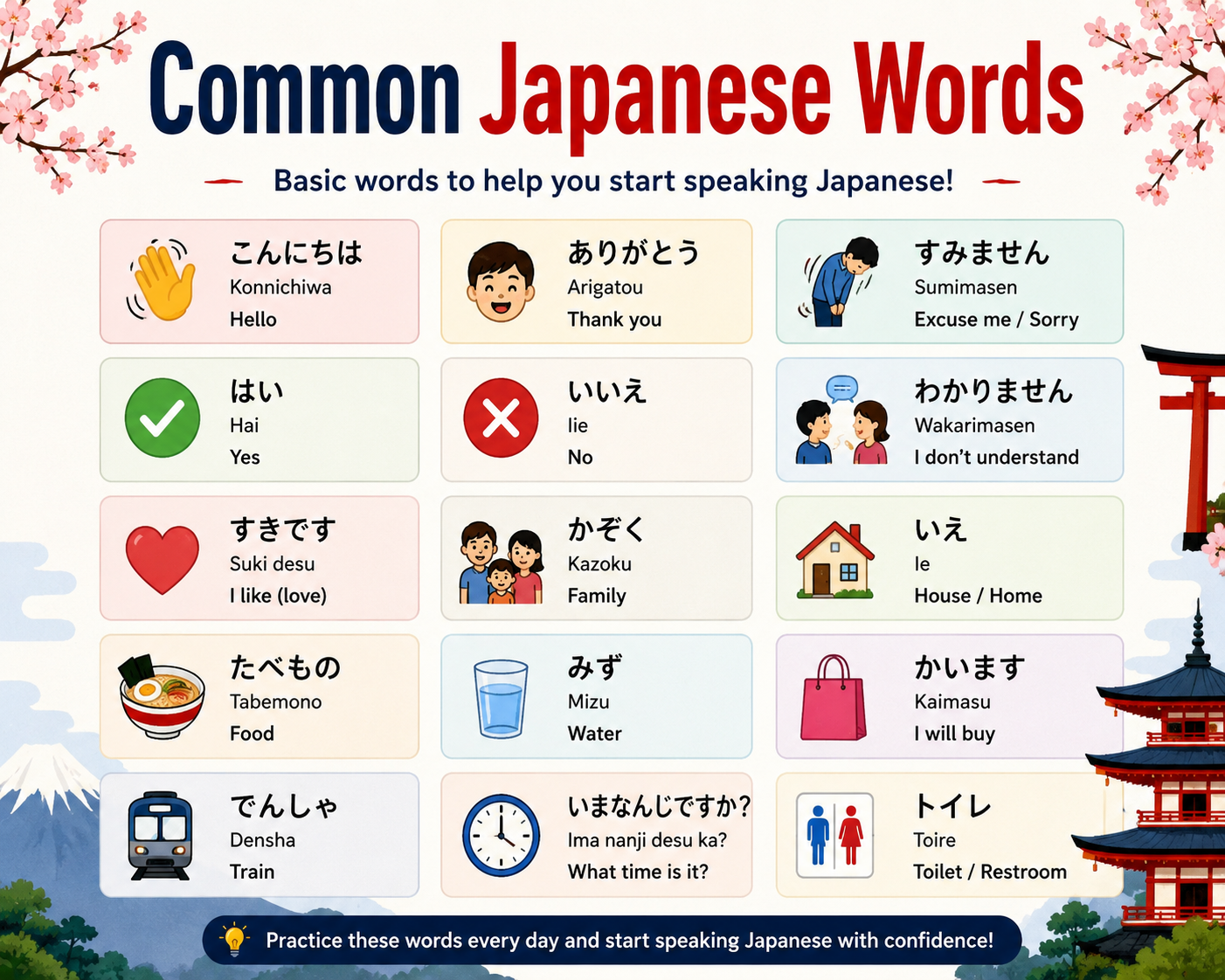
Learning Japanese can seem like an overwhelming task, but starting with the most common words is a strategic approach that can significantly accelerate your language acquisition. Understanding the 100 most frequently used words in Japanese provides a foundation that will enable you to comprehend a substantial portion of everyday conversations and written content.
The Importance of High-Frequency Words
In any language, a relatively small number of words account for a disproportionately large percentage of all language use. This principle, known as the Pareto principle, suggests that approximately 80% of communication relies on just 20% of available vocabulary. In Japanese, the 100 most Ultimate common Japanese words make up roughly 50% of all everyday speech and writing. This means that mastering these words offers tremendous value for learners.
Categories of Common Japanese Words
The 100 most common words in Japanese encompass several essential categories that form the backbone of the language.
Personal Pronouns and Demonstratives: Words like 私 (watashi - I), 彼 (kare - he), 彼女 (kanojo - she), これ (kore - this), それ (sore - that), and あれ (are - that over there) are fundamental for basic communication. These words appear in nearly every conversation and are crucial for clarity and context.
Verbs: Essential verbs dominate the common word list, including する (suru - to do), いる (iru - to be/exist), ある (aru - to have/exist for inanimate objects), なる (naru - to become), いく (iku - to go), くる (kuru - to come), and みる (miru - to see). These verbs form the foundation of sentence construction and appear frequently in both spoken and written Japanese.
Adjectives and Descriptors: Common descriptors like 大きい (ookii - big), 小さい (chiisai - small), 良い (yoi - good), 悪い (warui - bad), 新しい (atarashii - new), and 古い (furui - old) help speakers express qualities and make distinctions between objects and concepts.
Particles and Function Words: Japanese particles like は (wa - topic marker), を (wo - object marker), に (ni - location/direction marker), で (de - location of action), から (kara - from), and まで (made - until) are technically not nouns or verbs, but they are among the most frequently used words. These particles structure sentences and clarify grammatical relationships.
Interrogatives: Questions require specific words that appear frequently, including 何 (nani - what), どこ (doko - where), いつ (itsu - when), 誰 (dare - who), and どうして (doushite - why). These interrogative words are essential for asking questions in daily life.
Common Nouns: Everyday nouns like 人 (hito - person), 時間 (jikan - time), 日 (hi - day), 年 (toshi - year), 世界 (sekai - world), 子 (ko - child), 家 (ie - house), and 学校 (gakkou - school) represent objects and concepts people discuss regularly.
How to Use This Knowledge Effectively
Simply memorizing the 100 most common words isn't sufficient; learners must practice using these words in context. Reading children's books, watching anime with subtitles, or using language learning apps that focus on high-frequency vocabulary can help reinforce these words in practical situations.
Understanding word frequency distributions also helps learners prioritize their study time. Rather than spreading effort equally across all vocabulary, concentrating on the most common words first provides better return on investment, allowing learners to communicate more effectively sooner.
Beyond the First 100 Words
While the 100 most common words create a strong foundation, advancing to the next tier of vocabulary is necessary for more sophisticated communication. The next few hundred most common words will expand your ability to discuss specific topics, express nuanced feelings, and engage in more meaningful conversations.
Research suggests that knowing approximately 1,000 frequently used words enables comprehension of about 80% of Japanese news articles, while 2,000 words allow understanding of roughly 95% of everyday content. This progression illustrates how foundational high-frequency vocabulary truly is.
The Role of Context and Exposure
One crucial aspect of mastering the most Common Japanese Phrases words is understanding their multiple meanings and uses. Many high-frequency words in Japanese have several meanings and can be used in different contexts. For instance, する (suru) can mean "to do" in a general sense, but it combines with numerous nouns to create specific meanings. Consistent exposure to these words through authentic materials helps learners internalize these nuances.
Conclusion
The 100 most common words in Japanese represent an accessible entry point into the language. These words include essential pronouns, fundamental verbs, crucial particles, common adjectives, and everyday nouns that form the backbone of Japanese communication. By prioritizing these high-frequency words, learners can quickly develop practical communication skills and build momentum in their Japanese learning journey.
Investing time in thoroughly learning these 100 words, understanding their various uses, and practicing them in context provides learners with a solid foundation. This approach, supported by linguistic research about language frequency, offers an efficient path toward fluency. Rather than feeling overwhelmed by the complexity of Japanese, beginners can feel empowered knowing that mastering just 100 words opens the door to meaningful communication in this rich and fascinating language.

 English
 Arabic
 French
 Spanish
 Portuguese
 Deutsch
 Turkish
 Dutch
Dutch
 Italiano
 Russian
 Romaian
 Portuguese (Brazil)
