


Single View vs Dual View X-Ray Baggage Scanner: Which One Is Better?
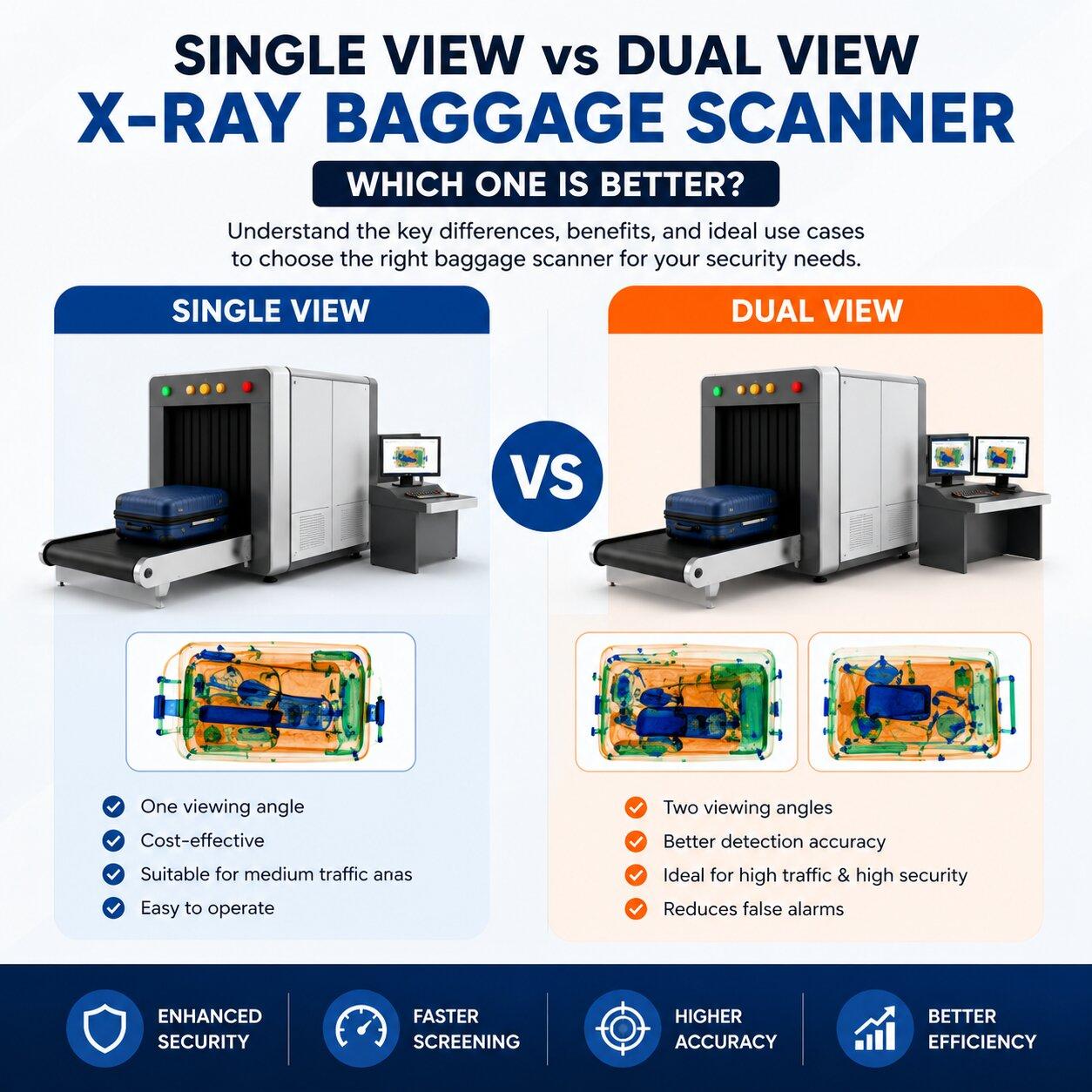
For airports, train stations, shopping centers, hotels, and government buildings, security screening is now a daily operational requirement rather than an option. Facility managers and procurement teams are under constant pressure to swiftly screen bags without slowing down visitors or jeopardizing safety as foot traffic in India's public and commercial places increases. This is precisely the point at which the appropriate X-Ray Baggage Scanner significantly improves daily operations and security results.
The single view baggage scanner and dual view baggage scanner systems are two of the most popular technologies nowadays, and each is designed for a different combination of risk level, budget, and visitor volume. Selecting the incorrect system can quietly hurt you in two ways: either by missing hidden items during screening or by creating long lines at entry points during peak hours. This guide explains how each technology functions, where it fits best, and how to make a confident purchasing decision for your facility.
What Is a Single View Baggage Scanner?
As a bag travels through the tunnel on a conveyor belt, a single view baggage scanner takes one X-ray picture of it from a single fixed viewpoint.
- How it operates: A detector array is placed on one side of the tunnel and an X-ray generator is placed on the other. The detectors record the amount of radiation absorbed by the contents of the bag as it moves between them; this information is then transformed into a single flat image that the operator may examine.
- One-angle imaging: The operator sees a single projection of the contents of the bag because there is only one viewing angle. In this picture, dense or overlapping items inside the bag may occasionally conceal one another.
- Common uses: This style is frequently used for daily baggage inspection machine requirements in small workplaces, schools, clinics, residential societies, warehouses, and boutique hotels.
- Advantages: Lower upfront cost, straightforward operator training, a compact footprint, and simpler maintenance since there is only one generator and one detector line to service.
- Limitations: Operators may occasionally need to halt the belt or ask for a manual recheck since single-angle imaging provides less detail when a bag is packed firmly or contains multilayer objects.
- Useful example: A single view baggage scanner is located at the lobby door of a boutique hotel with moderate daily guest traffic. The hotel receives dependable screening without the additional expense of a more sophisticated system, guest baggage are typically low-risk, and traffic is manageable.
What Is a Dual View Baggage Scanner?
A dual view baggage scanner simultaneously captures two views of the same bag using two separate X-ray sources placed at various angles.
- How it operates: The system consists of two complete imaging assemblies positioned at complementary angles, typically near perpendicular to one another, rather than a single generator and detector pair. As the bag travels through the tunnel, both images are created simultaneously, and the operator sees both perspectives concurrently on the screen.
- Improved object visibility: An object hiding behind another item in one image is frequently visible in the second view since the bag is photographed from two perspectives. This greatly lowers the likelihood of missing something crucial and image overlap.
- Faster operator decision-making: The baggage screening process is accelerated since operators need fewer manual reversals or re-scans to confirm what they are looking at when two viewpoints are already accessible.
- Real-world example: To keep lines moving during peak travel times, security personnel at a congested domestic airport terminal employ dual-view X-ray imaging at passenger checks. Because the two viewpoints allow operators to verify contents more quickly, fewer bags require a manual secondary check, maintaining high throughput without sacrificing detection.
Single View vs Dual View: Key Differences
This is a side-by-side comparison of the two systems' performance in terms of the elements that customers find most important.
|
Feature |
Single View Scanner |
Dual View Scanner |
|
Imaging angles |
1 |
2 |
|
Detection accuracy |
Good for standard risk levels |
Higher, due to two viewing angles |
|
Operator effort |
More manual interpretation needed |
Reduced manual interpretation |
|
Throughput |
Moderate |
Higher, suited to peak-hour crowds |
|
Investment |
Lower |
Higher |
|
Ideal risk level |
Low to medium |
Medium to high |
|
Best suited for |
Offices, schools, clinics, boutique hotels |
Airports, malls, metro and railway stations |
|
Image overlap |
More likely with dense bags |
Reduced significantly |
|
Maintenance |
Lower, single generator |
Slightly higher, two generators |
|
ROI at high footfall |
Lower |
Higher over time |
Advantages of Single View Systems
- Less expensive: an affordable starting point for businesses with more constrained security resources.
- Simple operation: new operators may pick up the interface and process fast.
- Compact footprint: requires no significant layout adjustments to accommodate smaller lobbies, entrances, and checkpoints.
- Lower maintenance: fewer components to service, since there is only one generator and detector assembly.
- Ideal for medium-risk facilities: works well where visitor numbers and risk profile stay within a predictable range.
Advantages of Dual View Systems
Improved detection accuracy: two perspectives lessen the possibility of overlooking hidden or stacked objects.
- Improved visibility: things that are concealed in one view are often visible in another.
- Decreased operator fatigue: fewer bags require manual re-checking, which relieves pressure during extended shifts.
- Faster inspections: smoother queue movement is supported by quicker confirmation per bag.
- Better threat detection: especially helpful for baggage that is densely packed or oddly shaped.
- Higher throughput: designed to manage continuous, high-volume screening without experiencing any slowdowns.
- Better ROI for high-traffic facilities: over time, fewer manual rechecks, fewer bottlenecks, and less staffing pressure frequently balance the higher initial cost.
Which Industries Should Choose Single View?
- Small Offices: low visitor count and predictable, low-risk items make single-angle imaging sufficient.
- Schools: moderate footfall, mostly personal bags, and tighter budgets favor a simpler system.
- Residential Complexes: General safety screening is the priority, not high-threat detection.
- Small Warehouses: Periodic package checks rather than continuous high-volume movement.
- Clinics: moderate foot traffic with medical supplies and personal belongings.
- Boutique Hotels: smaller guest volume allows for a more budget-friendly security screening equipment choice.
Which Industries Should Choose Dual View?
- Airports: very high footfall, strict regulatory mandates, and a higher-risk profile demand the best available airport baggage scanner technology.
- Metro Stations: Quick, continuous screening is necessary due to the constant flow of passengers.
- Railway Stations: large, diverse crowds carry a wide range of baggage types and sizes.
- Government Buildings: compliance and security mandates call for higher detection standards.
- Large Hotels: high guest and event traffic, along with VIP security needs, justify the added accuracy.
- Shopping Malls: large daily footfall, including families and event crowds, needs a dependable baggage scanner for shopping malls.
- Stadiums: Event-day spikes necessitate quick, large-scale screening under constrained time frames.
- Convention centers: business-critical events are accompanied by erratic luggage kinds.
Feature Summary: Which One Fits Your Facility?
|
Best Choice For |
Single View Scanner |
Dual View Scanner |
|
Visitor volume |
Low to moderate |
High to very high |
|
Security risk level |
Low to medium |
Medium to high |
|
Budget sensitivity |
Higher priority |
Lower priority |
|
Space available |
Compact spaces |
Standard to large checkpoints |
|
Typical facility |
School, clinic, boutique hotel |
Airport, mall, metro station |
Factors to Consider Before Buying
- Visitor Volume: For sustained throughput, a dual vision baggage scanner is typically indicated by larger daily foot traffic.
- Threat Level: The increased detection accuracy of two imaging angles is advantageous in higher-risk areas.
- Tunnel Size: Make sure the tunnel's dimensions match those of your usual luggage, especially big bags.
- Budget: consider long-term operational savings and risk mitigation against initial investment.
- Future Expansion: Take into account whether there will likely be an increase in visitors or security needs.
- Installation Space: Before choosing a model, make sure there is enough floor space and power.
- Compliance Requirements: Verify any relevant industry-specific or regulatory screening requirements.
- Maintenance Support: Verify the vendor's response times and spare parts availability.
- Operator Training: Take into account the time and resources required to instruct employees on the selected system.
Why Choose Krystalvision?
The manufacturer of the baggage screening system is just as important as choosing the proper one. With years of engineering experience, Krystalvision designs and produces security screening systems for Indian airports, hotels, shopping centers, government buildings, and industrial locations.
As an established X-Ray Baggage Scanner Manufacturer, Krystalvision offers both single view and dual view models, built with high-resolution imaging components and tested for reliable day-to-day performance. In addition to manufacturing, the team assists purchasers with technical consultancy, site evaluation, installation, and operator training. This helps facilities select a design that truly fits their foot traffic and risk profile rather than a one-size-fits-all setup.
The service includes software upgrades, spare parts availability, and ongoing after-sales assistance to ensure that facilities don't have to handle screening gaps on their own after installation. This combination of manufacturing depth and post-sale service is sometimes the determining factor for businesses evaluating several vendors.
Conclusion
Single view or dual view technology is not always "better"; the best option will depend on your facility's budget, available space, risk level, and visitor volume. A single view system might work well for a school or boutique hotel, but a dual view design will usually yield greater long-term value for an airport, mall, or government building. Before buying an X-Ray Baggage Scanner, take the time to properly analyze the site and determine your operational needs. This will save you money and future security issues.
Examine Krystalvision's selection of luggage screening options if you're considering your options, or contact the team for a customized advice based on the specific requirements of your facility.\
Frequently Asked Questions
1. What is the difference between Single View and Dual View baggage scanners?
ANSWER: A dual view scanner concurrently records two angles of a bag, increasing visibility and lowering the possibility of missing objects, whereas a single view scanner only records one viewpoint.
2. Which scanner is better for airports?
Answer: Because of the heavy traffic, stringent compliance regulations, and demand for quicker, more precise screening, dual view scanners are typically preferred at airports.
3. Is Dual View more accurate?
Answer: Indeed. Items that might be buried behind other objects in a single view image can be more easily identified thanks to the reduction of object overlap caused by two imaging angles.
4. Why do shopping malls use Dual View scanners?
Answer: Malls see large, unpredictable crowds throughout the day, and dual view systems help maintain fast throughput while keeping detection standards high.
5. Are Single View scanners suitable for hotels?
Answer: Smaller boutique hotels with moderate guest traffic often find single view scanners sufficient, while large hotels with high event traffic typically benefit more from dual view systems.
6. Does Dual View require more maintenance?
Answer: Dual view systems assist in maintaining quick throughput while maintaining high detection standards because malls have big, erratic crowds throughout the day.
7. Which scanner offers better ROI?
Answer: While major hotels with high event traffic usually benefit more from dual view systems, smaller boutique hotels with moderate guest traffic frequently find single view scanners enough.
8. Can both detect explosives and weapons?
Answer: Because dual vision systems use two generators rather than just one, their maintenance requirements are a little greater but still doable with a trustworthy service provider.
9. How do I choose the right tunnel size?
Answer: Instead of using the average bag size alone, base the tunnel size on the largest bags or luggage that your facility normally screens, with considerable room for future demands.
10. Which industries benefit most from Dual View systems?
Answer: Due to heavy traffic and stricter security regulations, airports, train and metro stations, government buildings, shopping centers, stadiums, and big hotels gain the most.

 English
 Arabic
 French
 Spanish
 Portuguese
 Deutsch
 Turkish
 Dutch
Dutch
 Italiano
 Romaian
 Portuguese (Brazil)
 Greek
Greek
