


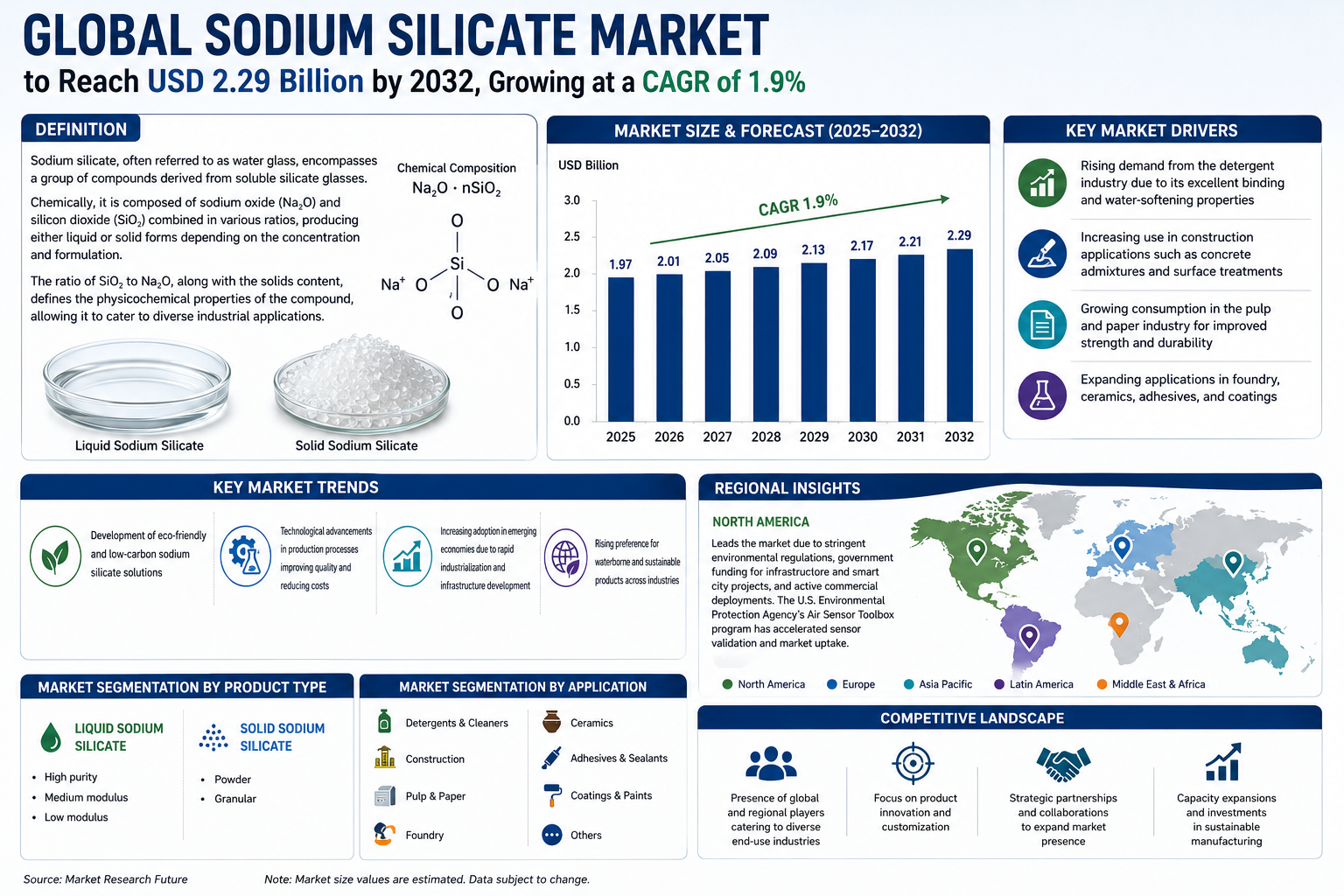
Global Sodium Silicate Market to Reach USD 2.29 Billion by 2032, Growing at a CAGR of 1.9%
Definition
Sodium silicate, often referred to as water glass, encompasses a group of compounds derived from soluble silicate glasses. Chemically, it is composed of sodium oxide (Na₂O) and silicon dioxide (SiO₂) combined in various ratios, producing either liquid or solid forms depending on the concentration and formulation. The ratio of SiO₂ to Na₂O, along with the solids content, defines the physicochemical properties of the compound, allowing it to cater to diverse industrial applications.
Industrially, sodium silicate plays a pivotal role as a multifunctional chemical. Its primary functions include acting as a builder in detergents, a binder and strength enhancer in paper production, a cement and concrete additive in construction, and a precursor for silica-based materials such as silica gels, zeolites, and aerogels. The compound is widely valued for its cost-effectiveness, water-softening properties, alkalinity maintenance, and environmentally benign profile compared to many synthetic alternatives.
The production process generally involves the fusion of silica sand with soda ash at high temperatures, followed by dissolution in water to form a liquid solution or solid granules. Sodium silicate is classified into liquid and solid forms, each with specific industrial advantages. Liquid sodium silicate is preferred for ease of handling, transport, and industrial integration, while solid sodium silicate finds applications where storage stability and concentrated dosing are required.
Its extensive utility spans across multiple sectors including detergents and soaps, construction, paper and pulp, adhesives, and emerging sustainable technologies. Sodium silicate’s versatility, combined with its chemical stability and environmental advantages, underpins its continued relevance in modern industrial applications.
Get FREE Sample of this Report at https://www.intelmarketresearch.com/download-free-sample/13682/sodium-silicate-market
Market Size
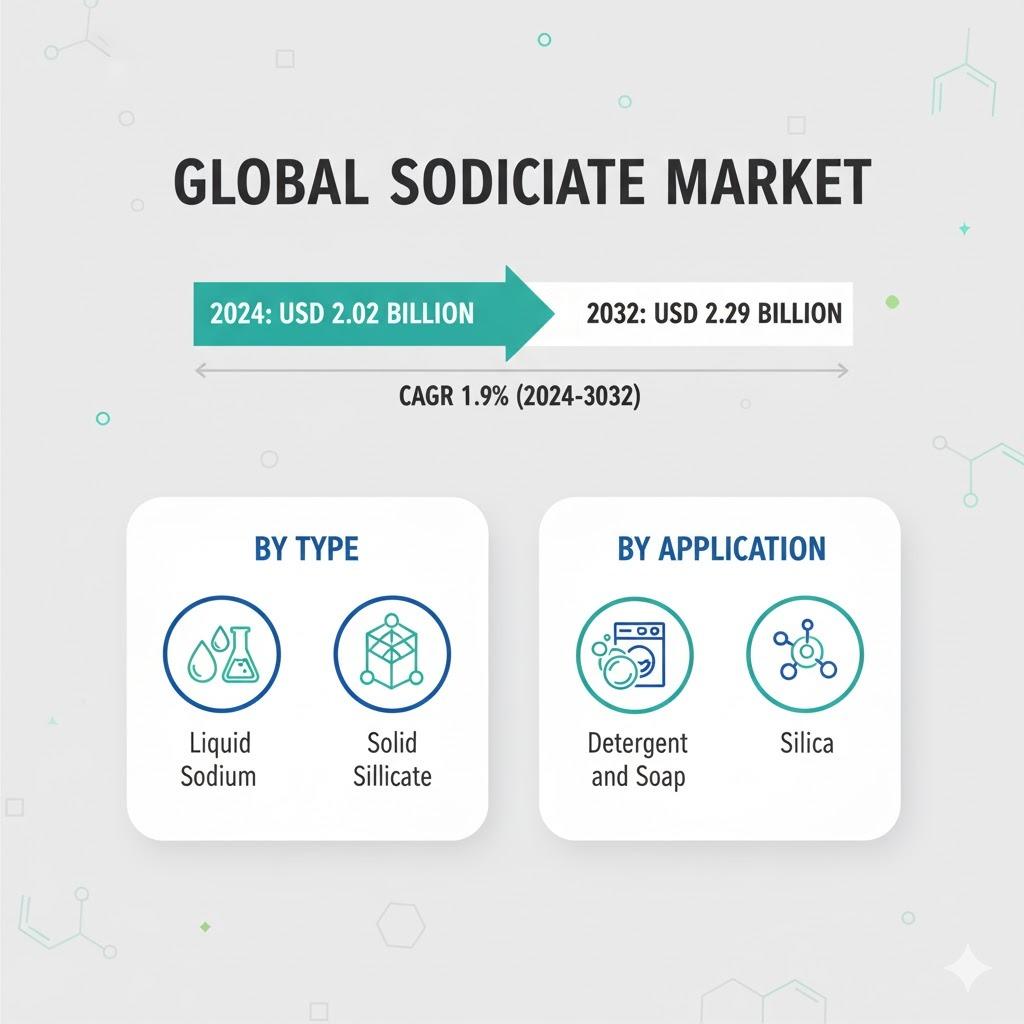
The global sodium silicate market was valued at USD 2.02 billion in 2024 and is projected to grow to USD 2.29 billion by 2032, reflecting a compound annual growth rate (CAGR) of 1.9%. The modest growth is primarily driven by the stable demand from core industrial sectors such as detergents, construction, and paper manufacturing.
The detergent and soap industry represents the largest single application segment, accounting for a significant portion of global sodium silicate consumption. Rising urbanization, hygiene awareness, and disposable incomes in emerging economies have fueled the growth of the detergent sector, creating a reliable and consistent demand base. Simultaneously, the paper and pulp industry, which uses sodium silicate as a coating pigment, binder, and strength additive, contributes to market stability. The shift toward sustainable packaging and recycling has further reinforced demand.
Construction and infrastructure development remain significant contributors to sodium silicate consumption, particularly in the Asia-Pacific region where urbanization and public infrastructure projects are accelerating. Sodium silicate enhances the durability, water resistance, and hardening properties of concrete, cement, and soil, making it indispensable in large-scale civil engineering projects.
Despite these opportunities, market growth is tempered by several constraints. Raw material price volatility, particularly in soda ash and silica sand, has a direct impact on production costs. Environmental regulations targeting industrial emissions and alkaline effluents impose compliance costs, especially in developed regions. Additionally, alternative materials such as zeolites in detergents and synthetic polymers in construction pose competitive challenges, limiting market expansion in some premium applications.
The market has also witnessed gradual technological evolution, with research efforts focusing on advanced applications such as sodium silicate-based aerogels, catalysts, and environmental remediation technologies. While these emerging applications are high-value and profitable, their contribution to overall market size is currently limited due to slower adoption rates.
Regional Analysis
Asia-Pacific
Asia-Pacific dominates the sodium silicate market, accounting for roughly 45% of global production. China, in particular, serves as the largest manufacturing hub, benefiting from abundant raw materials, low production costs, and extensive industrial infrastructure. The region’s growing detergent, construction, and paper industries underpin consistent domestic demand, while surplus production enables export opportunities. Rapid urbanization, infrastructure expansion, and rising industrial output in Southeast Asia, India, and other emerging economies further enhance market growth prospects.
North America
North America accounts for about 20% of global demand. The region’s consumption is primarily driven by stringent environmental regulations and demand for phosphate-free detergents, which has bolstered sodium silicate adoption as a safe alternative builder. Construction applications, particularly in concrete hardening and soil stabilization, also contribute to market growth. The market, however, faces challenges due to high raw material costs, energy-intensive production processes, and stiff competition from alternative materials.
Europe
Europe contributes nearly 13% of the global market, with Germany, France, and the UK leading consumption. The demand is largely influenced by environmental policies, particularly phosphate restrictions in detergents, recycling standards in the paper industry, and sustainability requirements in construction. European manufacturers are increasingly focusing on energy-efficient production technologies and specialty applications to remain competitive.
Rest of the World
Regions such as Latin America, Africa, and the Middle East represent emerging markets for sodium silicate. Driven by rapid urbanization, industrialization, and infrastructure development, these regions present significant opportunities for both export and local manufacturing. While current production capacity is limited, growing awareness of sustainable chemicals and cost-effective industrial solutions is expected to boost adoption.
Competitor Analysis (in brief)
The sodium silicate market features a semi-consolidated competitive landscape, with global leaders coexisting alongside regional manufacturers. The top three players—PQ Corporation, OxyChem, and PPG Industries—collectively account for approximately 35% of global production. These companies leverage large-scale manufacturing, vertically integrated operations, extensive distribution networks, and research-driven product development to maintain a competitive edge.
-
PQ Corporation (U.S.): Focuses on broad industrial applications, strong R&D capabilities, and vertically integrated production.
-
OxyChem (U.S.): Dominates the North American market, emphasizing large-scale manufacturing and strategic partnerships.
-
PPG Industries (U.S.): Specializes in silica and adhesive applications, investing heavily in product innovation.
-
Chinese Manufacturers: Collectively, they account for the largest production bloc, with Shandong Laizhou Welfare Sodium Silicate being a key player, competing primarily on cost and scale.
-
Other Notables: CIECH Group (Poland), Tokuyama Corporation (Japan), Nippon Chemical (Japan), Kiran Global (India), W. R. Grace & Co. (U.S.), Albemarle (U.S.), QINGDAO HAIWAN GROUP (China), and Huber (U.S.) focus on regional expansion, niche applications, and sustainable production technologies.
Recent market trends include capacity expansion in emerging regions, partnerships with downstream users, and adoption of energy-efficient manufacturing to meet regulatory standards while controlling costs.
Global Sodium Silicate: Market Segmentation Analysis
This report provides a deep insight into the global sodium silicate market, covering all its essential aspects. This ranges from a macro overview of the market to micro details of the market size, competitive landscape, development trend, niche market, key market drivers and challenges, SWOT analysis, value chain analysis, etc.
The analysis helps the reader to shape the competition within the industries and strategies for the competitive environment to enhance the potential profit. Furthermore, it provides a simple framework for evaluating and assessing the position of the business organization. The report structure also focuses on the competitive landscape of the Global Sodium Silicate market. This report introduces in detail the market share, market performance, product situation, operation situation, etc., of the main players, which helps the readers in the industry to identify the main competitors and deeply understand the competition pattern of the market.
In a word, this report is a must-read for industry players, investors, researchers, consultants, business strategists, and all those who have any kind of stake or are planning to foray into the sodium silicate market in any manner.
Market Segmentation (by Application)
-
Detergent and Soap
-
Silica
-
Paper Industry
-
Adhesive
-
Others
Detergent and Soap represents the largest application segment, driven by its essential role as a builder and corrosion inhibitor in cleaning formulations globally.
Market Segmentation (by Type)
-
Liquid Sodium Silicate
-
Solid Sodium Silicate
Liquid Sodium Silicate holds the dominant market position due to its superior handling characteristics, cost-effectiveness in transportation, and widespread industrial application compatibility.
Key Company
Companies Strive to Strengthen their Product Portfolio to Sustain Competition
The global sodium silicate market exhibits a semi-consolidated competitive landscape, characterized by a mix of large multinational corporations, regional leaders, and numerous smaller producers. This structure reflects the commodity nature of sodium silicate and its widespread industrial applications across diverse sectors such as detergents, silica production, paper manufacturing, and adhesives. While price competition remains intense, leading players differentiate through production scale, technological efficiency, geographic reach, and application-specific product development.
-
PQ Corporation (U.S.)
-
OxyChem (U.S.)
-
Shandong Laizhou Welfare Sodium Silicate (China)
-
PPG Industries (U.S.)
-
CIECH Group (Poland)
-
Nippon Chemical (Japan)
-
Kiran Global (India)
-
W. R. Grace & Co. (U.S.)
-
Tokuyama Corporation (Japan)
-
Huber (U.S.)
-
Albemarle (U.S.)
-
QINGDAO HAIWAN GROUP (China)
Geographic Segmentation
-
Asia-Pacific: Largest market share, dominated by China, with high consumption in detergent and industrial applications.
-
North America: Driven by phosphate-free detergent demand and construction applications.
-
Europe: Environmentally regulated market, focused on specialty applications and energy-efficient production.
-
Rest of the World: Emerging markets in Latin America, Africa, and the Middle East offering growth potential through infrastructure development and industrialization.
FAQ Section
Q1. What is the current market size of the sodium silicate market?
The global sodium silicate market was valued at USD 2.02 billion in 2024 and is projected to reach USD 2.29 billion by 2032, with a CAGR of 1.9%.
Q2. Which are the key companies operating in the sodium silicate market?
Key players include PQ Corporation, OxyChem, PPG Industries, Shandong Laizhou Welfare Sodium Silicate, CIECH Group, Tokuyama Corporation, Nippon Chemical, Kiran Global, W. R. Grace & Co., Albemarle, Huber, and QINGDAO HAIWAN GROUP.
Q3. What are the key growth drivers in the sodium silicate market?
Key drivers include rising demand in the detergent and soap industry, growth in construction and infrastructure projects, expansion in the paper and pulp sector, and emerging applications in sustainable technologies.
Q4. Which regions dominate the sodium silicate market?
Asia-Pacific leads the market, with China as the dominant producer, followed by North America and Europe. Emerging markets in Southeast Asia, Latin America, and Africa offer additional growth opportunities.
Q5. What are the emerging trends in the sodium silicate market?
Emerging trends include sustainable production technologies, advanced material applications such as aerogels and catalysts, strategic partnerships with end-users, and market expansion into developing regions.
Get the Complete Report & TOC at https://www.intelmarketresearch.com/materials-and-chemicals/13682/sodium-silicate-market
About Us
Intel Market Research is a leading provider of strategic intelligence, offering actionable insights in information technology, digital media solutions, and communication infrastructure. Our research capabilities include:
-
Real-time competitive benchmarking
-
Global technology adoption monitoring
-
Country-specific regulatory and market analysis
-
Over 500+ technology reports annually
Trusted by Fortune 500 companies, our insights empower decision-makers to drive innovation with confidence.
🌐 Website: https://www.intelmarketresearch.com
📞 International: +1 (332) 2424 294
📞 Asia-Pacific: +91 9169164321
🔗 LinkedIn: Follow Us

 English
 Arabic
 French
 Spanish
 Portuguese
 Deutsch
 Turkish
 Dutch
Dutch
 Italiano
 Romaian
 Portuguese (Brazil)
 Greek
Greek
