


How Businesses Source Korean Food in Bulk from Wholesale Suppliers
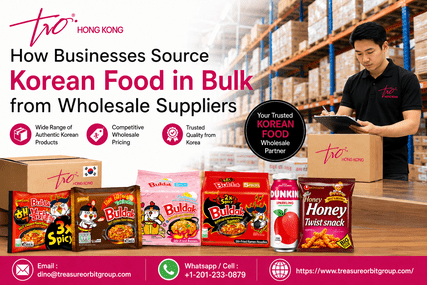
A Buyer's Guide to Sourcing Korean Products in Bulk
A decade ago, Korean food sat in a narrow aisle aimed mostly at Korean expats. Since then, that aisle has spread throughout the store. Buldak ramen appears in viral videos, Shin Ramyun is a pantry staple not only in Korea, but elsewhere, and consumers who have never even been to Seoul now are eating shrimp crackers and Banana Kick just for the sake of curiosity. It's a demand that is real and it's a demand that moves volume. For a retailer, importer, or wholesaler trying to ride that wave, the supplier behind the stock decides how smoothly you can keep up. This is a practical look at sourcing Korean products in bulk — what sells, what to check, and how the buying actually works.
Why Korean food is an easy category to ship
It's shelf-stable, most of what drives this trade is, and that's different from chilled goods or fragile goods. Instant pasta, cup noodles, and bagged snacks are able to last for months, are compact, and do not require special treatment for a long sea voyage.. A Korean food wholesale supplier can pack a container tight, send it halfway around the world, and have it arrive in sellable condition. That's a big part of why the category has spread so fast — the economics of moving it are forgiving.It doesn't mean shelf life is irrelevant. A buyer should still ask how much life is left on arrival, because a container that's been sitting somewhere for months is a different proposition from fresh stock. But compared with chocolate that blooms in the heat or drinks that weigh out a container, Korean dry goods are about as straightforward as bulk food gets.
The ramen lines doing the heavy lifting
When ordering Korean dishes by the load, instant noodles are typically the main course. It is almost entirely borne by two names.It's the social media that Samyang built for its Buldak Hot Chicken range. The whole draw and punch is the spice ladder, which by itself is a challenge to the regulars, a 2x for the 2x crowd, and a 3x for those who are willing to accept the challenge. Plus the flavours that made it easy, like Carbonara, Cheese, and Kimchi. The multipacks are sold to the households and cup and big-cup to the convenience trade. When the flavour goes viral it can sell a store shelf in days – hence depth trumps breadth here.The more stable side of the shelf is Nongshim. The work horse, Shin Ramyun, is available in a wide range — Black, Non-Frying, Neoguri, Champong, Ansungtangmyun, Chapagetti — in pouches and cups. Unlike a virally successful Samyang flavour, these do not blow up the following week, week after week, they simply sell.
Snacks and the newer Korean drinks
The snack side is of the same interest. The bagged line at Nongshim features shrimp crackers and Honey Twist and Tako Chips and Onion Ring and the ever-popular Banana Kick and a long run of potato chips, flavoured with tteokbokki and truffle mustard. These are impulse buys, so it is crucial to format and price these - the smaller bags go quickly from the till.The recent addition are Korean drinks. The Baskin Robbins and Dunkin sparkling lines, which come in cool colors like rainbow sherbert, apple mint and plum, are also cashing in on the novelty factor of the treats. Not as popular of a food as ramen, but for the customer who is looking for something they will not find in the other food sections, they are a popular choice.
What to look for in a Korean food wholesaler
Range is the first thing worth testing in any conversation. A capable Korean food wholesaler and distributor carries both halves of the shelf — the Samyang lines that pull attention and the Nongshim staples that hold steady — plus enough snacks and drinks to round out an order. Pulling all of it from one account beats running three suppliers across two countries.Label and ingredient compliance is the part newer importers underestimate. Every destination market has its own rules on labelling, ingredient declarations, and additives, and Korean packaging won't satisfy all of them out of the box. A supplier who already exports to your region knows what passes and what gets held at the border. Worth asking directly: which markets do they ship to regularly?For a lot of buyers, halal certification matters too. Several Samyang Buldak lines are halal-certified, but not all of them, and the status varies by product and factory. If you're selling into a Muslim-majority market, confirm the certification on the specific lines you want rather than assuming it covers the brand.
How ordering and export work
This is bulk trade pricing, and is then quoted carton by carton, then by container as the order increases. The unit cost drops as you move from 40 x 130g cartons to full 20 and 40-foot loads of ramen, and the smaller the volume, the worse the individual price. Ramen, snacks and drinks are usually mixed in one container and a decent provider will help you balance.A Korean food supplier/exporter based in an industry hub, such as Hong Kong, has an edge on reach – for example, the ability to ship food with ease and experience. Nevertheless, order a new supplier just like any other supplier: make your first order smaller, inspect dates and conditions on delivery, observe if it arrives on time and in good condition, and scale. Get freight, terms and lead time clarified in writing prior to the large order.
Frequently asked questions
What is the lowest number of Korean food items that can be ordered in bulk?
This is carton-and-container trade, rather than single case buying, depending on the supplier. Many sell by the case (for example 40 x 130g) and only offer the best price when selling in full container loads. Question about the rate in terms of carton to 20-foot or 40-foot container.
What are the best-selling items in Korea?
Instant ramen is the leader by a long shot, with Samyang Buldak and Nongshim Shin Ramyun in the lead. As add-on lines, come snacks such as shrimp crackers and the newer Korean drinks, which are sugar-free in the name of zero sugar.As add-on lines, there are snacks such as shrimp crackers and Banana Kick and the newer Korean drinks which are sugar-free in the name of zero sugar.
Is there a special way to store Korean snacks or noodles (Ramen)?
Not really. One reason for their appeal as a food for export is that they are shelf stable and easily portable. Simply inspect when goods arrive to see how far shelf life will last.
What it comes down to
That's Korean food, the niche aisle gone mainstream, and the customers who are doing well take it seriously, not like a novelty. It is the supplier who can not only provide the viral ramen, but also the consistent staples, who knows label compliance in your market and who can pack and ship a clean container that you want to build around. Take a small order first, check their stock and then gradually build up. A reliable Korean food wholesale supplier and distributor/exporter is not only filling a shelf but keeping a fast-moving, trend-conscious category stocked without a second thought.

 English
 Arabic
 Spanish
 Portuguese
 Deutsch
 Turkish
 Dutch
Dutch
 Italiano
 Russian
 Romaian
 Portuguese (Brazil)
 Greek
Greek
