


MBA in Digital Marketing vs MBA in Business Analytics: Which Is Better?
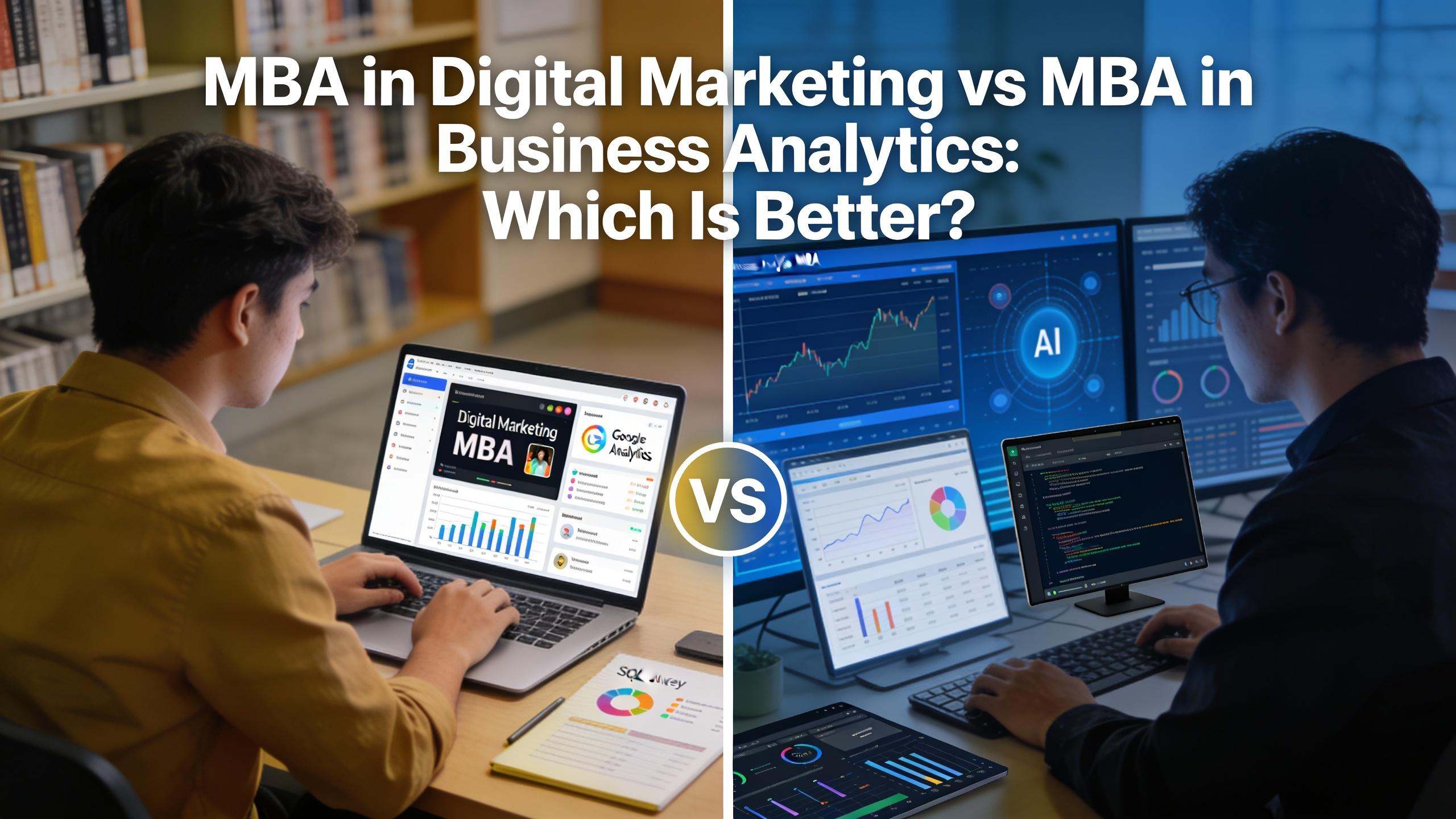
You are standing at a major crossroads after graduation. On one hand, you see businesses fighting for online attention. On the other hand, companies are drowning in data and looking for people to make sense of it. This leaves you with a major dilemma: should you choose an MBA in Digital Marketing or an MBA in Business Analytics?
Choosing your MBA specialization shapes your early career path, your daily work life, and your long-term growth. Both of these fields are booming in India, but they require entirely different mindsets. In this guide, we will break down the core differences, subjects, fees, and payouts for both options. By the end, you and your parents will have complete clarity on the right path for your future.
Understanding Both MBA Specializations
To make an informed decision, you must first understand what these two degrees actually teach you and where they fit in the corporate world.
What is MBA in Digital Marketing?
An MBA in Digital Marketing focuses on how brands communicate with customers online. You will learn to build brand awareness, run paid ad campaigns, and drive online sales. It blends corporate strategy with creative execution across social media, search engines, and websites.
What is MBA in Business Analytics?
An MBA in Business Analytics focuses on turning raw numbers into strategic business decisions. You will learn to use statistical tools, data models, and programming languages to predict trends and solve operational problems. It is a technical management degree that bridges the gap between data science and corporate leadership.
Who should choose each specialization?
-
Choose Digital Marketing if you love creativity, psychological consumer behavior, storytelling, and fast-paced communication.
-
Choose Business Analytics if you enjoy logic, mathematics, finding patterns in spreadsheets, and solving complex puzzles using structured data.
MBA in Digital Marketing vs MBA in Business Analytics
This detailed comparison table breaks down the core metrics of both programs across business schools in India.
| Feature | MBA in Digital Marketing | MBA in Business Analytics |
| Course Duration | 2 Years (4 Semesters) | 2 Years (4 Semesters) |
| Eligibility | Graduation with minimum 50% marks + CAT/MAT/XAT scores | Graduation (preferably Tech/Math/Sci) with 50% + CAT/XAT/GMAT scores |
| Core Syllabus | SEO, SEM, Social Media, Content Strategy, Brand Management | Python, SQL, Predictive Modeling, Machine Learning, Data Visualization |
| Course Fees (INR) | ₹3 Lakhs to ₹15 Lakhs | ₹5 Lakhs to ₹22 Lakhs |
| Skills Required | Creativity, Communication, Copywriting, Basic Analytics | Statistical Knowledge, Logical Reasoning, Coding Basics, Problem Solving |
| Career Scope | E-commerce, Ad Agencies, FMCG, Entertainment, Startups | FinTech, IT Services, Consulting, Banking, Supply Chain |
| Job Roles | Digital Marketing Manager, SEO Specialist, Performance Marketer | Business Analyst, Data Consultant, Risk Analyst, Product Analyst |
| Average Salary | ₹5 LPA to ₹12 LPA (Freshers) | ₹7 LPA to ₹15 LPA (Freshers) |
| Placement Opportunities | High demand in consumer-centric firms and marketing agencies | Massive hiring in global capability centers and tech firms |
| Future Demand | Rising with internet penetration and D2C brand growth | Exploding with big data, AI models, and corporate digitization |
Career Opportunities and Industry Demand
The corporate landscape in India is changing rapidly. Companies across major education and business hubs—including Delhi, Mumbai, Bangalore, Pune, Hyderabad, Chennai, Kolkata, Noida, and Patna—are investing heavily in both digital presence and data systems.
Top Industries and Hiring Trends
Digital marketing graduates find heavy recruitment in e-commerce, media, fast-moving consumer goods (FMCG), and advertising agencies. On the flip side, banking, financial services, insurance (BFSI), management consulting, and healthcare industries hire business analytics graduates to optimize their operations.
AI and Automation Impact
AI is changing both fields, but in different ways. In digital marketing, AI tools now draft copy and automate ad target bidding. In analytics, machine learning tools process massive datasets faster than ever. Instead of replacing jobs, these tools create a demand for managers who know how to direct AI workflows.
Entrepreneurship and Remote Work
Digital marketing offers immense freedom if you want to start a freelance consulting business or a private digital agency. It also offers a massive volume of remote, global roles. Business analytics roles are typically more structured within corporate offices, though global consulting firms offer incredible international travel and relocation prospects.
How to Choose the Right MBA Specialization
Do not just look at the starting salary figures when making your choice. Instead, evaluate your personal profile against these core pillars.
Assess Your Mindset: Creativity vs. Logic
Are you a right-brain or a left-brain thinker? Digital marketing requires you to understand human emotions, visual aesthetics, and cultural trends. Business analytics requires absolute comfort with numbers, structural logic, and long hours of data cleaning and database management.
Check the Technical Barrier
While an MBA in Business Analytics does not require you to be a hardcore software programmer, you will need to learn tools like SQL, Tableau, and basic Python. If the thought of writing code or studying statistical formulas stresses you out, digital marketing offers a much friendlier technical learning curve.
Align with Long-Term Career Goals
If your goal is to climb the corporate ladder toward roles like Chief Marketing Officer (CMO) or start your own brand, select digital marketing. If you want to work as a high-level corporate strategist, management consultant, or Chief Data Officer, then business analytics is your path.
Conclusion
Both paths offer excellent returns on your educational investment. Your choice between an MBA in Digital Marketing vs MBA in Business Analytics should ultimately depend on your natural strengths. If you love storytelling, consumer psychology, and creative campaigns, go for digital marketing. If you love discovering patterns in data, using logic, and solving operational mysteries, business analytics will serve you best. Talk to professionals in both fields, look at the curriculum of your target colleges, and choose the path that genuinely excites you.
Frequently Asked Questions
1. Which is better, MBA in Digital Marketing or MBA in Business Analytics?
Neither is universally better; it depends entirely on your skill set. If you are creative and business-focused, digital marketing is excellent. If you possess strong analytical skills and enjoy working with statistics, business analytics is the superior choice.
2. Which MBA specialization has a higher salary?
On average, freshers in MBA Business Analytics command a slightly higher starting package (₹7–15 LPA) compared to MBA Digital Marketing freshers (₹5–12 LPA) due to the technical nature of the role. However, top-tier performance marketers can match or exceed these numbers quickly.
3. Is Business Analytics better than Digital Marketing for freshers?
Business Analytics can be tougher for freshers who do not have a background in engineering, math, or computer science. Digital marketing is often more accessible to fresh graduates from any stream, including commerce and arts.
4. Can I switch careers after an MBA in Digital Marketing?
Yes, you can transition into broader corporate profiles like Brand Management, Product Marketing, Corporate Communications, or public relations, as the core of the degree is rooted in consumer behavior and business strategy.
5. Which specialization has better placement opportunities in India?
Both enjoy incredible placement rates across corporate hubs like Bangalore, Mumbai, and Gurgaon. Digital marketing sees more job volume across small and mid-sized businesses, while business analytics features highly structured recruitment from large multinational corporations and tech giants.

 English
 Arabic
 French
 Spanish
 Portuguese
 Deutsch
 Turkish
 Italiano
 Russian
 Romaian
 Portuguese (Brazil)
 Greek
Greek
