


BIS FMCS Certificate: A Complete Guide for Foreign Manufacturers
Introduction
Expanding into the Indian market offers excellent business opportunities for overseas manufacturers. However, before many products can be sold in India, compliance with the Bureau of Indian Standards (BIS) regulations is mandatory. One of the most important requirements for foreign manufacturers is obtaining a BIS FMCS Certificate. The BIS FMCS Certification process ensures that products manufactured outside India comply with Indian quality and safety standards. Whether you manufacture electrical products, chemicals, cement, steel, or household appliances, obtaining a BIS License for Foreign Manufacturer is often a legal requirement before entering the Indian market.
What is a BIS FMCS Certificate?
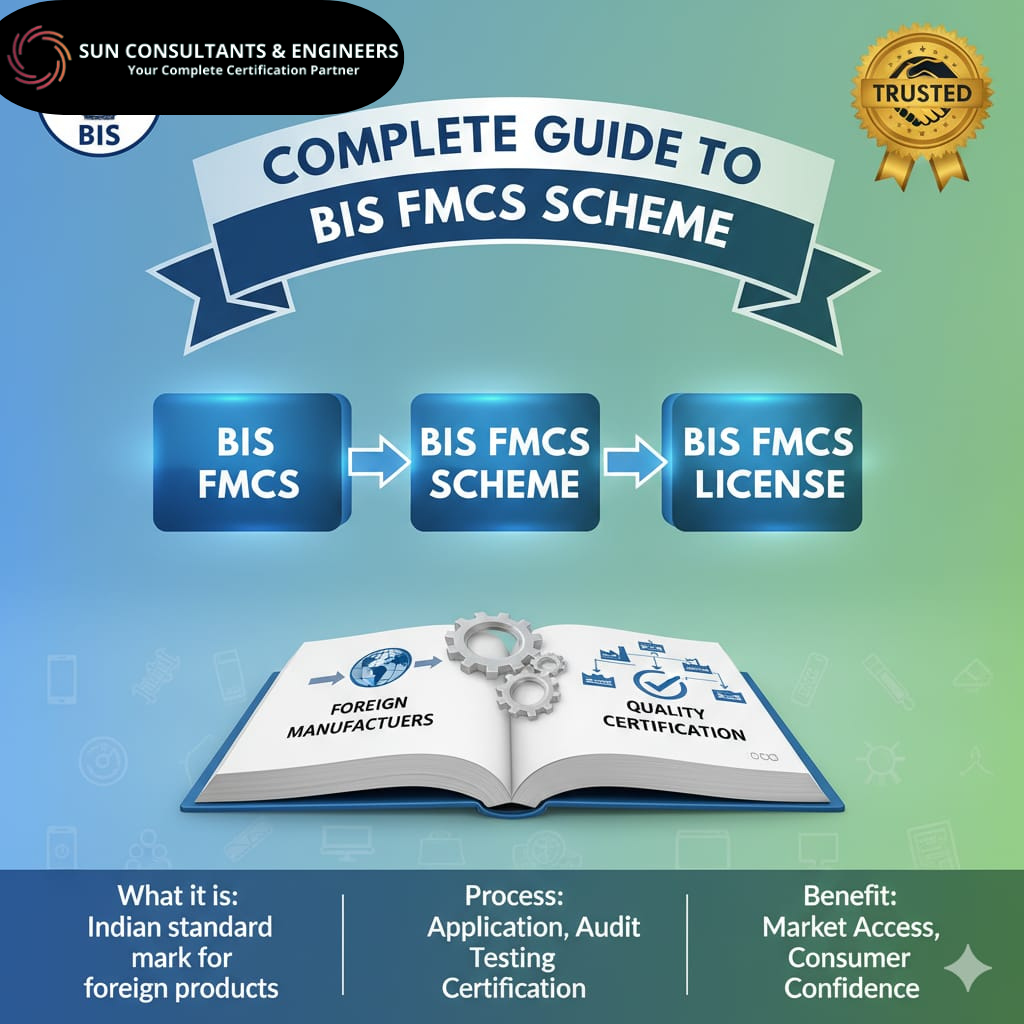
A BIS FMCS Certificate is issued under the Foreign Manufacturers Certification Scheme (FMCS) by the Bureau of Indian Standards. This certification authorizes foreign manufacturers to use the Standard Mark on products that conform to the relevant Indian Standards. Unlike domestic manufacturers, overseas companies must apply under the FMCS scheme to obtain permission for selling regulated products in India.
What is BIS FMCS Certification?
BIS FMCS Certification is a conformity assessment process conducted by BIS to verify that products manufactured outside India consistently meet prescribed Indian Standards.
The certification involves:
-
Product testing in BIS-recognized laboratories
-
Factory inspection by BIS officials
-
Verification of manufacturing facilities
-
Assessment of quality control systems
-
Compliance with applicable Indian Standards
Once approved, manufacturers receive a license that allows them to apply the BIS Standard Mark to certified products.
Who Needs a BIS License for Foreign Manufacturer?
A BIS License for Foreign Manufacturer is required for overseas manufacturers whose products fall under mandatory BIS certification.
Industries commonly requiring certification include:
-
Electrical equipment
-
Electronics
-
Steel products
-
Cement
-
Chemicals
-
Household appliances
-
Automotive components
-
Industrial products
-
Consumer goods
If your product appears under mandatory BIS certification orders, obtaining certification is compulsory before exporting to India.
Benefits of a BIS Certificate for Foreign Manufacturer
Obtaining a BIS Certificate for Foreign Manufacturer offers several advantages.
Legal Market Access
Many regulated products cannot be imported into India without valid BIS certification.
Increased Customer Confidence
Products carrying the BIS Standard Mark are trusted for meeting Indian safety and quality requirements.
Better Market Reputation
Certification demonstrates commitment to international manufacturing standards and product reliability.
Competitive Advantage
Certified products often gain preference among importers, distributors, and government buyers.
Reduced Regulatory Issues
Proper certification minimizes customs delays and regulatory compliance risks.
Eligibility for BIS FMCS Certification
To apply for BIS FMCS Certification, manufacturers should satisfy certain conditions:
-
The manufacturing facility must be located outside India.
-
The production process should comply with applicable Indian Standards.
-
Adequate quality control systems should be implemented.
-
Required testing facilities should be available or accessible.
-
An Authorized Indian Representative (AIR) must be appointed where applicable.
Meeting these conditions helps streamline the certification process.
Documents Required
The documentation generally includes:
-
Company registration certificate
-
Manufacturing license
-
Factory layout
-
Product specifications
-
Quality control manual
-
Test reports
-
List of manufacturing equipment
-
Calibration certificates
-
Details of production capacity
-
Appointment letter for Authorized Indian Representative
-
Trademark authorization (if applicable)
Proper documentation significantly reduces processing delays.
BIS FMCS Certification Process
The BIS FMCS Certification process usually follows these steps:
Step 1: Application Submission
The foreign manufacturer submits the application along with supporting documents.
Step 2: Document Verification
BIS reviews the application to ensure completeness and compliance.
Step 3: Product Testing
Product samples are tested according to applicable Indian Standards.
Step 4: Factory Inspection
BIS officials inspect the overseas manufacturing facility to verify production capability and quality management systems.
Step 5: Evaluation
Inspection reports and laboratory test results are reviewed.
Step 6: License Grant
If all requirements are met, BIS issues the BIS License for Foreign Manufacturer, allowing the use of the Standard Mark.
Validity of BIS Certificate for Foreign Manufacturer
The BIS Certificate for Foreign Manufacturer remains valid for the prescribed licensing period and can be renewed upon continued compliance with BIS requirements. Manufacturers must maintain consistent production quality and cooperate with surveillance activities conducted by BIS.
Common Challenges During Certification
Many foreign manufacturers encounter challenges such as:
-
Understanding Indian Standards
-
Preparing technical documentation
-
Coordinating factory inspections
-
Product testing requirements
-
Managing communication with Indian authorities
-
Appointing an Authorized Indian Representative
Proper planning and professional guidance can simplify these processes.
Tips for Faster Approval
To improve the chances of timely certification:
-
Prepare complete documentation before applying.
-
Ensure manufacturing facilities follow quality management practices.
-
Conduct internal quality checks.
-
Verify applicable Indian Standards.
-
Maintain proper production records.
-
Respond promptly to BIS queries.
These practices help avoid unnecessary delays during evaluation.
Why Compliance Matters
India has strengthened product quality regulations to protect consumers and ensure product safety. Manufacturers exporting regulated products without certification may face shipment delays, customs issues, penalties, or restrictions on market entry. Obtaining a BIS FMCS Certificate demonstrates that your products comply with Indian regulations and meet the expectations of customers, distributors, and regulatory authorities.
Conclusion
The BIS FMCS Certificate is an essential requirement for foreign manufacturers seeking access to the Indian market. Through BIS FMCS Certification, overseas companies can demonstrate compliance with Indian quality standards while enhancing customer confidence and expanding business opportunities. Obtaining a BIS License for Foreign Manufacturer requires careful preparation, accurate documentation, product testing, and successful factory inspection. Once certified, manufacturers gain legal authorization to market their products in India with the BIS Standard Mark.

 English
 Arabic
 Spanish
 Portuguese
 Deutsch
 Turkish
 Dutch
Dutch
 Italiano
 Russian
 Romaian
 Portuguese (Brazil)
 Greek
Greek
