


Cost of BIS Certification & BIS Certification Process India
Introduction
Businesses that manufacture or import products in India must comply with various quality and safety standards before entering the market. One of the most important certifications is the BIS Certification, issued by the Bureau of Indian Standards (BIS). Understanding the cost of BIS certification, the BIS certification process, and the BIS certificate process helps businesses plan their compliance journey efficiently. Whether you are an Indian manufacturer or a foreign company exporting products to India, knowing the BIS certification process India can save both time and unnecessary expenses. This guide explains everything you need to know.
What is BIS Certification?
BIS Certification is a conformity assessment that confirms a product meets the quality, safety, and performance standards prescribed by the Bureau of Indian Standards. Several products require mandatory BIS approval before they can be manufactured, imported, or sold in India. The certification enhances consumer confidence while ensuring regulatory compliance.
Why is BIS Certification Important?
Obtaining BIS Certification offers several advantages:
-
Ensures compliance with Indian regulations.
-
Improves product quality and safety.
-
Builds customer trust.
-
Supports hassle-free product sales in India.
-
Reduces the risk of legal penalties and product recalls.
-
Enhances business credibility in domestic and international markets.
For manufacturers and importers, BIS certification is often a mandatory requirement rather than an optional one.
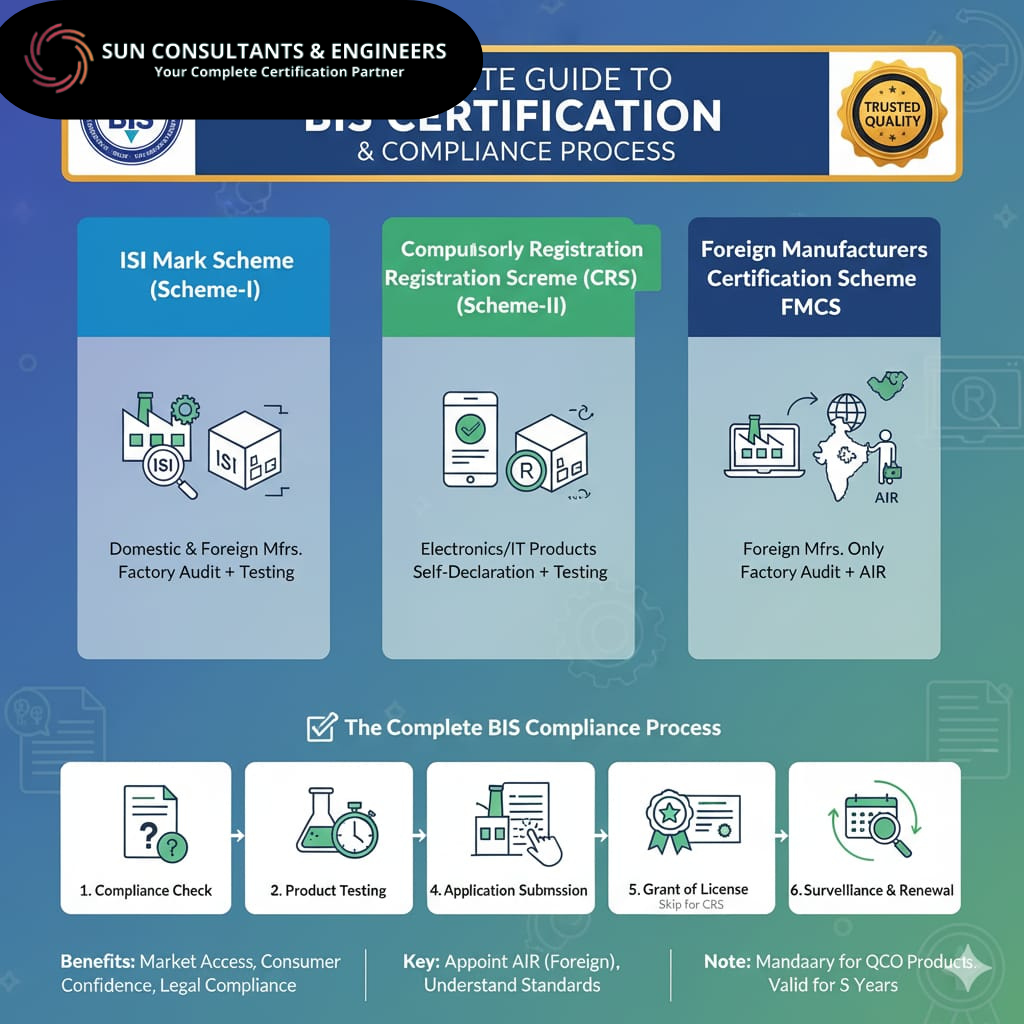
BIS Certification Process
The BIS certification process generally follows a structured procedure. While the exact steps may vary depending on the product category and certification scheme, the standard process includes:
1. Product Identification
Determine whether your product falls under mandatory BIS certification requirements.
2. Applicable Indian Standard
Identify the relevant Indian Standard (IS) applicable to the product.
3. Documentation Preparation
Collect all required documents, including:
-
Business registration documents
-
Manufacturing details
-
Product specifications
-
Factory information
-
Quality control documents
4. Product Testing
The product must be tested in a BIS-recognized laboratory to verify compliance with applicable standards.
5. Application Submission
Submit the application along with test reports and supporting documents to BIS.
6. Factory Inspection
For certain certification schemes, BIS officials conduct a factory inspection to verify manufacturing capabilities and quality control systems.
7. Evaluation
BIS reviews the submitted documents, laboratory reports, and inspection findings.
8. Grant of Certification
Once all requirements are satisfied, the BIS Certificate or License is issued.
This complete BIS certificate process ensures that only compliant products enter the Indian market.
BIS Certificate Process for Different Manufacturers
The BIS certificate process may differ depending on the applicant.
Indian Manufacturers
Domestic manufacturers generally apply under the relevant BIS certification scheme applicable to their products.
Foreign Manufacturers
Overseas manufacturers exporting products to India may need to apply through the Foreign Manufacturers Certification Scheme (FMCS) or other applicable BIS schemes.
Although documentation requirements vary, the overall evaluation process remains similar.
BIS Certification Process India
The BIS certification process India is designed to maintain uniform quality standards across industries. It involves collaboration between manufacturers, BIS-recognized laboratories, and the Bureau of Indian Standards.
The process focuses on:
-
Product safety
-
Quality assurance
-
Manufacturing consistency
-
Regulatory compliance
-
Consumer protection
Proper planning significantly reduces delays during certification.
Cost of BIS Certification
One of the most frequently asked questions is about the cost of BIS certification.
The total certification cost depends on several factors, including:
-
Product category
-
Applicable certification scheme
-
Laboratory testing charges
-
Factory inspection requirements
-
Government application fees
-
Annual license fees
-
Product complexity
-
Number of product variants
-
Manufacturing location
Because every product has different compliance requirements, there is no single fixed cost of BIS certification applicable to all businesses. It is advisable to obtain a customized cost estimate based on your specific product and certification requirements.
Documents Required
The documentation requirements may vary, but commonly include:
-
Company registration certificate
-
Manufacturing license
-
Product specifications
-
Factory layout
-
Quality management documents
-
Test reports
-
Authorized signatory details
-
Brand authorization (if applicable)
Providing accurate documentation helps avoid unnecessary processing delays.
Common Challenges During Certification
Many businesses face difficulties during the certification process due to:
-
Incorrect documentation
-
Selection of wrong product standards
-
Incomplete applications
-
Testing failures
-
Delays in laboratory reports
-
Regulatory updates
-
Factory inspection observations
Proper preparation helps minimize these challenges.
Tips for Faster BIS Certification
Businesses can improve their chances of smooth approval by following these best practices:
-
Verify the applicable Indian Standard before applying.
-
Prepare complete documentation.
-
Ensure product testing is conducted correctly.
-
Maintain proper manufacturing quality controls.
-
Respond promptly to BIS queries.
-
Keep records organized throughout the process.
A systematic approach often results in quicker approvals.
Conclusion
Understanding the cost of BIS certification, the BIS certification process, the BIS certificate process, and the BIS certification process India is essential for manufacturers and importers planning to enter the Indian market. Since certification requirements differ based on product type and applicable standards, businesses should prepare carefully before submitting their applications. Proper documentation, accurate product testing, and compliance with BIS requirements can make the certification process smoother and more efficient.

 English
 Arabic
 French
 Portuguese
 Deutsch
 Turkish
 Dutch
Dutch
 Italiano
 Russian
 Romaian
 Portuguese (Brazil)
 Greek
Greek
